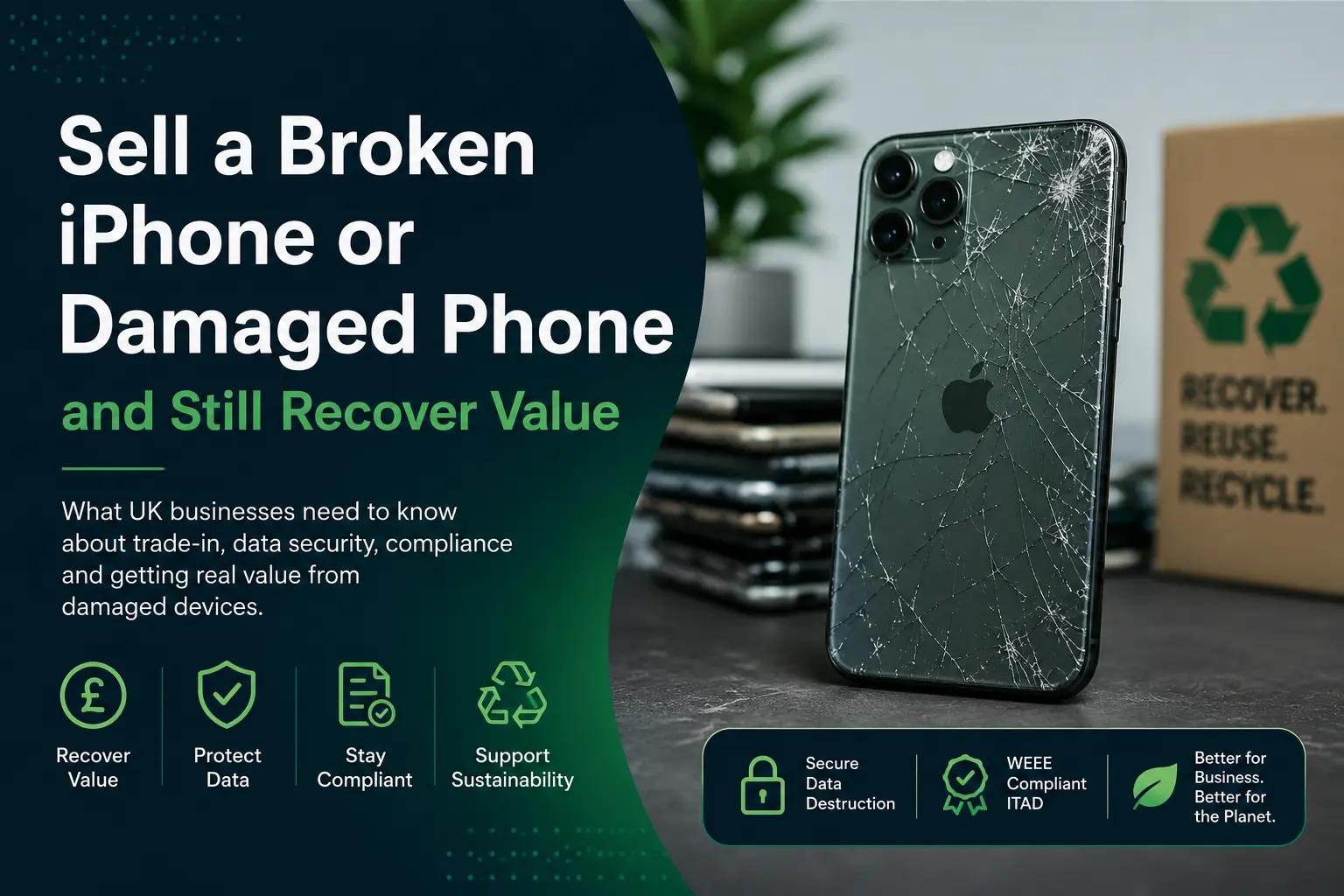
There is a common assumption running through IT departments and procurement teams across the UK: if a device is cracked, faulty, or failing to power on, it has no value. It sits in a drawer, a storage cupboard, or a cardboard box under someone’s desk, quietly depreciating while the business waits to figure out what to do with it.
That assumption is costing UK businesses real money — and creating real compliance risk.
The UK generates approximately 1.6 million tonnes of e-waste annually, yet a significant proportion of that waste starts as stockpiled corporate devices that businesses assumed were worthless. In reality, a cracked-screen iPhone can still carry substantial component value. A phone that refuses to boot can still contain recoverable data — and recoverable parts. Understanding how damaged devices are actually valued, processed, and turned into a business outcome is the difference between writing off an asset and recovering meaningful value from it.
This post covers what types of damage trade-in and ITAD providers typically accept, how damaged devices are valued, why data security obligations do not disappear just because a device is broken, and what practical steps IT and procurement leads can take to maximise recovery from a mixed-condition fleet.
Does Damage Actually Affect Trade-In Eligibility?
The short answer is yes — but not in the way most people assume. Damage affects how a device is valued and where it is routed, not whether it can be traded in at all. The trade-in and ITAD markets do not operate on a binary of “mint condition accepted, everything else refused.” They operate on graded buyback models that recognise working, damaged, and scrap conditions as distinct — and commercially viable — categories.
This is because refurbishers and ITAD providers actively seek damaged stock. Parts shortages are a persistent reality in the secondary device market, and the economics of repair arbitrage — buying a damaged device cheaply, repairing or stripping it, and recovering value through refurbishment or component sales — create genuine demand for devices that a business might dismiss as junk.
The key distinction to understand is that “damaged” is a spectrum. A cosmetically cracked screen is treated very differently from water-damaged internal components, and both are treated differently from a device that has been physically destroyed. Knowing where your devices sit on that spectrum is the starting point for any meaningful recovery conversation.
What Types of Damage Are Typically Accepted?
For IT managers trying to assess their own fleet, a practical breakdown of fault categories is more useful than vague reassurances that “all conditions considered.”
Cosmetic damage — cracked screens, scuffed or dented casings, worn edges — is among the most commonly accepted fault type. These devices are typically still viable for refurbishment. The screen can be replaced, the casing refinished, and the device resold into the secondary market. Residual value is reduced, but the device is far from worthless.
Functional faults — battery degradation below a usable threshold, faulty charging ports, broken buttons, or failures of biometric features such as Face ID or Touch ID — reduce value further but do not eliminate it. Many of these faults are economically repairable, depending on the device model and current parts availability. Others may make the device unviable for resale as a working unit but still valuable for component harvesting.
Catastrophic damage — liquid ingress affecting internal components, bent or split chassis, non-functional motherboards — moves the device out of refurbishment territory and into parts harvesting or responsible recycling. The logic board alone can account for up to approximately 50% of a phone’s residual value in secondary markets, meaning even a severely damaged device contributes meaningfully to circular recovery processes.
As a general rule, a device with a single identifiable fault is more favourable than one with compound faults across multiple systems. An iPhone with a cracked screen and nothing else is a very different proposition from one with a cracked screen, a failed camera, and liquid damage history.
What Damage Usually Makes a Device Unacceptable?
There are edge cases where a device has negligible or zero trade-in value: physically destroyed units — crushed, burned, or severely corroded — where even component recovery is uneconomical. These represent a small fraction of most corporate fleets.
Critically, zero trade-in value does not mean zero responsibility. Under the UK’s WEEE Regulations, businesses have a legal obligation to dispose of electronic equipment through authorised routes regardless of condition. Devices that cannot be traded in must still be handled through certified recycling channels — not placed in general waste, not left indefinitely in storage, and certainly not passed informally to a third party. A reputable ITAD or trade-in provider will route even beyond-repair devices through compliant WEEE recycling, with zero landfill.
How Is a Damaged Phone Valued?
The valuation of a damaged device is driven by several intersecting factors: the nature and severity of the fault, the device model and age, storage capacity, and current demand in secondary markets. There is no single price list — the market is dynamic, and values shift as new device generations launch and parts demand fluctuates.
The underlying economics are worth understanding. Refurbished devices are typically resold at 20–40% below the retail price of a new equivalent, which determines the margin available to a refurbisher and, in turn, what they can offer at trade-in. If the cost of repairing a damaged device is less than the uplift in resale value that repair generates, the device gets refurbished. If not, it is stripped for parts or recycled. This repair-versus-recycle tipping point is the commercial logic behind every valuation a damaged device receives.
The lack of standardisation in grading methodologies across the market makes internal valuation genuinely difficult for most IT teams. Without specialist knowledge of current secondary market pricing, it is almost impossible for a procurement manager to accurately assess what a batch of mixed-condition devices is worth. This is one of the strongest practical arguments for using a specialist B2B trade-in provider rather than attempting ad hoc resale.
Why Bulk Matters More Than Individual Condition
For businesses managing corporate device fleets, the conversation about damaged devices should rarely be about a single handset. The real opportunity lies in aggregate recovery across tens or hundreds of mixed-condition devices.
In a corporate trade-in programme, individual device conditions are assessed across the batch as a whole. A fleet of 200 devices coming off a 24–36 month refresh cycle will typically include a mix of working, cosmetically damaged, functionally degraded, and occasionally non-functional units. A structured bulk trade-in process handles all of them in a single workflow — collection, data destruction, grading, and payment — rather than requiring separate decisions for each device.
This is precisely the use case that structured B2B trade-in programmes are designed for. The aggregate cash recovery from a mixed-condition fleet is almost always greater than what a business would realise through piecemeal disposal, and the compliance and reporting outputs — Certificate of Destruction, ESG impact data — are delivered as part of the same process.
The Data Security Issue Nobody Talks About
Here is the risk that rarely appears in conversations about damaged device disposal: faulty and non-functional devices still contain recoverable data, yet they are frequently overlooked in standard IT asset sanitisation processes.
The ICO’s position is unambiguous. Data must be irreversibly destroyed, not simply deleted — and this obligation does not disappear because a device is damaged, failing, or switched off. The critical point that many IT teams miss is that “doesn’t power on” does not mean “data is inaccessible.” Logic boards and storage chips can often be read directly, even when a device appears completely dead. A specialist with the right tools can extract data from a device that a user would consider destroyed.
This creates significant GDPR exposure for businesses that discard broken devices without certified data destruction. The UK’s Data Use and Access Act, which came into force in June 2025, forms part of an evolving compliance landscape in which data handling obligations are becoming more clearly defined and more actively scrutinised. Damaged devices are arguably the highest-risk category, because they are precisely the ones most likely to be set aside and forgotten in a decommissioning workflow.
What Certified Data Destruction Looks Like for Damaged Devices
For working devices, certified data destruction typically involves software erasure aligned to NIST 800-88, ADISA, or ISO-aligned standards — overwriting data to a level that makes recovery computationally infeasible. For devices that cannot be powered on, software erasure is not possible, which means physical destruction of the storage medium is required.
In both cases, a Certificate of Destruction should be issued. This document provides an auditable, device-level record confirming that data has been irreversibly destroyed — model, serial number, and method all evidenced. It is the document an IT Director or Data Protection Officer needs to demonstrate compliance in the event of an audit or breach investigation.
Businesses should never accept a trade-in provider that cannot evidence data destruction for every device submitted, regardless of condition. At iGo Trade In, certified data destruction is handled for all device states — functional or otherwise — with a Certificate of Destruction issued as standard and included alongside payment.
The Hidden Cost of Stockpiling Broken Devices
The default for many IT teams, when faced with a pile of damaged handsets, is to do nothing. The logic is understandable: the devices seem low-value, the process seems complex, and there are more pressing priorities. But the “do nothing” decision has its own cost — and it compounds over time.
Idle broken devices are depreciating assets. Residual value falls month-on-month as device models age and newer generations launch. A batch of iPhones that would have recovered £3,000 in aggregate today may recover £1,800 in twelve months’ time, not because they have deteriorated further, but because the secondary market has moved on. The longer businesses wait, the smaller the recovery.
Beyond the financial loss, stockpiled devices create ongoing compliance and audit liability. Under WEEE obligations and GDPR, businesses cannot simply hold broken electronic equipment indefinitely without a plan for authorised disposal. And while devices sit in storage, they represent missed ESG reporting opportunities — e-waste diversion data and carbon savings metrics cannot be captured for devices that have not been processed through a certified programme.
The ESG Angle — Your Worst Devices May Have the Biggest Impact
There is a counter-intuitive truth worth highlighting for sustainability leads and ESG officers: the most damaged devices in a fleet are often the most important for impact reporting.
Damaged devices diverted from landfill or informal export represent the highest e-waste diversion impact per unit. When a non-functional device is responsibly recycled through certified WEEE channels rather than entering an informal disposal route, the environmental benefit is real and measurable. For businesses with ESG reporting obligations — whether to boards, clients, or regulators — those metrics matter.
A trade-in programme that includes ESG impact reporting as a standard output delivers carbon savings data and e-waste diversion figures automatically, without requiring additional internal effort. iGo Trade In provides an ESG impact report alongside every trade-in, covering exactly this data. For sustainability leads who need device-level metrics to support annual reporting or supply chain due diligence, this is a material benefit — not a nice-to-have.
How to Maximise the Value of a Damaged Phone or Fleet
Whether you are looking to sell a broken iPhone or process a fleet of mixed-condition corporate devices, the principles for maximising recovery are the same.
Act promptly. Device values depreciate on a rolling basis. The best time to submit a batch for trade-in is as soon as devices are identified as end-of-life, not months later.
Document faults accurately. Over-stating damage typically results in a lower offer. Providing an honest, accurate description of each device’s condition — fault type, functional impact, any known history — leads to a more precise valuation and avoids discrepancies at the grading stage.
Consolidate into a single bulk submission. For businesses with multiple damaged or retired devices, a single bulk submission simplifies logistics, data destruction, and reporting significantly. It also ensures that the full aggregate value of the fleet is captured rather than lost across fragmented individual disposals.
Consider the full output, not just the cash. For a business, the value of a trade-in programme is not limited to the payment received. Certified data destruction, a Certificate of Destruction, and an ESG impact report are equally important outputs — for compliance, for audit trails, and for stakeholder reporting.
What to Look for in a Business Trade-In Provider
Not all trade-in providers are equipped to handle damaged corporate devices at scale, and the differences matter. When selecting a provider, IT and procurement leads should verify the following:
The provider must offer certified GDPR-compliant data destruction for all device conditions, including devices that cannot be powered on. They should be a registered Upper Tier waste carrier, broker, or dealer with the UK Environment Agency — this is a legal requirement for handling WEEE. A Certificate of Destruction should be issued for every device processed, without exception.
Logistics should flex to your volume: pre-paid courier packaging for smaller batches, dedicated van collection for larger fleet volumes. ESG impact reporting should be included as standard, not available only as an optional upgrade. Valuation should be transparent, grading methodology explained, and payment made within a defined timeframe — iGo Trade In’s standard is 14 days.
iGo Trade In is built specifically for this use case: B2B device trade-in at scale, handling mixed-condition corporate fleets with certified data destruction, compliant logistics, and ESG reporting included. As part of the iGo Life ecosystem, it connects naturally to complementary services — iGo Recycle for secure device collection and certified destruction, and iGo Fulfilment for businesses sourcing refurbished hardware — covering the full device lifecycle from procurement through to end-of-life.
What Happens to Your Damaged Phone After Trade-In?
Understanding the end-to-end journey of a traded-in device helps businesses see how the circular economy actually works in practice — and why it produces better outcomes than any informal alternative.
Devices assessed as viable for refurbishment are repaired, quality-checked, and resold into the secondary market, typically at 20–40% below the retail price of a new equivalent. This route recovers the most value and extends the device’s useful life, reducing the demand for new production.
Devices beyond economic repair are assessed for component harvesting. High-value parts — logic boards, cameras, batteries — are recovered and channelled into secondary markets where they serve repair operations or further manufacturing. Given that the logic board alone can represent approximately 50% of a device’s residual value, this is a commercially meaningful process even for heavily damaged units.
Devices with no recoverable component value are responsibly recycled through certified WEEE channels, with zero landfill. Data destruction is completed before any onward processing at every stage of this journey, meaning no device leaves the chain without its data having been irreversibly handled.
This is how the UK’s WEEE Regulations are intended to work in practice. Choosing an authorised, compliant provider is not simply a matter of good practice — it is a legal and ethical obligation that also happens to deliver better financial and reporting outcomes than the alternatives.
Conclusion
Damaged phones — cracked iPhones, faulty handsets, devices that haven’t powered on in months — are not write-offs. They are assets with residual value, compliance obligations attached, and ESG reporting potential. The businesses that recognise this recover cash, close their data security exposure, and generate the impact data their sustainability leads need. The businesses that do not are paying a cost they may not have fully quantified.
The value of a damaged device will be lower than that of a working equivalent. But the cost of doing nothing is not zero — it is the sum of ongoing depreciation, compliance liability, and missed reporting opportunity, accumulating quietly in a storage cupboard.
The practical next step is straightforward: audit your fleet, identify devices due for retirement, whether damaged or otherwise, and submit them through a B2B trade-in provider that handles the full process compliantly. Certified data destruction, flexible collection logistics, payment within 14 days, a Certificate of Destruction, and an ESG impact report — that is what a properly structured corporate trade-in programme delivers.
If your business has damaged, end-of-life, or mixed-condition devices ready for retirement, iGo Trade In is built to handle exactly that. Get an instant valuation at igotradein.co.uk and turn a compliance liability into a recoverable asset.