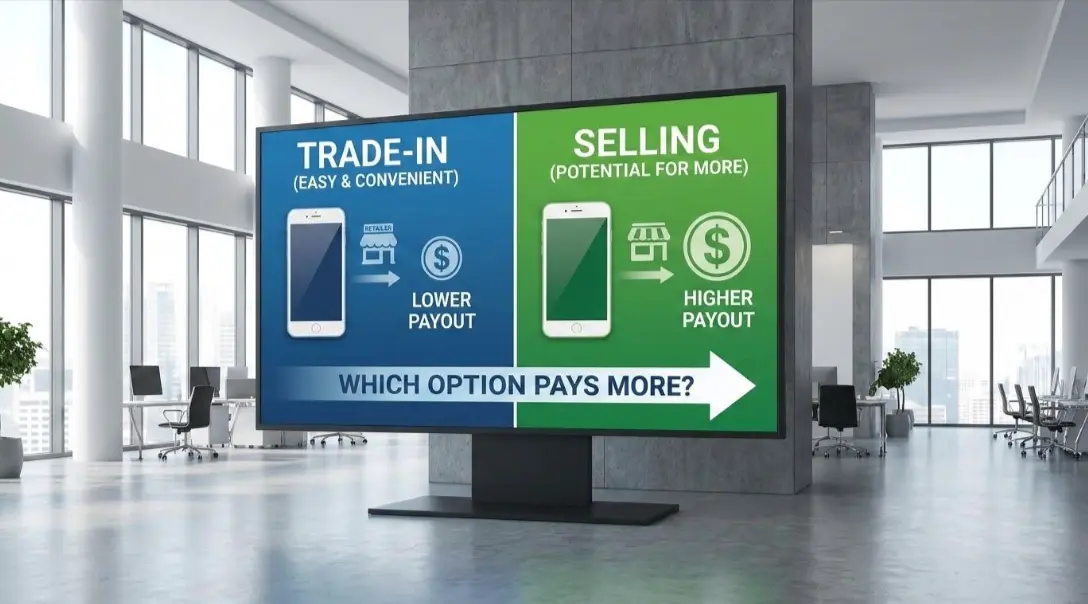
Here is a striking reality that most IT and procurement teams overlook: approximately 88% of smartphones replaced by businesses are still fully functional at the point of disposal. Yet the residual value locked inside those devices quietly evaporates — lost to poor disposal decisions, ad-hoc resale arrangements, or devices quietly accumulating in IT storage rooms waiting for someone to decide what to do with them.
For UK businesses approaching a device refresh cycle, fleet upgrade, or office decommission, the question of what to do with outgoing phones is rarely treated with the strategic attention it deserves. The instinct is often to either trade in phone handsets through whatever mechanism is most convenient, or to sell them on the open market in pursuit of a higher headline price. Neither approach is automatically better — and the difference between them, at scale, can be substantial.
This guide breaks down how each route actually works, what each yields in net terms, and which approach makes more sense depending on your fleet size, compliance obligations, and ESG priorities. The answer may not be what you expect.
What Does It Actually Mean to Trade In a Phone?
In a consumer context, trading in a phone often means handing over a handset in exchange for a voucher or discount on a new model. The B2B equivalent is a different proposition entirely.
When a business decides to trade in phone devices at scale, it typically engages a specialist platform or IT Asset Disposition (ITAD) provider. The process is straightforward in principle: the business submits device details — model, condition, quantity — and receives a guaranteed upfront valuation. From there, the trade-in partner handles everything else: collection logistics, certified data destruction, quality grading, and payment within a defined window.
Modern B2B trade-in platforms have professionalised this considerably. Instant valuations, flexible collection options, full chain-of-custody documentation, and compliance certificates are now standard expectations rather than added extras. The key distinction from open-market selling is that the valuation is locked in at the point of agreement — there is no price negotiation, no buyer sourcing, and no uncertainty about what you will actually receive.
What Does Selling Devices on the Open Market Actually Involve?
The secondary smartphone market is large and commercially active. According to IDC data reported by Silicon UK, the global used smartphone market reached $72.9 billion in 2023, growing 12.4% year-on-year. That scale reflects genuine demand — businesses exploring open-market resale are not operating in a niche or illiquid environment.
In practice, selling corporate devices through open-market channels means engaging one of several routes: listing devices directly on secondary market platforms, working with ad-hoc brokers, or negotiating directly with third-party resellers. Each requires a defined sequence of operational steps. Every handset needs to be individually tested and graded against condition criteria. Data must be wiped — and that wipe must be verifiable. Devices need packaging, tracking, and logistics coordination. If a buyer disputes the condition of a device on arrival, that adds further time and administrative cost to the process.
Some businesses attempt to manage this internally, typically by diverting IT staff to the task during or after a refresh cycle. Others use brokers, who may simplify the process but introduce their own margin and timelines into the equation. Both approaches carry hidden costs that rarely appear on the initial cost-benefit analysis.
To be clear: open-market resale can, in some circumstances, generate a higher gross price per device. That is an important distinction, and the comparison that follows addresses it directly.
The Real Comparison — Trade In Phone vs. Selling at Scale
The most important word in that heading is “scale.” The comparison between trading in phones and selling them outright looks very different depending on whether you are disposing of ten devices or three hundred. Here is how the two routes stack up across the four dimensions that matter most.
Upfront Value vs. Net Return
The most persistent misconception in this space is that selling always yields more money. The headline price per device on the open market may well exceed a trade-in valuation — but headline price and net return are not the same thing.
Consider the variables that erode gross value on the selling side: the time cost of grading and testing each device, the labour involved in managing logistics and communications with buyers, the cost of arranging compliant data destruction separately, and the risk of price depreciation during the sales window. Depreciation is not a minor consideration. Data from OnRecycle UK indicates that a flagship device can lose approximately 38% of its value within a year of purchase — meaning that every week spent managing the sales process rather than completing a trade-in is a week of value walking out the door.
Across a fleet of 50 to 500 devices, these variables compound significantly. A gross per-device price that looks attractive when applied to a single handset becomes considerably less impressive when multiplied across a large batch and adjusted for the time, resource, and compliance costs required to actually achieve it. Net return — what lands in the business’s account after all costs are accounted for — is the only figure that matters.
Speed and Predictability
Trade-in provides a guaranteed price and a defined payment timeline. iGo Trade In, for example, pays within 14 days of collection — a fixed, predictable window that allows businesses to plan accordingly.
Open-market selling offers no such certainty. Prices depend on buyer availability, platform dynamics, condition disputes, and, critically, market timing. That last factor carries more risk than most businesses appreciate. According to OnRecycle UK, 40% of UK businesses that delayed their 2025 device refresh cycles into 2026 contributed directly to secondary market oversupply — depressing resale prices at precisely the moment those businesses were trying to recover value from outgoing devices.
This is not a theoretical risk. It is a pattern that repeats whenever enterprise refresh waves hit simultaneously, and it illustrates why predictability has genuine financial value. A business that locks in a trade-in valuation today is insulated from the market conditions of next month. One that waits to sell is not.
Operational Burden and Internal Resource Cost
Selling corporate devices at scale is operationally intensive work. For an IT team managing a 100-device refresh alongside their existing responsibilities, the task of individually testing, grading, wiping, packaging, and tracking each handset represents a significant overhead — one that is almost never captured on a cost-benefit analysis, but absolutely should be.
The hours spent managing the disposal of outgoing devices are hours not spent on higher-value IT priorities. When that overhead is properly costed — even at a conservative internal rate — the apparent per-device price advantage of open-market selling frequently disappears.
Trade-in platforms handle all of this end-to-end. For larger fleets, dedicated van collection removes the logistics burden entirely. For smaller batches, pre-paid courier boxes provide a low-friction alternative. Full chain-of-custody documentation is maintained throughout, without any internal resource required to produce or manage it.
Data Security and Compliance Cost
This is where the comparison becomes, for most UK businesses, non-negotiable.
UK GDPR places clear obligations on organisations regarding the secure disposal of devices containing personal data. The ICO’s guidance on disposal and deletion is explicit: devices must be securely wiped or physically destroyed before leaving the organisation’s control, and there must be an audit trail to demonstrate this. Failure to meet this standard creates exposure under Articles 5 and 32 of UK GDPR — the provisions governing data integrity and appropriate security measures. It is also worth noting that ICO guidance in this area is currently under active review following the Data (Use and Access) Act, which came into effect on 19 June 2025, reinforcing the regulatory currency of this issue.
When businesses sell devices through open-market channels or ad-hoc brokers, the responsibility for arranging compliant data destruction does not disappear — it simply falls on the business to manage separately. That means sourcing a certified wiping service, obtaining documentation, and maintaining an audit trail independently of the sales process. When this cost is properly accounted for, the per-device economics of open-market selling shift further in favour of trade-in.
B2B trade-in platforms with built-in certified data wiping — conducted to NIST and ADISA standards — and a Certificate of Destruction issued as standard eliminate this risk entirely. Compliance is not an add-on; it is part of the service.
Where ESG Fits Into the Value Equation
For a growing number of UK businesses, the decision of how to dispose of corporate devices is no longer purely a financial one. Organisations with Scope 3 emissions reporting obligations or sustainability KPIs now have a measurable stake in what happens to their outgoing hardware — beyond what it yields in cash.
The environmental case for reuse over disposal is well evidenced. Manufacturing accounts for approximately 80% of a smartphone’s total carbon footprint, according to research cited by 4Gadgets UK. A device that is reused rather than scrapped avoids the carbon cost of manufacturing a replacement, and data from Vodafone UK suggests that each refurbished phone can reduce lifecycle emissions by approximately 50kg of CO₂e. Refurbishment also avoids the extraction of approximately 76.9kg of raw materials per device — a meaningful circularity benefit for organisations with supply chain sustainability commitments.
For businesses that need to quantify and report these outcomes, trade-in partnerships that provide formal ESG impact reports — covering carbon savings and e-waste diverted from landfill — translate environmental action into reportable metrics. iGo Trade In includes an ESG impact report with every trade-in, making it straightforward to present these figures to boards, clients, and stakeholders.
The point is not that ESG considerations should override financial ones. It is that they add a genuine, quantifiable layer of value on top of cash recovery — one that open-market resale arrangements rarely capture or document.
When Might Selling Beat Trade-In?
A credible comparison guide should acknowledge where the alternative route genuinely wins. Open-market resale can deliver a better outcome in a defined set of circumstances.
If a business is disposing of a small number of premium, recent-model devices in excellent condition — say, a handful of flagship handsets from the past twelve months — the gross per-device price available on the open market may exceed a trade-in valuation. Similarly, organisations with established in-house ITAD capability, verified compliance infrastructure, and direct buyer relationships may be equipped to manage the operational and regulatory requirements of open-market selling without the overhead costs that typically erode net returns.
In these scenarios, the calculus can legitimately favour selling. The important caveat is that most UK businesses operating at fleet scale — managing dozens or hundreds of mixed-condition devices across a standard three-year refresh cycle — do not operate in these conditions. For the majority, the combination of compliance cost, operational overhead, and price volatility that accompanies open-market resale makes trade-in the stronger net-value proposition once all factors are properly accounted for.
The Phone Trade-In Comparison — A Quick-Reference Summary
For readers who want a concise reference, here is how the two routes compare across the criteria that matter most for B2B device disposal.
| Criteria | Trade-In (e.g. iGo Trade In) | Open-Market Selling |
| Valuation certainty | Guaranteed upfront | Variable; subject to market conditions |
| Speed of payment | Fixed window (14 days) | Unpredictable; buyer-dependent |
| Data security | Certified wiping included | Must be arranged separately |
| Compliance coverage | NIST, ADISA, GDPR, WEEE compliant | Organisation’s responsibility |
| Certificate of Destruction | Issued as standard | Not provided |
| ESG reporting | Impact report included | Not typically available |
| Logistics handling | Fully managed (van or courier) | Managed internally or via broker |
| Scalability | Designed for bulk fleet disposal | Operationally intensive at scale |
| Operational overhead | Minimal — end-to-end service | Significant internal resource required |
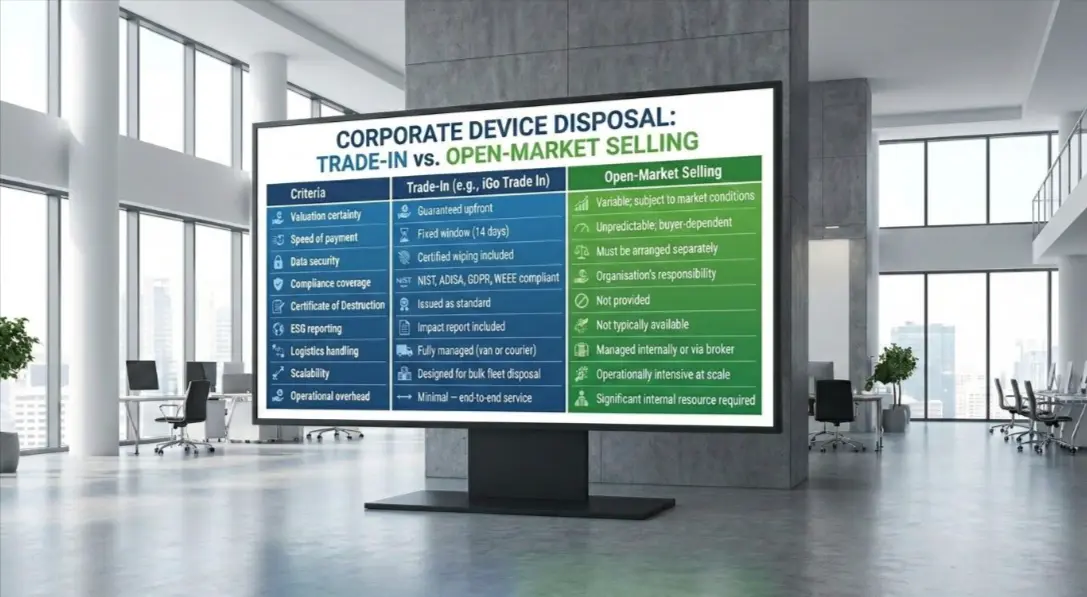
The phone trade-in comparison above reflects best-in-class trade-in capability. Not all trade-in providers offer the full combination of compliance credentials, ESG reporting, and logistics flexibility — so it is worth evaluating providers against these criteria specifically.
How iGo Trade In Works for UK Businesses
iGo Trade In is a self-service B2B trade-in platform designed specifically for UK businesses managing device fleets. The process begins with the online portal at igotradein.co.uk, where businesses input their device details and receive an instant valuation. There is no need for prior negotiation or lengthy onboarding.
Once a trade-in is agreed, iGo handles collection — via dedicated van for larger fleet disposals, or pre-paid courier boxes for smaller batches. Every device undergoes certified data wiping to NIST and ADISA standards, followed by a quality assessment. Payment is made within 14 days of collection, and every trade-in includes a Certificate of Destruction and an ESG impact report quantifying the carbon savings and e-waste diverted as a result of the trade-in.
The compliance credentials underpin the service throughout. iGo Trade In is a registered Upper Tier waste carrier, broker, and dealer with the UK Environment Agency, and operates in full compliance with UK GDPR, WEEE regulations, and ITAD industry standards. For resellers, IT dealers, and mobile network channel partners managing trade-ins on behalf of business clients, a white-label model is available.
Devices assessed as fit for reuse are refurbished and resold into the secondary market. Units beyond economical repair are responsibly recycled — zero devices go to landfill.
iGo Trade In is part of the broader iGo Life ecosystem, which covers the full corporate device lifecycle: iGo Fulfilment for wholesale refurbished IT hardware, iGo Recycle for secure collection and responsible disposal, and iGo Bespoke for customised tech accessory bundles. For businesses seeking a single partner across the entire device lifecycle — from procurement through to end-of-life — that breadth of capability matters.
Timing Your Trade-In — Don’t Let Value Walk Out the Door
Residual value depreciates with every month that passes. A flagship device that retains approximately 62% of its original value at the twelve-month mark will be worth considerably less at 24 or 36 months — and that trajectory only steepens as newer models enter the market and the secondary market adjusts its pricing accordingly.
Market dynamics compound the timing risk further. When enterprise refresh waves arrive simultaneously — as happened when 40% of UK businesses pushed their 2025 refresh cycles into 2026 — secondary market supply surges and prices soften across the board. Businesses that waited found themselves recovering less for their outgoing devices than they would have done six months earlier, precisely because the market was flooded with similar stock.
The practical implication is straightforward: the best time to trade in corporate phones is before the next refresh wave, not during it. For businesses operating on a three-year device lifecycle, building trade-in into the refresh process from the outset — rather than treating it as an afterthought once new devices have already arrived — maximises the residual value recovered. Devices sitting in IT storage are not a neutral holding position. They are depreciating assets.
Conclusion
For most UK businesses managing device fleets of any meaningful size, trading in phones delivers stronger net value than open-market selling once compliance costs, operational overhead, price volatility, and ESG obligations are properly factored into the equation. The headline per-device price is only part of the picture — and often the least important part.
The choice is not really about which route offers a higher number on paper. It is about which route delivers more value in practice, with less risk, less internal resource, and a compliance and sustainability record you can actually stand behind.
See what your corporate devices are worth. Get an instant trade-in valuation at igotradein.co.uk.