
E-Waste Explained: What UK Businesses Need to Know
The UK generated approximately 1.8 million tonnes of e-waste in 2025 — a 6% increase on the previous year. Of that, only around 496,000 tonnes were formally collected and processed through official channels. That gap is not simply an environmental statistic. It represents hundreds of thousands of tonnes of end-of-life electronic equipment leaving UK businesses through informal, undocumented, or non-compliant routes every year — taking unwiped data, unrecovered value, and unreported environmental impact with them.
For IT directors, procurement leads, and IT asset managers, electronic waste is not a distant sustainability concern. It is an active operational, legal, and financial challenge that exists inside every business running a device fleet. The moment a laptop is retired, a smartphone upgraded, or a server decommissioned, a set of legal obligations comes into play — obligations that many UK businesses are either unaware of or only partially meet.
This article explains what e-waste is, why volumes are rising, what the law requires of UK businesses, and what best practice looks like for those who want to get it right. Whether you are managing a fleet of 50 devices or 5,000, the fundamentals are the same.
What Is E-Waste?
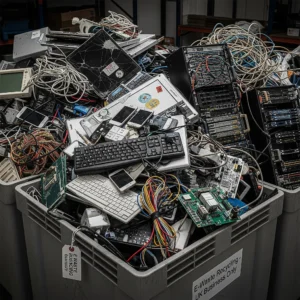
E-waste — also referred to as electronic waste or, in regulatory language, WEEE (Waste Electrical and Electronic Equipment) — is the term used for any electrical or electronic equipment that has reached the end of its useful life. The category is broader than most people initially assume. It covers everything from smartphones, laptops, and tablets to servers, monitors, networking equipment, printers, and a wide range of office peripherals.
In a consumer context, e-waste might mean a broken television or an old games console. In a corporate context, the picture is both larger in scale and more complex in its implications. Enterprise e-waste typically involves higher volumes, greater data sensitivity, and stricter compliance obligations than anything arising from individual consumer behaviour. A business retiring a batch of 150 smartphones is not simply disposing of old hardware — it is managing a process that touches GDPR obligations, environmental regulations, financial recovery, and ESG reporting all at once.
What Counts as Electronic Waste in a Business Context?
For most IT and procurement teams, the list of qualifying equipment is longer than expected. Corporate smartphones, tablets, laptops, desktop computers, and monitors are the obvious examples. Less obvious, but equally relevant, are servers and storage arrays, networking and communications equipment, office printers and multifunction devices, scanners, projectors, and telephony systems.
Even smaller peripherals can fall under WEEE classification if they contain embedded batteries or circuit boards. Wireless keyboards, Bluetooth headsets, docking stations, and charging equipment may all qualify depending on their components. If it plugs in, charges up, or contains electronic circuitry, there is a reasonable chance it is subject to WEEE regulation — and should be treated accordingly.
How Is E-Waste Different From General Business Waste?
Electronic waste cannot be handled like ordinary commercial refuse. It is subject to a distinct legal framework under the UK WEEE Regulations and carries data security risks that general waste simply does not. A business cannot legally place a retired laptop in a skip or pass it to a general waste contractor without potentially breaching both environmental and data protection law.
The distinction matters in practice: the disposal route for a cardboard box and the disposal route for a decommissioned server are not interchangeable. Understanding that difference is the starting point for everything that follows.
How Much E-Waste Does the UK Generate — and Why Is It Growing?
The UK is one of the highest per-capita e-waste generators in the world, producing approximately 24 kilograms of electronic waste per person each year. At a national level, that translated to roughly 1.8 million tonnes in 2025. The formally collected figure — around 496,000 tonnes — tells a stark story about how much of that waste is being handled properly, and how much is not.
The gap between generation and formal collection is not a rounding error. It points to a structural problem: more electronic equipment is entering the economy each year, lifespans are shortening, and the infrastructure for compliant end-of-life processing is not keeping pace.
Enterprise Device Refresh Cycles Are a Major Driver
Corporate IT decisions are a material contributor to national e-waste volumes — not merely a footnote to the consumer story. With a typical enterprise device lifecycle of around three years, businesses are generating a predictable, recurring stream of end-of-life hardware. That predictability is actually an advantage for organisations with structured disposal processes in place, but a compounding problem for those without one.
Major OS transitions — Windows 11 migrations being the clearest recent example — alongside the security demands of hybrid and remote working have accelerated refresh cycles for many organisations. Each wave of upgrades pushes another cohort of devices into the disposal pipeline. The business decisions made in a procurement meeting have a direct and measurable effect on the national e-waste picture.
The Growing Volume of Untracked Electronic Waste
Estimates suggest that as much as 40% of UK e-waste is not properly accounted for or recycled through official channels. In practice, “untracked” means devices sitting in storage rooms for months or years, quietly depreciating while occupying space and accumulating data risk. It means equipment passed to unverified collectors, or — in the worst cases — discarded through general commercial waste streams without any documentation.
For businesses, the untracked problem is not just an environmental issue. It is a compliance exposure and a data security vulnerability. Every device that leaves an organisation without a documented chain of custody is a potential liability.
More Electronics Are Being Placed on the Market Each Year
The volume of electrical and electronic equipment being placed on the UK market continues to rise year-on-year. Some categories saw increases of as much as 10% in recent quarters. More equipment entering the market today means more e-waste in the pipeline tomorrow. For organisations without a structured end-of-life process, that trajectory compounds the problem with every device refresh cycle that passes.
Why E-Waste Matters for UK Businesses — Beyond the Environment
The environmental case for responsible e-waste management is well established. But for IT directors, procurement leads, and business owners, the more immediate concerns are legal liability, data security exposure, and commercial opportunity cost. Getting e-waste management wrong is not just bad for the planet — it has tangible consequences for the organisation.
Legal and Regulatory Liability
Under the Environmental Protection Act, businesses have a duty of care that requires waste — including electronic waste — to be handled by authorised carriers and properly documented throughout the chain of custody. This is not a bureaucratic technicality. It is a legal obligation that applies to every device leaving your premises, regardless of volume or value.
Passing equipment to an unregistered collector, or disposing of it without the appropriate documentation, is non-compliant disposal — and carries the risk of regulatory penalties and reputational damage. The fact that a business acted in good faith is not a defence if the carrier it engaged was not authorised.
Data Security and GDPR Risk
Every device that leaves an organisation without certified data destruction represents a live GDPR exposure. Under UK GDPR, organisations are responsible for ensuring that personal data on employee and customer devices is securely erased or destroyed before disposal. That responsibility does not end when the device is handed to a third party — it extends to ensuring the third party is capable of and accountable for completing the destruction properly.
The ICO’s guidance is unambiguous: devices awaiting disposal must be securely stored with restricted access, and businesses must retain documented evidence of destruction. A Certificate of Data Destruction is the standard mechanism for demonstrating compliance. Without one, an organisation cannot prove what happened to the data on a retired device — and in the event of an ICO investigation or a breach inquiry, the absence of that audit trail is itself a significant problem.
Hidden Financial Value Being Written Off
There is also a straightforward commercial argument. Devices that are stockpiled, written off, or sent for recycling without first exploring their reuse value represent real cash being left on the table. Refurbished devices can be purchased at 20 to 50% less than the cost of buying new — which demonstrates that the secondary market actively places value on the equipment businesses routinely discard. Recovering that value through trade-in at the point of refresh, rather than delayed or unplanned disposal, is a materially better financial decision.
UK E-Waste Regulations — What Businesses Are Legally Required to Do
Several distinct regulatory frameworks apply to how UK businesses handle electronic waste. None of them are optional, and between them they cover environmental compliance, data protection, and — increasingly — sustainability reporting. Understanding what each framework requires in practice is the foundation of a compliant disposal process.
The UK WEEE Regulations
The UK WEEE Regulations are the primary legal framework governing the disposal of electrical and electronic equipment. Under these regulations, businesses are required to ensure that WEEE is properly treated, recovered, and recycled — and, critically, that they maintain evidence notes and records demonstrating compliance throughout the process.
In practice, this means using authorised WEEE treatment facilities, obtaining the appropriate paperwork, and being able to demonstrate a clear chain of custody if the Environment Agency requires it. Businesses cannot simply hand equipment to a collection service and consider the matter resolved. The obligation includes verifying that the party collecting the equipment is authorised to handle WEEE and that the appropriate evidence documentation is provided. The GOV.UK WEEE guidance is the authoritative reference point for understanding these requirements in detail.
Extended Producer Responsibility — What Changed in 2025
The Extended Producer Responsibility framework was updated in 2025, with online marketplaces classified as producers from August 2025. These changes expanded the scope of who bears responsibility for the end-of-life treatment of products placed on the UK market — and the business community has been slow to catch up.
Research published in 2026 found that 64% of businesses were unprepared for EPR changes, and 50% were entirely unaware of them. That is not a niche compliance gap — it represents a majority of UK businesses operating without a full understanding of their legal position. For any business involved in sourcing, selling, or disposing of electronic equipment, the EPR updates are relevant and require attention.
UK GDPR and Data Destruction Obligations
UK GDPR places specific obligations on organisations at the point of device disposal. Any device that has held personal data — whether that is employee information, customer records, or application credentials — must have that data securely erased or physically destroyed before the device leaves the organisation’s control. Accepted methods include certified software wiping aligned to recognised standards, degaussing for magnetic media, and physical shredding for devices where wiping is not technically feasible.
The method matters less than the documentation. A Certificate of Data Destruction, issued by a qualified ITAD provider, is the standard evidence mechanism. Without it, a business cannot demonstrate compliance in the event of an ICO investigation, an insurance inquiry, or a client audit. The ICO’s guidance is clear that good intentions and informal assurances are not a substitute for documented proof.
Duty of Care Under the Environmental Protection Act
The duty of care obligation under the Environmental Protection Act requires businesses to ensure that any waste leaving their premises — including IT equipment — is handled by a carrier that is registered with the Environment Agency as an authorised waste carrier, broker, or dealer. This applies regardless of the volume of devices being disposed of, and regardless of whether the business is paying for collection or receiving a payment for the equipment.
Before engaging any disposal or trade-in partner, businesses should verify that the organisation’s waste carrier registration status with the Environment Agency. iGo Trade In, as a registered Upper Tier waste carrier, broker, and dealer with the UK Environment Agency, provides a straightforward example of what compliant partnership looks like — but the principle applies to any provider a business chooses to work with.
What Is Coming — Digital Waste Tracking and Scope 3 Reporting
The regulatory landscape is tightening further. The UK’s mandatory Digital Waste Tracking system is expected to roll out in October 2026, which will require businesses to record and report waste movements digitally rather than through paper-based documentation. For organisations that currently rely on informal or inconsistent disposal processes, this will represent a significant administrative step change.
Separately, Scope 3 Category 12 emissions reporting — covering the end-of-life treatment of sold products — is expected to become mandatory for more UK businesses by 2027. Organisations that do not already have structured, reportable end-of-life processes will face considerable challenges meeting these requirements as the deadlines approach. Building compliant, documented processes now is the practical choice — not a task to defer until legislation forces the issue.
The Risks of Getting E-Waste Disposal Wrong
Understanding the regulatory landscape is one thing. Understanding what is actually at stake when disposal is handled informally or through unverified third parties is another. The consequences of getting this wrong are specific and serious.
Data Breaches and GDPR Penalties
Improperly disposed devices are one of the most common and underappreciated vectors for data exposure in a corporate context. Retired smartphones and laptops frequently contain residual data — emails, contact records, application credentials, customer information, authentication tokens — that can survive a basic factory reset. Without certified wiping or physical destruction, a business is operating on trust rather than verified evidence.
If that trust proves misplaced and data is recovered from a disposed device, the financial and reputational consequences of the resulting breach will almost certainly exceed the cost of proper ITAD by a significant margin. The ICO has the power to issue substantial fines for GDPR violations, and a breach traced to improper device disposal is unlikely to attract a sympathetic response.
Regulatory Non-Compliance and Enforcement
The Environment Agency actively monitors WEEE compliance, and businesses found to have disposed of electronic waste through unauthorised channels or without required documentation face enforcement action, including financial penalties. As the digital waste tracking system comes online in 2026, the Agency’s ability to identify documentation gaps will increase materially.
The window for informal or ad-hoc disposal practices is narrowing. Businesses that have historically handled device retirement on an occasional, reactive basis — perhaps passing old equipment to a local recycler without verifying their credentials or requesting evidence notes — need to review that approach before the regulatory infrastructure makes those gaps impossible to ignore.
Missed Financial Recovery and ESG Reporting Gaps
There is also a commercial dimension that is easy to overlook when disposal is treated as an afterthought. Each device that is recycled without first exploring trade-in or reuse represents a missed financial recovery. And each disposal event that is not properly documented represents a gap in the organisation’s ESG reporting.
For businesses with sustainability commitments or formal ESG reporting obligations, this matters increasingly. Boards, investors, and in some cases clients are asking for quantifiable data on e-waste diversion, carbon savings, and reuse rates — not general statements about responsible recycling. An organisation that cannot produce that data is in a weaker position than one that can.
Best Practices for Managing E-Waste in Your Business
Moving from awareness to action requires a structured approach. The following practices give IT managers and procurement leads a practical framework for managing electronic waste in a way that is compliant, financially sound, and supportable from an ESG perspective.
Audit Your Device Fleet Regularly
It is not possible to plan compliant or cost-effective disposal without visibility of what you have. Maintaining an accurate, up-to-date IT asset register — one that includes purchase date, expected end-of-life date, and disposal status for every device — is the foundational step. Regular audits also surface stockpiled equipment that is sitting in storage while silently depreciating in value and accumulating data risk.
Define a Clear Device Lifecycle Policy
Formalising the approach to device refresh and end-of-life disposal in a written policy removes ambiguity and ensures consistency across teams, sites, and refresh cycles. The policy should cover what triggers a refresh (age, performance, OS support lifecycle), which disposal pathways are approved (trade-in, certified recycling), what data destruction standards are required, and what documentation must be obtained and retained. A clear policy also provides an evidential foundation in the event of a compliance review.
Always Use a Verified, Compliant Disposal Partner
Any organisation handling your disposed IT equipment must be registered with the Environment Agency as an authorised waste carrier, broker, or dealer. This is a legal requirement — not a quality preference. Before engaging a provider, verify their registration status and ask for their relevant certifications. ADISA accreditation, ISO 27001 certification, and NIST-aligned data wiping practices are markers of a credible ITAD or trade-in provider. Ask for examples of the documentation they provide: WEEE evidence notes, Certificates of Data Destruction, and chain-of-custody records should all be standard outputs.
Prioritise Reuse Over Recycling Where Possible
The waste hierarchy is clear: reuse should come before recycling wherever it is technically viable. Devices in good condition should be assessed for refurbishment and reuse — whether within the organisation, through a structured trade-in process, or via a resale channel — before recycling is considered. This approach maximises the financial value recovered from the device and reduces the carbon footprint associated with disposal. iGo Trade In’s model is built around this principle: devices assessed as fit for reuse are refurbished and resold; only those beyond repair proceed to recycling, with a zero-landfill commitment across both streams.
Collect the Right Documentation Every Time
Good intentions are not sufficient evidence of compliance. For every batch of devices disposed of, businesses should obtain and retain a Certificate of Data Destruction, WEEE evidence notes, and a waste transfer note where applicable. Where the disposal partner provides an ESG impact report quantifying carbon savings and e-waste diversion, that documentation is increasingly valuable for sustainability reporting purposes. Building the habit of collecting this paperwork as a standard part of every disposal event is far easier than trying to reconstruct an audit trail retrospectively.
Corporate Smartphones and Tablets — A Specific E-Waste Challenge
Within the broader e-waste picture, corporate smartphones and tablets occupy a particular position. They are high-volume, frequently refreshed, data-rich, and — when managed well — commercially valuable. They also present specific risks when managed poorly that are worth addressing directly.
High Refresh Rates Mean High Disposal Volumes
With enterprise mobile device lifecycles running at approximately three years, a business operating a fleet of 200 smartphones will be turning over roughly 65 to 70 devices per year. That is a predictable, recurring disposal obligation — one that requires a structured, repeatable process rather than an occasional, ad-hoc response. Without that structure, devices accumulate in drawers and storage rooms, data risk compounds, and the residual value of equipment degrades week by week.
Mobile Devices Carry the Highest Data Risk at End of Life
Smartphones and tablets typically hold some of the most sensitive data within an organisation: email accounts, messaging applications, multi-factor authentication credentials, customer data accessed via mobile applications, and MDM profiles. A factory reset alone is not sufficient for GDPR-compliant disposal. Certified data wiping to NIST or ADISA standards is required, and a documented Certificate of Destruction must be retained as evidence. For businesses operating under any form of regulatory obligation — financial services, healthcare, legal, or otherwise — this is non-negotiable.
Trade-In as a Better Alternative to Recycling-Only
For businesses managing corporate mobile device disposal at scale, a structured trade-in process is a materially better option than a recycling-only approach. iGo Trade In’s self-service B2B portal allows businesses to input their device inventory, receive instant valuations, and arrange collection — either via a dedicated van for large fleet returns, or pre-paid boxes for smaller batches. Certified data wiping, WEEE-compliant processing, payment within 14 days, a Certificate of Destruction, and an ESG impact report detailing carbon savings and e-waste diversion metrics are all included as standard.
For businesses that need a clean audit trail, a documented environmental outcome, and a financial return on their retired fleet, this is a fundamentally different proposition to dropping devices at a recycling point and hoping for the best.
E-Waste and ESG — Why Responsible Disposal Is Now a Business Imperative
E-waste management has moved firmly into the ESG agenda. What was once treated as an operational footnote — something to sort out after the real work of a device refresh was done — is now part of how businesses are evaluated by boards, investors, clients, and regulators.
End-of-Life IT Is Part of Your Scope 3 Emissions
Under the Greenhouse Gas Protocol’s Scope 3 framework, the end-of-life treatment of products falls under Category 12. As Scope 3 reporting becomes mandatory for more UK businesses by 2027, the environmental outcomes of IT asset disposal — including carbon savings from device reuse and recycling — will need to be quantified, reported, and defended to stakeholders.
Businesses that currently have no structured disposal process, and therefore no data on what happens to their retired devices, will find themselves unable to populate this category meaningfully. That gap will become increasingly visible as reporting requirements tighten and as clients and investors begin asking more specific questions about supply chain emissions.
ESG Reporting Requires Data, Not Intentions
The shift in ESG expectations is important to understand clearly. Stakeholders are no longer satisfied with statements of intent or general commitments to “recycling responsibly.” They want numbers: tonnes of e-waste diverted from landfill, carbon savings generated by device reuse, reuse rates versus recycling rates, and documented evidence of compliant destruction. Producing that data requires working with a disposal or trade-in partner that generates it as a standard output — not one that simply collects devices and provides a basic receipt.
For IT directors and procurement leads who are increasingly being drawn into sustainability reporting conversations, the practical implication is straightforward: the disposal partner you choose today determines the ESG data you can report tomorrow. Choosing a partner that provides a structured ESG impact report alongside a Certificate of Destruction is not just a nice-to-have — it is the infrastructure for credible sustainability reporting.
Managing E-Waste Well Is Now a Business Fundamental
The picture that emerges from this overview is clear. E-waste is not a peripheral concern — it is a mainstream operational, legal, and financial challenge for any UK business running a device fleet. The volumes are significant and growing. The regulatory obligations are real and enforceable. The data risks are live and consequential. And the commercial opportunity — recovering value from retired devices rather than writing them off — is being missed by a large proportion of organisations.
The good news is that getting it right is achievable. It requires visibility of your device estate, a clear lifecycle policy, a verified and compliant disposal partner, and a commitment to collecting the documentation that demonstrates compliance at every step.
If you are managing a corporate device fleet and want to understand what a structured, compliant, and commercially sensible trade-in process looks like in practice, iGo Trade In was built specifically for that purpose. The B2B portal provides instant valuations, flexible collection logistics, certified data destruction, WEEE-compliant processing, payment within 14 days, and ESG impact reporting — all in a single, auditable process.
Visit igotradein.co.uk to get an instant valuation for your device fleet, or explore the broader iGo Life ecosystem — including iGo Recycle for pure recycling needs and iGo Fulfilment for sourcing refurbished business hardware — to find the right solution for your organisation’s needs.