
According to Deloitte estimates, around 7 million unused phones worth more than £500 million are sitting idle across the UK right now. Some are in kitchen drawers. Many more are in IT storage rooms, locked in device cupboards, or listed on internal asset logs that nobody has reviewed since the last refresh cycle. The value is real. The opportunity is largely being missed.
For an individual looking to sell a personal handset, the question of where to sell a phone in the UK is relatively easy to answer. A quick search, a comparison site, and a prepaid envelope will usually get the job done. For businesses managing tens, hundreds, or thousands of devices, it is an entirely different challenge — one that touches on data security law, regulatory compliance, financial recovery, and increasingly, sustainability reporting.
This guide covers the full range of options available to UK phone sellers in 2026, from consumer marketplaces through to enterprise-grade IT asset disposition platforms. It is written for both individuals who want a straightforward answer and for business decision-makers — IT Directors, Procurement leads, and IT Asset Managers — who need to make the right call for their organisation, not just the most convenient one. The right answer depends on who you are, how many devices you are managing, and what your compliance obligations look like.
Why More People and Businesses Are Looking to Sell Phones Right Now
Several converging factors are making this conversation more pressing in 2026 than it has been at any point before.
Enterprise smartphone replacement cycles have shortened considerably, with the average now projected at around 2.28 years per device. Businesses are upgrading faster than ever, driven by software support windows, security requirements, and the performance demands of mobile-first working. At the same time, the UK’s 3G network switch-off has accelerated the redundancy of older handsets across corporate fleets, generating an estimated 70,516 kg of additional e-waste as a direct consequence. These two dynamics together are producing significant volumes of outgoing devices — many of which are not being handled optimally.
Layered on top of this is a broader e-waste crisis that is not going away. E-waste is the fastest-growing waste stream globally, expanding at three to five percent annually. In 2022, the UK collected just 31.2% of the total WEEE it generated — meaning the vast majority of electronic waste was either stockpiled, improperly handled, or simply unaccounted for. That gap represents not just an environmental failure but a significant pool of recoverable financial value.
The Enterprise Refresh Problem Nobody Talks About
Shorter refresh cycles should, in theory, mean more regular resale opportunity for corporate devices. The paradox is that many organisations still have no clear, structured process for what happens to their outgoing fleet. Devices are returned, stored, passed between IT teams, and eventually either handed to a recycler, listed on a consumer marketplace without proper data clearance, or simply forgotten. The fragmentation of this process — multiple vendors, no consistent audit trail, a default assumption that recycling is the responsible answer — means the value in those devices goes largely unrealised. The compliance risk, meanwhile, remains very much alive.
The Main Options to Sell Your Phone in the UK
There is no single best route for everyone. The right option depends on factors including how many devices you are dealing with, what condition they are in, whether you need certified data destruction, and whether your organisation requires documented compliance outputs. The following breakdown is designed as a practical decision-making guide rather than a simple ranked list — because different readers will have very different priorities.
Consumer Resale Marketplaces
Platforms like eBay, Facebook Marketplace, and Gumtree remain among the most well-known routes for selling a phone in the UK. For individuals with one or two personal handsets in good condition, the appeal is clear: the potential return is higher than most other options, and the process is straightforward. You list the device, negotiate a price, and post it.
The limitations, however, are significant — particularly for any business context. These platforms require meaningful time investment, offer no data wiping support, provide no compliance documentation, and scale poorly beyond a handful of devices. For organisations, the security implication is the most critical concern: no device should ever be listed on a consumer marketplace without prior certified data erasure. A factory reset is not sufficient — more on that shortly.
Manufacturer and Network Trade-In Schemes
Apple, Samsung, and the major UK networks — EE, O2, Vodafone, and Three — all offer trade-in programmes, typically structured as incentives when upgrading to a new device. These schemes are primarily consumer-facing. The values offered tend to be tied to the upgrade incentive rather than open market rates, which means they are not always the most financially competitive option even for individuals.
For businesses, the limitations go further. These schemes are not designed for bulk processing, do not provide chain of custody documentation, and typically lack the GDPR compliance outputs that corporate device disposal requires. They are a reasonable convenience for a consumer upgrading a personal handset — but they are not a viable solution for managing a corporate fleet.
Comparison and Price Aggregator Sites
Price aggregator sites allow individual sellers to benchmark buy-back offers from multiple buyers in a single search, which is genuinely useful for anyone wanting to quickly understand the resale value of a personal device. The process is fast, the comparison is easy, and for a single handset, these tools do the job well.
At scale, they become irrelevant. Aggregator platforms are built around individual consumer transactions. They cannot handle bulk logistics, provide no compliance or ESG reporting outputs, and are not designed with corporate disposal requirements in mind. A useful tool for the individual reader; not a solution for any business managing more than a handful of devices.
Local Recycling and Drop-Off Schemes
WEEE recycling drop-off points, council-run take-back schemes, and in-store recycling programmes offered by major retailers all provide a route for keeping devices out of landfill. That baseline is important, and it should be acknowledged: responsible recycling is always preferable to improper disposal or stockpiling.
However, there is an important principle that many organisations overlook: recycling is not the best outcome when reuse is possible. A device that still holds residual market value — which many two to three year-old corporate smartphones do — sent directly to a recycler represents a missed financial return. It also represents a lower environmental outcome. Refurbishing and reusing a device avoids the carbon cost of manufacturing a replacement, whereas recycling recovers materials but does not preserve the embodied energy already invested in the device. The circular economy hierarchy is clear on this: reuse before recycle. Yet many businesses still default to the recycling route simply because it feels like the responsible choice.
Dedicated Trade-In and Buy-Back Platforms
Specialist buy-back platforms that offer instant online valuations, prepaid postage, and payment on receipt occupy a middle ground between consumer marketplaces and enterprise ITAD providers. They offer speed and convenience that peer-to-peer selling does not, and for individual sellers or very small businesses they can be a practical option.
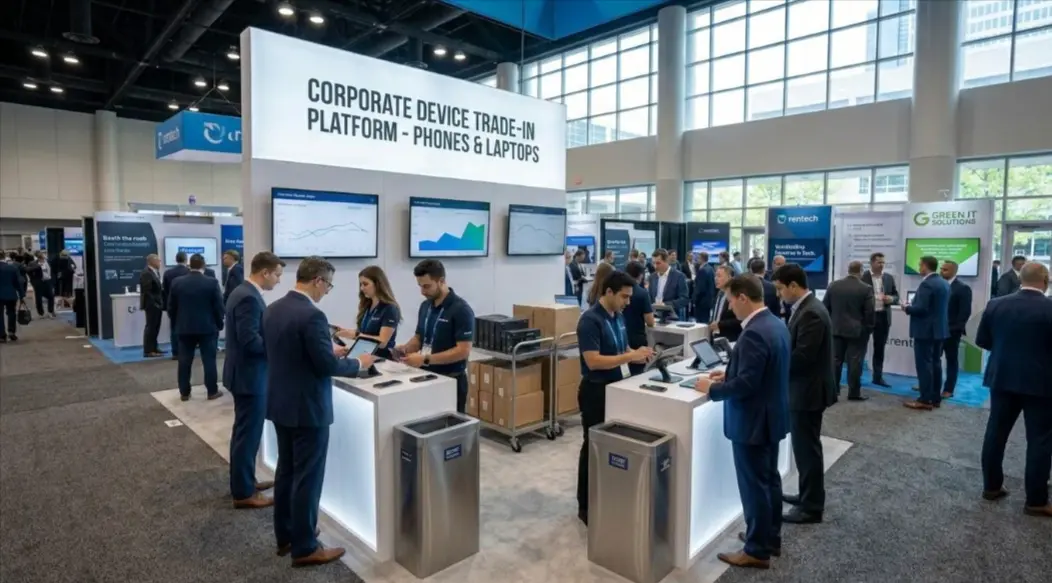
If you are considering this route for a small business with a modest number of devices, there are a few things worth verifying before committing: whether the platform offers certified data wiping with documented evidence, what the payment terms look like, and how transparent the valuation process is.
Capability varies significantly across providers in this space, and not all platforms are equipped to serve even modest business requirements.
ITAD Providers and B2B Trade-In Platforms
For organisations managing meaningful volumes of corporate devices, IT Asset Disposition — ITAD — is the appropriate framework. ITAD describes the structured process of retiring, data-wiping, valuing, and either remarketing or responsibly recycling corporate devices at end of lifecycle. It is purpose-built for the complexity that consumer-grade channels cannot address.
A credible ITAD or B2B trade-in provider should offer certified data destruction aligned with recognised standards such as NIST, ADISA, and ISO frameworks. It should provide GDPR-compliant audit documentation, a Certificate of Destruction for every device processed, and full chain of custody records from collection through to final disposition. Logistics should be flexible — a van collection for large fleet disposals, prepaid courier boxes for smaller batches — and ESG impact reporting should be a standard output, not an optional extra.
This is the space that iGo Trade In is built for. Designed specifically for UK businesses going through device refresh cycles, iGo Trade In provides a self-service portal where organisations input their devices and receive instant valuations. Collection is arranged via dedicated van or prepaid boxes depending on volume. On receipt, devices undergo certified GDPR-compliant data wiping, quality grading, and confirmation — with payment made within 14 days, a Certificate of Destruction issued, and an ESG impact report delivered alongside. iGo Trade In is registered with the UK Environment Agency as an Upper Tier waste carrier, broker, and dealer. Devices assessed as fit for reuse are refurbished and resold; those beyond repair are responsibly recycled with zero landfill. For any organisation managing a fleet of ten devices or more, this is the category of solution that satisfies compliance, financial, and sustainability requirements simultaneously.
What Businesses Should Think About Before Selling Corporate Phones
Once a business has decided to act on its outgoing devices, the next question is not just where to sell them — it is how to approach the process correctly.
Data Security and GDPR Compliance — Not Optional
Under Articles 5 and 32 of the UK GDPR, as enacted through the Data Protection Act 2018, organisations are legally required to ensure the secure destruction of personal data held on devices before disposal. The ICO’s guidance on disposal and deletion is explicit: acceptable methods include certified data wiping, degaussing, and physical destruction. The ICO also makes clear that devices awaiting disposal must be stored securely with controlled access — the obligation does not begin at the point of handover to a third party.
The critical point here is that the compliance risk is not disposal itself — it is improper disposal. A device that has been factory reset and sold on eBay may still hold recoverable data. A device that has been processed through certified data erasure by an accredited provider does not. The distinction carries real legal weight, particularly as the regulatory landscape continues to develop. The Data (Use and Access) Act, which came into effect on 19 June 2025, is a reminder that organisations cannot afford to treat data destruction on outgoing devices as an administrative afterthought.
Documentation and Audit Trails
Many organisations underestimate how much the paperwork matters. A compliant device disposal process should generate a clear documentary record: asset tracking logs, certificates of data erasure, certificates of destruction, and chain of custody records covering every stage from collection to final disposition. These are not bureaucratic box-ticking exercises. They are the evidence an organisation would need to present in the event of a data breach investigation, an ICT waste audit, or a regulatory enquiry. Organisations that cannot demonstrate what happened to their devices — and when, and how — are exposed. Those that can are protected.
Reuse vs Recycle — Why the Distinction Matters
As noted earlier, reuse delivers a better outcome than recycling on both financial and environmental grounds. A device that is refurbished and resold generates a direct cash return for the business that disposed of it. It also avoids the carbon cost of manufacturing a new device to replace it — a meaningful saving, given that lithium-ion batteries alone account for roughly 30% of a smartphone’s total carbon footprint.
Recycling is the right outcome for devices that are genuinely beyond refurbishment. It is not the right default for an entire fleet. Before agreeing terms with any disposal partner, organisations should ask what their reuse rate looks like — that is, what proportion of devices received are refurbished and resold versus processed for materials recovery. The answer tells you a great deal about where a provider sits on the value chain.
Logistics — Matching the Solution to the Volume
The logistics of collection should match the scale of the disposal. Large fleet refreshes — hundreds of devices across one or more sites — are best handled via a dedicated van collection with documented handover. Smaller batches are well served by prepaid courier boxes. What matters is that the logistics element is documented, that chain of custody is maintained from the moment devices leave the organisation’s premises, and that the collection process is part of the overall audit trail. A mature B2B trade-in provider will offer both options and make the documentation straightforward.
How Corporate Trade-In Works in Practice
For those unfamiliar with the process, a well-run B2B trade-in is considerably more straightforward than it might sound.
It begins with inputting device details — make, model, storage capacity, and condition — into a portal-based valuation tool. Instant valuations are generated, giving the organisation a clear picture of expected financial return before committing to anything. Collection is arranged based on volume: a dedicated van for larger batches, prepaid boxes for smaller ones. Devices are collected with documented handover records.
On receipt, devices are processed through certified data wiping in line with recognised NIST, ADISA, and ISO-aligned standards. Each device is quality graded and assessed against the original condition information provided. Any significant discrepancy in condition triggers a revised valuation, with the organisation notified before any adjustment is applied. Payment is made within an agreed window — typically 14 days — alongside the Certificate of Destruction for each device processed.
Finally, an ESG impact report is issued, detailing the carbon savings achieved, the volume of e-waste diverted from landfill, and the number of devices extended into reuse. This is the output that sits on the desk of the sustainability lead and feeds into the annual report, the board update, or the client-facing ESG disclosure.
iGo Trade In’s portal-based model follows exactly this workflow, designed to give IT and Procurement teams a transparent, auditable process from first valuation to final payment with minimal administrative burden.
The ESG Angle — Why Device Trade-In Is Now a Sustainability Decision
Device disposal has moved well beyond the IT department. In 2026, it is firmly on the sustainability agenda — and the data makes clear why.
The UK generated only 31.2% of its total WEEE in reported collections in 2022, according to figures from the UK’s WEEE monitoring data. The remainder was either stockpiled, improperly handled, or processed outside the formal reporting chain. E-waste is growing at three to five percent annually and represents one of the most complex waste challenges facing businesses and regulators alike. Corporate fleets, refreshed every two years or less, represent a meaningful and recurring contribution to that challenge — but also a meaningful and recurring opportunity to address it.
The expectation on businesses today is not just that they dispose of devices responsibly — it is that they can prove they did so, with numbers. Sustainability and ESG officers are increasingly stakeholders in the device disposal decision, and they need quantifiable outputs: carbon savings expressed in kg of CO₂ avoided, volumes of e-waste diverted from landfill, numbers of devices extended into productive reuse rather than recycled. These metrics are now expected inputs to sustainability reports, Scope 3 emissions disclosures, and client-facing ESG documentation.
A trade-in partner that cannot provide this data is not meeting the standard expected in 2026. An organisation that chooses a disposal route — recycling, for example, or a consumer marketplace — that generates no such data is creating a reporting gap that will become harder to explain as ESG scrutiny increases.
How to Choose the Right Option for Your Situation
The practical decision is simpler than it might appear once you apply the right criteria to your circumstances.
If you are an individual with one or two personal handsets to sell, a comparison site or dedicated consumer buy-back platform will likely give you the best combination of speed, convenience, and return. If you are a very small business with fewer than ten devices and a basic data hygiene requirement, a certified buy-back platform that confirms data wiping and provides some form of erasure documentation may be sufficient.
If you are an IT Manager, IT Director, or Procurement lead overseeing a fleet refresh of 20, 100, or 500-plus devices, a dedicated B2B trade-in or ITAD provider with full compliance documentation, flexible logistics, and ESG reporting outputs is not just the better option — it is arguably the only option that satisfies all of your legal, financial, and sustainability obligations simultaneously. The consumer-facing channels were not designed for this, and using them creates exposure that a structured ITAD process eliminates.
Common Mistakes to Avoid When Selling Business Phones
A few errors come up repeatedly when organisations attempt to handle device disposal without a structured approach, and they are worth naming directly.
The most common is assuming that a factory reset makes a device data-safe. It does not. A factory reset removes the visible file structure on a device but does not overwrite the underlying data storage, meaning it can be recovered with widely available forensic tools. Certified data erasure, carried out by an accredited provider, is required for GDPR compliance.
Another frequent mistake is hoarding devices. Residual value depreciates quickly — a smartphone that would have returned meaningful value eighteen months ago may return very little today. Organisations that stockpile outgoing devices while waiting for a convenient moment to act are quietly destroying value on their own balance sheets.
Using consumer-grade resale channels for corporate devices — whether that is eBay, a consumer trade-in platform, or a network trade-in scheme — leaves an organisation without the compliance documentation it needs and potentially with data protection exposure. Similarly, routing all devices through a recycler because it feels like the responsible choice, regardless of whether they have genuine resale value, forfeits both the financial return and the higher-order environmental benefit that reuse delivers.
Finally, fragmented disposal — using different vendors for collection, data wiping, and remarketing — increases risk and reduces both oversight and financial return. A single, end-to-end provider with a documented chain of custody is invariably a better outcome than stitching together a process from multiple parties.
Conclusion
There is no single best place to sell your phone in the UK — the right answer depends entirely on who you are, how many devices you are managing, and what your compliance and sustainability obligations require. For individuals, speed and convenience are reasonable priorities, and the consumer channels serve them well. For businesses, the priorities are different: data security, regulatory compliance, documented audit trails, maximum residual value recovery, and increasingly, quantifiable ESG outcomes.
What is clear is that device trade-in is no longer just an administrative task at the tail end of a refresh cycle. Managed correctly, it is a structured, value-generating process that sits at the intersection of IT, finance, and sustainability strategy — one that pays back financially, protects the organisation legally, and produces the evidence that sustainability teams and stakeholders are increasingly asking for.
If you are a business looking to understand what a managed B2B trade-in process could look like for your organisation, iGo Trade In is a purpose-built UK platform designed for exactly this. Visit igotradein.co.uk to get an instant valuation on your devices, or speak to the team about a managed collection for your next fleet refresh.