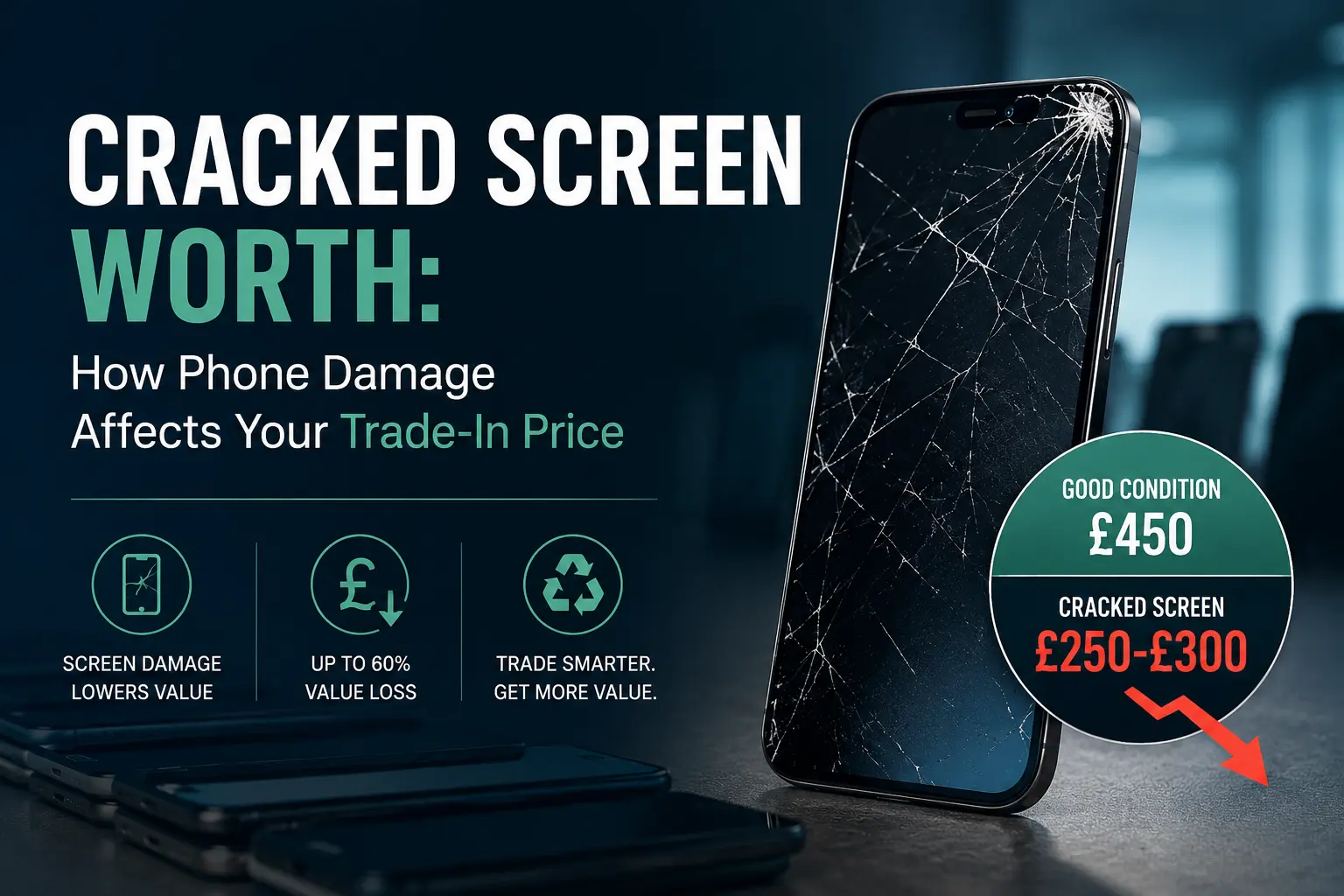
A cracked screen can wipe out between 20% and 60% of a phone’s trade-in value — and for businesses managing dozens or hundreds of corporate devices, that damage compounds quickly into significant lost revenue. What might seem like a minor cosmetic issue on a single handset becomes a material procurement concern the moment you scale it across a refresh cycle.
This article is not a consumer guide about whether to fix your personal phone. It is a practical resource for anyone responsible for managing device fleets, planning refresh cycles, or trying to recover maximum residual value from corporate tech. We will cover how phone grading actually works, what happens to a device’s value at each tier of screen damage, whether repairing before trade-in makes financial sense, and what businesses can do to minimise value loss across a fleet. By the end, you will have a clear, grounded understanding of the cracked screen trade-in equation — and the practical steps to act on it.
Why Screen Condition Is the Single Biggest Factor in Trade-In Pricing
In the UK trade-in and ITAD markets, screen condition typically carries more weight in the valuation process than battery health, model age, or minor cosmetic wear elsewhere on the device. This is not simply about aesthetics. Graders and trade-in platforms evaluate screen condition as a structural indicator of resale potential — it directly determines which commercial pathway a device can follow and, therefore, what it is worth.
How Trade-In Grading Systems Work
Grading has evolved considerably in recent years. Where older programmes relied on subjective letter grades — A, B, C — more sophisticated ITAD providers now operate defect-based grading models that standardise assessments across large volumes of devices. Screen defects are typically categorised as minor, major, or critical, and each category maps directly to a different price bracket or resale route.
Industry standards such as those promoted by ADISA and the reCore framework emphasise consistent grading and full audit trails throughout the device lifecycle. Screen condition is a core grading component under these frameworks — not an afterthought — which is why the first thing an assessor looks at when a device arrives is the display.
The Three Resale Pathways a Screen Crack Decides
Understanding how screen condition determines a device’s commercial route is one of the most useful conceptual frameworks for anyone managing fleet trade-ins at scale. The same make and model can follow three completely different value pathways depending on screen condition:
Resale-ready: An intact screen with no visible defects allows a device to be cleaned, wiped, and listed directly for secondary market resale. This is the highest-value pathway.
Refurbishment required: A cracked or significantly damaged screen means the device needs a screen replacement before it can be resold. This adds both cost and time before the device re-enters the market, and those costs are reflected in a lower trade-in price.
Parts and recycling only: A severely damaged or non-functional screen — where the display is unresponsive or partially dead — typically places a device in the lowest tier, where it is broken down for component harvesting or responsibly recycled.
Screen damage is not just a cosmetic concern. It is the primary variable that determines which of these three categories a device lands in, and that category determines your return.
What a Cracked Screen Is Actually Worth — The Numbers
Minor Damage vs. Major Damage: The Price Gap Is Wider Than Most Expect
The financial impact of screen damage runs along a spectrum, but the gap between the two ends of that spectrum is wider than most businesses anticipate. Minor cosmetic flaws — hairline cracks, small corner chips — typically reduce trade-in value by around 20%. Significant screen damage, including large cracks, spiderwebbing, or dead pixels, can cut trade-in value by 50% or more.
Some UK trade-in schemes automatically halve the quoted value the moment a cracked screen is identified during inspection, regardless of how functional the device remains. Major UK network operators apply reductions of around 40% for damaged devices and up to 70% for heavily smashed handsets. Understanding that damage severity does not just nudge the price — it can trigger a categorical price halving — is essential when planning trade-in submissions.
A Real-World Example: iPhone 13 Trade-In Value With and Without Damage
Concrete figures make the point more clearly than percentages alone. An iPhone 13 in good condition trades in at approximately £450 in the current UK market. With a cracked screen, that same device realises between £250 and £300 — a drop of 33–45% depending on the programme.
That is a single device. Multiply that loss across a fleet of 200 or 500 units, and you are looking at a procurement or ITAD planning concern of real financial weight — not a rounding error.
Why Buyers Treat Cracks as a Proxy for Deeper Damage
There is a psychological and commercial dynamic at work in the pricing gap that goes beyond the physical cost of a screen replacement. Secondary market buyers and refurbishers treat a cracked screen as a signal of potential internal damage — even when the device functions perfectly. The reasoning is that a phone which has been dropped hard enough to crack its screen may also have sustained damage to internal components that is not immediately visible.
This perception consistently inflates the discount applied to damaged devices across UK trade-in programmes and secondary resale platforms. It is not always rational, but it is reliable. Understanding this dynamic helps businesses make smarter decisions about when to invest in repair and when to accept the trade-in price as offered.
Should You Repair the Screen Before Trading In?
This is one of the most practically useful questions a business can ask before a refresh cycle — and the honest answer is: not always, and often not worth it.
The Cost of a Screen Repair vs. the Value It Recovers
Professional screen repairs in the UK typically cost between £100 and £300, depending on the model and repair provider. The relevant question is not simply what that repair costs — it is what trade-in uplift the repair will actually recover. For mid-range or older handsets, the repair cost frequently equals or exceeds the additional value a repaired screen would add to the trade-in price. The economics simply do not work.
For flagship devices — recent iPhones or Samsung Galaxy S-series handsets — the maths can occasionally work in your favour. But only when the repair is performed to a standard that satisfies the grader, and only when the uplift is clearly larger than the combined cost of repair and any residual grading risk.
The Non-OEM Parts Problem
There is an important complication that businesses managing fleet repairs at scale need to be aware of. Repairs carried out using non-original (non-OEM) components can actually reduce trade-in value further — by an additional 10–20% in some grading frameworks. ITAD assessors and trade-in platforms increasingly check for third-party screen replacements, particularly on Apple devices where software flags non-genuine parts.
A repaired screen is not automatically a good screen in grading terms. This is a common and costly misconception when making repair decisions across dozens of devices. A non-OEM repair may move a device out of the “damaged” category on visual inspection, only to land it in a lower tier when the grader identifies the third-party component.
When Repair Does Make Financial Sense
The balanced view is that there are circumstances where repairing before trade-in is the right call. These typically include high-value flagship devices with significant remaining resale potential, situations where OEM-quality repairs are available at a controlled and predictable cost, and fleet programmes where a small number of premium devices warrant individual attention.
A simple decision framework helps here: calculate the net value — trade-in uplift minus repair cost minus any grading risk margin — and proceed only when that calculation is clearly positive. If the margin is tight or uncertain, accepting the damaged device valuation and submitting as-is is usually the more commercially sound decision.
How Different Types of Screen Damage Are Graded
Not all cracks are equal, and understanding the distinctions between damage tiers helps businesses set realistic expectations before submitting devices — and avoid the frustration of revised valuations that come back lower than anticipated.
Hairline Cracks and Minor Chips
At the lowest tier of damage in most grading systems, you have barely visible hairline cracks or small chips that do not affect touch functionality or display quality. Depending on the programme, these may still allow a device to grade as “good” rather than “damaged,” although many UK trade-in operators apply at least a minor markdown even for superficial flaws.
Worth noting: what looks insignificant to the user may still trigger a grade reduction in a rigorous defect-based grading model. Setting accurate internal expectations before submission avoids disputes downstream.
Significant Cracks, Spiderwebbing, and Touch Issues
This is where meaningful value loss typically begins. Visible cracks across a portion of the screen, spiderwebbing patterns, or any impact on touch sensitivity or display quality generally move a device into a “damaged” or “poor” category. The 40–50% value reductions discussed earlier are characteristic of this tier. Even when the device functions normally, its resale pathway shifts from direct resale to refurbishment — which adds processing cost and time before it can re-enter the market.
Shattered Screens and Display Failure
Severely damaged screens — where the display is unresponsive, showing dead pixels, or partially or fully non-functional — typically place a device in the lowest value tier: parts or recycling only. At this point, residual cash value is minimal.
It is worth stating clearly: even a completely non-functional screen does not eliminate data security obligations. Certified data erasure or destruction is required regardless of screen condition, and any temptation to deprioritise a badly damaged device from the data wiping queue creates a genuine GDPR compliance risk.
What Cracked Screens Mean for Businesses Managing Device Fleets
The Hidden Cost of Fleet-Wide Screen Damage
The individual device numbers become considerably more significant at fleet scale. If 30% of a 500-device fleet carries cracked screens and each device loses between £100 and £150 in trade-in value as a result, that represents between £15,000 and £22,500 in recoverable value that simply disappears. For businesses that are not actively tracking device condition between refresh cycles, this is a silent budget leak — invisible until the trade-in valuations come back.
Device Condition Management During the Refresh Cycle
Businesses that actively monitor device condition throughout the lifecycle — not just at the point of return — consistently recover better trade-in returns. In practical terms, this means establishing clear usage policies that include protective cases and screen protectors as standard, tracking damage incidents as they occur rather than retrospectively, and conducting condition audits before a refresh cycle begins rather than on the day devices are submitted.
Early visibility into damage across the fleet allows IT teams to make informed decisions about repair, replacement, or trade-in routing well ahead of the submission date. Decisions made under time pressure at the end of a refresh cycle are almost always more costly than those planned in advance.
The ESG Dimension — Screen Damage and the Circular Economy
The sustainability implications of screen damage deserve more attention than they typically receive in ITAD planning conversations. When screen damage moves a device from a resale pathway to a recycling pathway, it does not just reduce the cash return — it reduces the environmental value of that device’s second life. Refurbishment and direct reuse deliver significantly lower carbon impact than recycling, which requires energy-intensive material recovery processes.
A cracked screen can shift a device from the high-value, low-carbon reuse loop into a more resource-intensive recycling process. Only around 10% of phones are currently refurbished across European markets, which points to a large amount of untapped environmental and commercial value being lost — often because of damage that could have been prevented or managed differently. For businesses with ESG commitments or sustainability reporting obligations, device care policies and trade-in planning are directly relevant to the numbers they report.
How to Sell Damaged Phones Without Losing More Than You Have To
Be Accurate and Upfront About Condition From the Start
The most common source of trade-in value disputes is the gap between the condition a business self-reports and the condition an assessor actually finds during inspection. Describing a device as “good” when it has a visible crack leads to a revised valuation after grading — which wastes time, creates friction, and undermines trust with your trade-in partner.
Being accurate from the outset means the quote you receive reflects reality and is the quote you can plan around. It also demonstrates the kind of operational maturity that makes for a smoother, faster trade-in process at scale.
Submit Damaged Devices Alongside Intact Ones — Don’t Stockpile
A common mistake when managing fleet returns is holding back damaged devices while waiting for repairs or a more favourable moment. Stockpiling creates two compounding problems: devices continue to depreciate, and they remain in a grey area for GDPR compliance. Any device that has held company data — regardless of screen condition — needs to be processed and data-wiped. The longer it sits, the greater the compliance exposure and the lower the eventual return.
The practical guidance here is straightforward: submit damaged devices as part of the same trade-in batch as intact ones, be transparent about condition, and let the trade-in partner apply their grading framework correctly. Mixing condition grades in a single submission is normal practice for any experienced ITAD partner.
Work With a Trade-In Partner That Uses Transparent Grading
Not all trade-in programmes handle damaged devices equally, and the quality of the grading process has a direct impact on what you recover. Businesses should look for partners that provide clear, condition-based grading criteria in advance, a transparent revision process when assessed grades differ from expectation, certified data destruction regardless of the device’s physical state, and documentation that satisfies GDPR and WEEE compliance requirements.
For organisations trading in corporate smartphones and tablets at scale, platforms like [iGo Trade In](https://igotradein.co.uk) provide instant valuations, certified data wiping, and ESG impact reports — covering damaged and intact devices alike — so that every device in a fleet is handled consistently and compliantly, whatever its screen condition.
What Happens to a Cracked-Screen Device After Trade-In?
A common misconception is that damaged devices are simply discarded once they leave a business. Understanding what actually happens to them is useful both for making informed decisions and for meeting the reporting obligations that come with responsible device disposal.
Devices accepted with screen damage typically follow one of two routes. Where the damage is repairable and the device has sufficient residual value, it goes through screen replacement, full functional testing, and certified data erasure before re-entering the secondary market as a refurbished unit. Where damage is too severe for cost-effective repair, the device is broken down for component harvesting and certified material recovery — with zero landfill.
In both cases, certified data erasure occurs before any physical processing begins. This is not optional. Under WEEE regulations and the Environmental Protection Act 1990, UK businesses have a duty of care to ensure devices are handled by authorised carriers and treated appropriately — a duty that applies equally to cracked-screen handsets as it does to pristine ones. Working with a registered waste carrier, broker, and dealer ensures this obligation is met and documented.
Key Takeaways — What a Cracked Screen Is Worth and What to Do About It
– Cracked screens reduce trade-in value by 20–60% depending on severity, with major UK network trade-in programmes applying reductions of 40–70% for significant damage
– Screen condition determines which resale pathway a device follows: direct resale, refurbishment, or recycling — and that pathway determines the return
– Repairing before trade-in is not always cost-effective, particularly when non-OEM parts are involved, which can reduce value by a further 10–20%
– At fleet scale, screen damage creates significant hidden value loss — easily reaching tens of thousands of pounds across a single refresh cycle
– Damaged devices carry full GDPR data security obligations and should be processed promptly, not stockpiled
– Transparent, condition-accurate submissions and a trade-in partner with clear, auditable grading criteria are the most reliable way to maximise returns across a mixed-condition fleet
Conclusion
Screen damage is a normal part of device lifecycle management — but it does not have to mean writing off value or creating compliance risk. Businesses that approach trade-in with accurate condition data, a clear repair-versus-trade-in framework, and the right partner in place consistently recover more from both damaged and intact devices than those that treat the process as an afterthought at the end of a refresh cycle.
If your organisation is managing corporate smartphones and tablets at scale, iGo Trade In handles the full process — from instant valuations and flexible collection logistics to certified GDPR-compliant data destruction and ESG impact reporting — for every device in your fleet, regardless of screen condition. Get started at igotradein.co.uk or reach out to the iGo Life team to discuss your next device refresh.
Got devices to move on?
Get a valuation and trade in your business fleet with iGo Trade In — certified data erasure and an ESG impact report included.