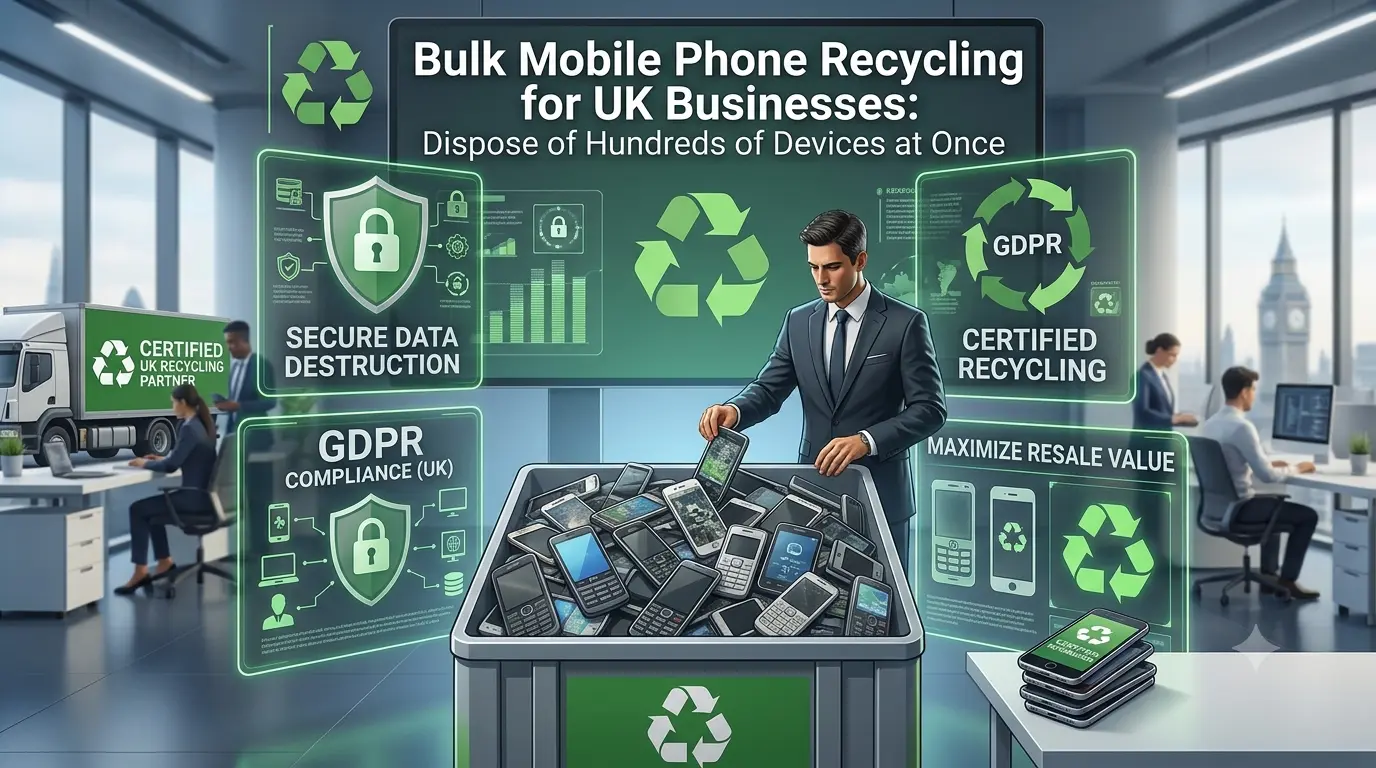
UK businesses are collectively sitting on millions of end-of-life mobile devices — many of them gathering dust in IT cupboards, storage rooms, or desk drawers, quietly losing value with every passing month. Despite the scale of the problem, formal e-waste recycling in the UK still falls well short of what is generated: the country produced approximately 1.65 million tonnes of e-waste in 2022, equivalent to roughly 24.5 kg per person, one of the highest rates globally, while only a fraction of that volume is captured through official recycling channels.
For IT managers, procurement leads, and business owners facing a device refresh or office decommissioning, the question is rarely whether to dispose of old devices — it is how to do it correctly, securely, and without leaving money on the table. This guide covers everything you need to know: your legal obligations under UK regulations, the real data security risks, how to manage bulk logistics, how to recover value when you sell bulk phones, and how to turn responsible disposal into a documented ESG outcome.
Why Bulk Mobile Phone Recycling Is a Growing Priority for UK Businesses
The case for structured bulk device disposal has never been stronger. Three pressures are converging at once: the need to recover cost from ageing assets, increasing compliance risk from improper disposal, and growing stakeholder expectations around ESG accountability. Add to that the rise of device-as-a-service models and standardised corporate refresh cycles, and you have a situation where large volumes of end-of-life devices are arriving all at once — not in ones and twos, but in hundreds.
The Hidden Cost of Stockpiling Old Devices
There is a quiet financial drain happening inside many UK businesses, and it goes largely unnoticed until the damage is done. When devices reach the end of their refresh cycle, the instinct is often to set them aside and deal with them later. But later is expensive. A smartphone worth £80 today may be worth £20 in twelve months. A high-value flagship that could generate meaningful return as part of a bulk trade-in this quarter may be worth little more than scrap value by the time it finally gets actioned.
Proactive bulk mobile phone recycling — or better still, a structured trade-in programme — is first and foremost an asset management decision. Treating end-of-life devices as recoverable assets rather than unavoidable waste changes the economics entirely.
The Scale of the UK E-Waste Challenge
The numbers here are hard to ignore. The UK generated approximately 1.65 million tonnes of e-waste in 2022, placing it among the highest-volume producers globally relative to population size. Yet despite this volume, the UK continues to fall short in certain WEEE collection categories — the 2025 collection target was 517,285 tonnes, and categories such as small mixed WEEE failed to meet their targets. Industry analysis suggests up to 40% of UK WEEE is not properly collected or recycled through formal channels, meaning a significant proportion of devices — including corporate mobile phones — are ending up in informal or unregulated streams.
Bulk business recycling is a material part of the solution. When UK companies deal with end-of-life devices through certified channels, they contribute directly to closing that collection gap.
What UK Regulations Say About Business Device Disposal
Compliance is not optional, and ignorance is not a defence. UK businesses disposing of mobile phones in bulk are subject to three overlapping regulatory frameworks, each carrying its own obligations and risks.
WEEE Regulations — Your Legal Obligations as a Business
Under the UK WEEE Regulations, businesses must ensure that electrical and electronic equipment is collected, treated, and recycled by authorised providers. Devices cannot be disposed of through general waste — that is both an environmental and regulatory breach. 2025 amendments to the WEEE Regulations introduced new reporting requirements, broadening the compliance scope and increasing the transparency obligations placed on producers and distributors. For businesses running large fleets of company devices, this means the disposal route needs to be documented and defensible.
Duty of Care Under the Environmental Protection Act
The Environmental Protection Act places a duty of care on any business that produces, holds, or transfers waste. In practice, this means ensuring waste is handled only by licensed waste carriers, and that proper transfer notes and audit trails are maintained throughout the chain. Critically, your duty of care does not end when devices leave your premises — the business remains accountable for how that waste is handled downstream.
This accountability is set to become more visible. DEFRA’s digital waste tracking system becomes mandatory from October 2026, meaning the movement of waste — including electronic devices — will need to be recorded and reported digitally in real time. Businesses that have not yet established traceable disposal processes will find themselves playing catch-up quickly.
UK GDPR and the ICO’s Expectations on Device Disposal
For most IT managers, data security is the sharpest concern. Under UK GDPR and the Data Protection Act 2018, organisations are required to ensure that personal data is securely erased or destroyed before any device leaves their control. Crucially, the ICO requires documented evidence of that disposal — a Certificate of Data Destruction, not a verbal assurance or a generic confirmation email. Without that documentation, the business cannot demonstrate compliance in the event of an audit or an incident. Failure to securely dispose of devices is not a minor procedural lapse — it can constitute a data breach, triggering notification obligations and potentially significant regulatory fines.
The Risks of Getting Bulk Mobile Phone Recycling Wrong
Understanding the regulations is one thing. Understanding what actually goes wrong in practice is another.
Data Breach Exposure from Improperly Wiped Devices
A factory reset is not a certified data wipe. Residual data on improperly sanitised devices can be recovered using tools that are widely available and require no specialist knowledge. For devices that have held customer data, HR records, financial information, or access credentials, this represents a genuine and serious exposure. Without certified data erasure — following recognised standards such as NIST 800-88 or ADISA — a business remains liable for any data that resurfaces after disposal.
Non-Compliance With Waste Carrier Licensing
This is a compliance gap that catches many businesses off guard. It is surprisingly common for companies to hand over devices to parties who are not registered waste carriers — a van hire company, a local IT trader, or even a well-meaning member of staff taking devices to a recycling centre in their own vehicle. If the party transporting or processing the waste is not registered with the UK Environment Agency as a licensed waste carrier, the originating business is in breach of its duty of care obligations, regardless of the outcome for the devices. You can verify a carrier’s registration through the Environment Agency’s public register before any handover takes place.
Losing Money by Acting Too Late
The longer devices sit idle, the less they are worth. Bulk mobile phone recycling without a trade-in component means leaving recoverable cash behind. Many businesses assume that once devices are past their refresh point they have no remaining value — but this is rarely true, particularly for relatively recent flagship models. A structured approach that includes the option to sell bulk phones alongside compliant recycling allows businesses to recover residual value while still meeting every regulatory and data security obligation. It is not an either/or choice.
How Bulk Mobile Phone Recycling Actually Works — Step by Step
Knowing what a well-run process looks like helps businesses ask the right questions and set the right expectations.
Step 1 — Audit and Catalogue Your Devices
Before anything else, the business needs to know what it has. A basic device audit should capture make, model, storage capacity, condition, and IMEI for each unit. This information does not need to be exhaustive, but having it prepared upfront significantly speeds up the valuation and logistics planning process. It also provides the foundation for the audit trail your compliance obligations require.
Step 2 — Get Valuations (Including the Option to Sell Bulk Phones)
Reputable B2B trade-in platforms allow businesses to input their device inventory and receive instant valuations. Devices in good working condition — particularly recent-generation models — can often generate meaningful cash return when handled through a structured trade-in. This is a fundamentally smarter approach than treating all end-of-life devices as waste. When you sell bulk phones through a certified B2B platform rather than a consumer recycling scheme, the pricing reflects volume and the process is built for corporate requirements from the outset.
Step 3 — Arrange Collection at Scale
Logistics is where bulk disposal often stalls. A credible trade-in or recycling partner should offer flexible collection options: dedicated van collection for large fleets spanning one or multiple sites, and pre-paid courier boxes for smaller batches. Either way, the collecting party must be a registered Upper Tier waste carrier with the UK Environment Agency — both for legal compliance and for the integrity of your audit trail.
Step 4 — Certified Data Destruction
Certified data wiping means following a recognised standard — typically NIST 800-88 for erasure methodology — carried out by an ADISA-accredited operator, with asset-level audit records maintained throughout. Each device should be individually tracked through the process. Devices that are beyond repair and cannot be sanitised through software-based erasure are physically destroyed, and documentation is provided in either case.
Step 5 — Grading, Reuse, and Responsible Recycling
After data destruction, devices are graded by condition. Those fit for reuse are refurbished and re-enter the market — extending the useful life of the device and avoiding the carbon cost of new manufacturing. Units that cannot be refurbished are responsibly recycled with zero landfill, in line with WEEE obligations. iGo Trade In handles this end-to-end process as a certified B2B platform, managing bulk trade-ins from initial valuation through to responsible recycling for devices that cannot be resold.
Step 6 — Payment and Documentation
For devices with trade-in value, payment is typically made within 14 days of completion. The documentation package should include a Certificate of Data Destruction with asset-level detail, WEEE transfer notes, and an ESG impact report. This is not bureaucratic box-ticking — it is the evidence your compliance team, auditors, and sustainability stakeholders will need.
Data Security in Bulk Recycling — What Certified Really Means
The word “certified” is used loosely in the ITAD market. Understanding what it should actually mean is essential for anyone responsible for device disposal.
ADISA, NIST, and ISO — Understanding the Key Standards
NIST 800-88 is the data sanitisation standard most widely adopted in professional ITAD, specifying the methodologies — clear, purge, and destroy — appropriate for different media types. ADISA is the UK-specific standard for IT asset recovery, covering not just data erasure but the entire chain of custody, from collection through processing to final disposition. ISO 27001 is the broader information security management standard, providing assurance that an organisation’s security controls are independently audited. When selecting a bulk recycling or trade-in partner, these are the specific certifications to ask for by name.
The Certificate of Data Destruction — What It Should Include
A proper Certificate of Data Destruction is a device-level document, not a batch-level summary. It should include the IMEI or serial number of each device, the make and model, the erasure method applied, the date of destruction, the name and credentials of the certified operator, and a unique reference number for your audit records. A generic confirmation that “devices have been wiped” is not sufficient for UK GDPR compliance or ICO audit purposes. If a provider cannot supply itemised certificates, that is a significant red flag.
Maximising Value When You Sell Bulk Phones or Trade In at Scale
Done well, bulk device disposal is not just a cost — it is an opportunity to recover meaningful value from assets that are already paid for.
Which Devices Carry the Most Resale Value?
As a general rule, recent-generation flagship smartphones hold value best. Apple iPhones and Samsung Galaxy devices in good condition, with original storage configurations and clear network lock status, consistently attract the strongest bulk trade-in prices. The sweet spot is devices that are less than three years old — these retain enough secondary market demand to generate real returns. Condition matters significantly: working devices with intact screens and no major physical damage will always command better valuations than units that have been left deteriorating in storage.
Bulk Volumes Increase Your Negotiating Position
Unlike consumer trade-in schemes, B2B bulk trade-in platforms price volume as an advantage. When a business can sell bulk phones in a single catalogued transaction — with clear condition grading and a consistent inventory — it simplifies the process for both parties and typically improves the per-unit return. A well-organised bulk submission removes friction from the process and demonstrates that the business is a serious counterparty, not someone offloading a random collection of unknown devices.
ESG Impact — Why Bulk Recycling Matters Beyond Compliance
For many businesses, the compliance angle is the primary driver of action. But the ESG case is increasingly compelling in its own right — particularly for companies with sustainability commitments, board-level reporting obligations, or supply chain ESG questionnaires to complete.
The Carbon Case for Reuse Over Recycling
The carbon mathematics of device reuse are significant. Refurbishing or reusing a smartphone can save approximately 45–55 kg of CO₂e per device compared to manufacturing a new one. For a business disposing of 500 devices through a trade-in programme that prioritises reuse, that represents roughly 25 tonnes of CO₂e saved — a material figure for Scope 3 Category 12 reporting on downstream waste impacts.
ESG Impact Reports as a Business Asset
Certified B2B trade-in providers — including iGo Trade In — provide ESG impact reports alongside every bulk trade-in, detailing the e-waste diverted from landfill and the carbon savings generated by reuse. These reports are not just useful — they are increasingly necessary. Mandatory ESG disclosures are expected from 2027, and businesses are already being asked to evidence their environmental performance by clients, investors, and procurement frameworks. An itemised ESG impact report from a certified trade-in is a practical, audit-ready document, not a marketing statement.
How to Choose the Right Bulk Mobile Phone Recycling Partner in the UK
With a fragmented vendor landscape spanning recyclers, refurbishers, brokers, and ITAD specialists, the due diligence question matters.
Key Questions to Ask Any Recycling or Trade-In Provider
Start with the fundamentals: Are they a registered Upper Tier waste carrier with the UK Environment Agency? Can they demonstrate ADISA accreditation and NIST-compliant data destruction processes? Will they provide asset-level Certificates of Data Destruction for every device? Do they offer ESG impact reporting as a standard output? What are their logistics options — can they handle dedicated van collection for large fleets, as well as courier solutions for smaller batches? What is their payment timeline, and how transparent is their valuation methodology?
These are not onerous requests. Any credible provider should be able to answer them without hesitation.
Red Flags to Watch Out For
Poor-quality providers tend to share recognisable characteristics: no verifiable certifications, vague references to data destruction without itemised documentation, unclear WEEE compliance, and no audit trail beyond the point of collection. The risk is not just regulatory — devices that enter informal or grey-market channels without proper documentation create downstream data security exposure that remains the originating business’s liability.
Bulk mobile phone recycling is no longer a disposal afterthought
Bulk mobile phone recycling is an asset management, compliance, and ESG opportunity that UK businesses can ill afford to mishandle. The combination of tightening WEEE regulations, mandatory digital waste tracking from 2026, UK GDPR documentation requirements, and growing stakeholder pressure around Scope 3 emissions means that how a business disposes of its end-of-life devices is increasingly visible and increasingly consequential.
The practical steps are clear: audit your devices before anything leaves the building, choose a certified partner who can demonstrate registered waste carrier status and ADISA-accredited data destruction, insist on asset-level documentation, and explore trade-in options before defaulting to pure recycling. Recovering value from devices that are already paid for is not a bonus — it is simply good asset management.
iGo Trade In is a B2B platform built specifically for this purpose — handling bulk mobile phone recycling and trade-ins at scale, with certified data destruction, WEEE-compliant logistics, payment within 14 days, and ESG impact reporting included as standard. For businesses that need broader lifecycle support, the wider iGo Life ecosystem also covers IT fulfilment and responsible recycling through iGo Recycle.
If you have devices to move, the most expensive thing you can do is wait. Get an instant valuation at igotradein.co.uk, or get in touch to discuss a collection solution that fits your fleet size and timeline.