
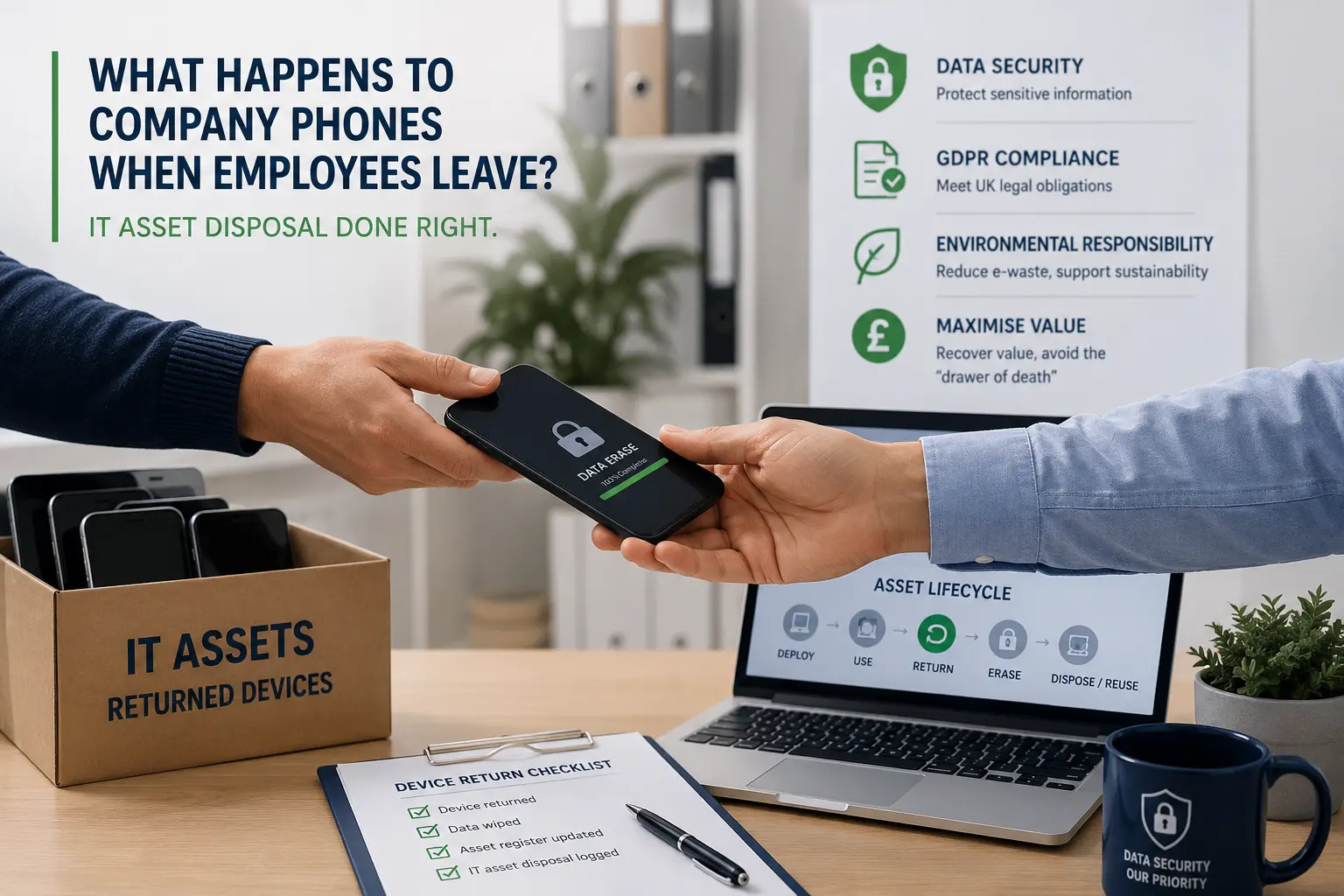
A UK IT and HR Guide to IT Asset Disposal
Picture this: an employee hands in their notice, and someone in IT — or perhaps HR — suddenly realises there is no clear process for what happens to the company phone. Who collects it? When? What happens to the data on it? Does it get reissued, stored, or disposed of? And if it is disposed of, how?
This scenario plays out in UK businesses every day, and it is more consequential than most organisations appreciate. Employee offboarding is one of the most common — and most overlooked — triggers for IT asset disposal obligations. When a device changes hands, it carries with it legal responsibilities around data security, compliance, and environmental duty of care that cannot be left to chance or an informal process.
With the average enterprise mobile device lifecycle sitting at around 3–3.4 years, businesses with growing teams are processing device returns constantly, not just occasionally. This guide covers everything a UK IT or HR professional needs to know: device return policies, data security, regulatory compliance, and the practical options for what to do with a phone once it comes back.
Why Employee Offboarding Is a Hidden IT Asset Disposal Trigger
Every time an employee leaves your business, a mini IT asset disposal event is quietly triggered. The device they have been carrying — loaded with emails, contacts, access credentials, and potentially sensitive client or business data — needs to be recovered, processed, and dealt with in a compliant, auditable way.
The challenge is that most businesses do not treat it this way. Without a formalised process, returned devices tend to follow one of two unhelpful paths: they either leave the building with the employee, or they end up sitting in a drawer, a stockroom, or a server room cupboard. Neither outcome is acceptable from a data security, compliance, or commercial standpoint.
Rapid smartphone depreciation makes inaction costly. Every month a returned device sits unprocessed, its residual resale value falls. For a business managing dozens or hundreds of devices across a refresh cycle, that cumulative loss is real and measurable.
The “Drawer of Death” Problem in UK Businesses
The phrase is informal, but the problem is entirely serious. Most IT teams are familiar with the accumulation of returned or otherwise unprocessed devices — phones that came back from leavers, spares from upgrades, handsets that were replaced but never formally decommissioned. They sit there, unregistered in any meaningful way, unwiped, unloved, and slowly losing value.
Research from the ICO makes clear that this is not just an IT problem — it is a deeply human one. The average UK adult holds around three unused devices, and 75% keep at least one old device rather than disposing of it. That behavioural tendency towards hoarding transfers directly into the workplace, particularly when there is no formal process to prompt action.
Those stockpiled devices carry a dual risk: they still hold sensitive company data, and they represent lost financial and ESG value with every passing month. The ICO also found that 14 million UK people do not know how to erase their data from an old device — which should prompt any IT leader to think carefully about whether “just wipe it before you hand it back” is a policy they can rely on.
Who Is Responsible — IT, HR, or Procurement?
Fragmented ownership is one of the most common reasons device offboarding falls through the cracks. In many UK SMBs and mid-market businesses, no single function owns the device lifecycle end-to-end. HR manages the leaver process. IT manages the hardware. Procurement may have sourced the devices originally. Finance tracks the asset register. But when an employee leaves, none of these functions has a clearly defined handoff point — and the result is gaps, delays, and exposure.
Defining Clear Ownership Across IT and HR Teams
In practice, responsibilities divide naturally along functional lines, and clarity here prevents the process from stalling. HR owns the offboarding timeline and should be responsible for triggering device return as part of the formal leaver checklist — ideally flagging to IT as soon as a leaving date is confirmed, not on the final day. IT owns device recovery, certified data sanitisation, and all downstream processing decisions. Procurement or Finance should maintain an accurate, up-to-date asset register that can be queried at any point.
These responsibilities should be documented formally rather than assumed — ideally referenced in the employee’s contract, IT acceptable use agreement, or a standalone device return policy.
What Should Be in Your Device Return Policy
A clear device return policy does not need to be lengthy, but it does need to cover the essentials. It should specify the return deadline — best practice is the final working day — and the expected condition of the device on return. It should set out what happens if a device is lost or damaged, including any financial implications. It should confirm that the business will arrange certified data erasure on returned devices and explain, briefly, what that means for the employee. Clarity in this policy protects both the organisation and the individual — and removes ambiguity at what can sometimes be a tense moment in the employment relationship.
Data Security When a Company Phone Changes Hands
This is where the stakes are highest. Under UK GDPR and the Data Protection Act 2018, organisations have a legal obligation to ensure the secure erasure or destruction of personal data when devices are retired or reassigned — and that obligation applies whether the disposal is handled internally or through a third party. If you use an external provider, due diligence on that provider is your responsibility.
Why a Factory Reset Is Not Enough
This is a misconception that persists across IT teams of all sizes, and it needs to be addressed directly. A factory reset does not securely erase data. It removes access to that data and makes the device appear clean, but the underlying data remains on the storage medium and can, in many cases, be recovered using widely available forensic tools. For corporate devices carrying business-critical data, personal information, or access credentials, this is not an acceptable standard.
Certified data wiping is a fundamentally different process. It overwrites the storage to a recognised technical standard — such as NIST 800-88, which specifies the exact methodology for secure media sanitisation — ensuring that data cannot be recovered. The distinction matters enormously in the context of UK GDPR compliance.
What Certified Data Wiping Actually Means
Certified data destruction produces a documented audit trail: a Certificate of Destruction that confirms which device was wiped, when, by whom, and to which standard. This certificate is the evidence an organisation needs to demonstrate GDPR compliance if queried by the ICO or during an audit. Standards to look for include NIST 800-88, ADISA, and ISO-aligned methodologies.
The importance of using qualified professionals for this process cannot be overstated. ICO data shows that 29% of UK adults do not know how to wipe a device. In a business context, that statistic translates to a serious risk if data erasure is left to individual employees or to IT generalists without specific ITAD expertise.
Mobile Device Management and Offboarding
Mobile device management (MDM) platforms play a useful supporting role in the offboarding process. An MDM system allows IT teams to remotely lock, wipe corporate data from, or unenroll a device before it physically returns — which matters particularly in situations where a device may not come back promptly, or where the circumstances of departure are sensitive.
Remote MDM wipe should be treated as an important operational safeguard, not a compliance solution. It is a useful first step in limiting data exposure, but it does not produce the audit-grade documentation that certified data destruction provides. For GDPR purposes, a Certificate of Destruction from a qualified ITAD provider remains the gold standard.
The Four Options for a Returned Company Phone
Once a device is back in IT’s hands and the data security question has been properly addressed, there are four practical paths forward. The right option depends on the device’s age, condition, and the business’s current requirements.
Option 1 — Redeploy to Another Employee
If the device is in good condition and still meets the performance requirements of its next intended user, redeployment is the most cost-efficient outcome. The process is straightforward: certified data wipe, factory reset post-wipe, MDM re-enrolment, and a hardware check to confirm the device is fit for issue. Redeployment extends the useful life of the device at zero additional hardware cost and is consistent with a circular IT approach.
Option 2 — Hold for Seasonal or Temporary Use
Some businesses maintain a pool of spare devices to support contractors, temporary staff, or seasonal surge periods. If a returned handset is going into this pool, it should still be wiped and enrolled in the asset tracking system — not simply placed in a drawer with a note attached. Maintaining proper records of pooled devices, including their condition and availability status, keeps this option auditable and operationally useful.
Option 3 — Trade In for Cash Recovery and Certified Data Destruction
For devices that are surplus to requirements, approaching end of life within the fleet, or part of a broader refresh cycle, a B2B trade-in is the most commercially sensible route. Trading in through a specialist platform like iGo Trade In enables businesses to recover residual value from devices that would otherwise sit depreciating, while simultaneously receiving certified data destruction and a Certificate of Destruction as part of the same process. For organisations with ESG reporting obligations, iGo Trade In also provides an impact report documenting carbon savings and e-waste diversion — making it a single-process solution for IT asset disposal at scale.
For IT Directors and Procurement leads managing larger device estates, the cumulative value across even a modest fleet is worth taking seriously. Rapid depreciation means the sooner devices are processed, the more value is recovered.
Option 4 — Responsible Recycling for Beyond-Repair Devices
Devices that cannot be reused or traded in must be recycled through a compliant route under the WEEE Regulations 2013. This is not optional, and it is not something that can be delegated informally. Businesses must use a registered waste carrier and retain a waste transfer note as proof of duty of care under the Environmental Protection Act. Devices should never enter general waste streams, and they should never be passed to an unverified third party. If in doubt about a provider’s credentials, check their Environment Agency registration directly.
UK Legal and Compliance Obligations You Need to Know
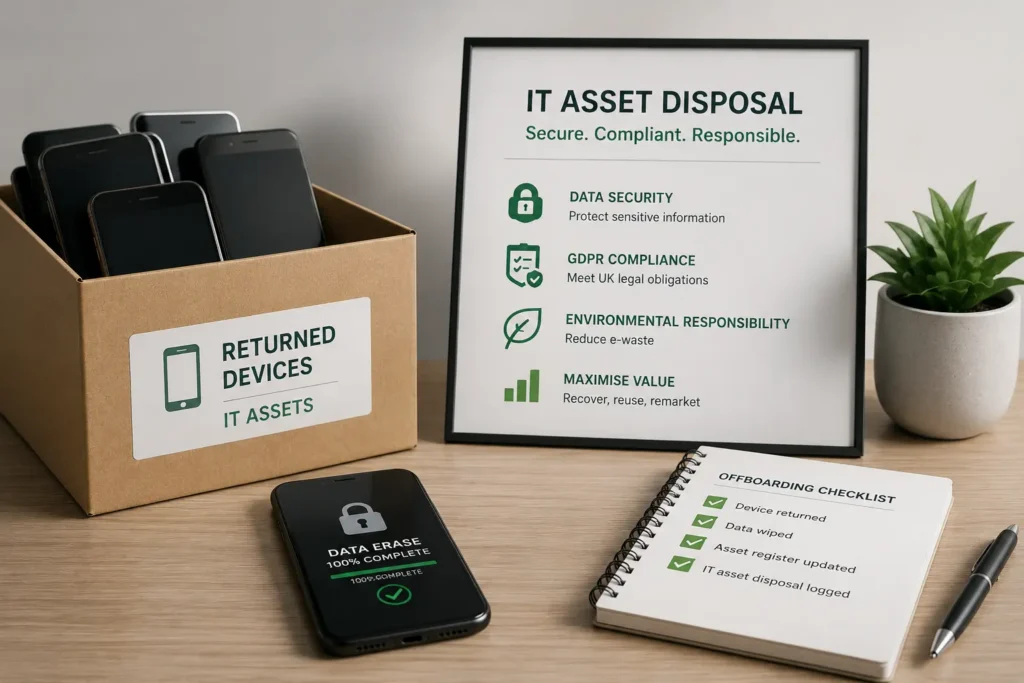
The regulatory landscape around IT asset disposal is not especially complex, but it does require some foundational understanding. Here is a practical summary of the obligations most relevant to UK businesses managing company phones.
UK GDPR and the Data Protection Act 2018
Under UK GDPR and the Data Protection Act 2018, personal data must be securely erased or destroyed before a device is reassigned or disposed of. This obligation applies equally to internal disposal and to third-party providers — and if you use a third party, you are responsible for verifying that they meet the required standard. The ICO has both investigative and enforcement powers, and demonstrable non-compliance — particularly where data has been compromised — carries material financial and reputational risk.
WEEE Regulations 2013 — When Does a Phone Become Waste?
Under the WEEE Regulations 2013, a device becomes waste when the business intends to discard it. This is an important legal distinction: under Environment Agency guidance, devices can remain classified as assets — not waste — if reuse is genuinely intended, documented, and the device requires only minimal repair. This classification affects which disposal route is legally appropriate and what documentation is required. Getting it right matters both for compliance and for the practical management of your device estate.
Duty of Care and Waste Transfer Documentation
The Environmental Protection Act places a duty of care on businesses to ensure that any waste they generate — including electronic devices — is handled responsibly. In practice, this means using licensed waste carriers, retaining waste transfer notes, and being able to demonstrate downstream compliance through an auditable chain of custody. Before handing any devices to an ITAD or trade-in provider, check that they hold the relevant Environment Agency registrations — including Upper Tier waste carrier, broker, and dealer status.
ADISA and ITAD Standards — What to Look for in a Provider
ADISA (Asset Disposal and Information Security Alliance) certification is one of the most widely recognised standards for IT asset disposal in the UK. An ADISA-certified provider will deliver certified erasure to a documented methodology, maintain a full chain of custody, and align with UK GDPR data controller obligations. When selecting a data destruction or trade-in partner, looking for ADISA certification — alongside NIST 800-88 and ISO-aligned processes — is a straightforward way to verify that the provider operates to a credible, auditable standard.
Building a Scalable Device Offboarding Process
Knowing what the obligations are is one thing. Building a repeatable process that reliably meets them is another. For IT Managers and IT Directors overseeing growing device estates, a structured offboarding workflow is not optional — it is the only way to ensure compliance and value recovery at scale.
Step-by-Step Device Offboarding Checklist
A practical device offboarding process follows a consistent sequence:
- HR confirms leaver date and notifies IT
- Device return is included in the formal leaver checklist
- IT initiates MDM remote lock or corporate data wipe
- Device is physically collected on or before the final working day
- Device is logged into the asset tracking system with condition noted
- Certified data destruction is arranged with a qualified provider
- Device is assessed for redeployment, trade-in, or responsible recycling
- Certificate of Destruction is received and filed
- Asset register is updated to reflect the device’s new status
This sequence is auditable, repeatable, and scalable. It works for a single device return and for a fleet of a hundred.
Asset Tracking — Knowing What You Have and Where It Is
You cannot manage what you cannot see. A maintained, up-to-date asset register — one that links every device to an employee, records its condition and age, and tracks its current status — is the foundation of effective device lifecycle management. Without it, offboarding becomes reactive, error-prone, and impossible to audit. An accurate asset register also makes it far easier to identify the right moment for a bulk trade-in, based on device age, fleet-wide condition, and the financial case for recovery.
Scaling Up — Managing Device Returns Across Larger Fleets
For businesses managing 50 or more devices in a refresh cycle, or navigating an office decommission or redundancy programme, ad hoc handling does not scale. Each device handled individually creates operational overhead, inconsistency, and compliance risk. Bulk trade-in through a structured platform is a more efficient model — iGo Trade In, for example, provides instant valuations, flexible logistics that scale from pre-paid courier boxes for smaller batches to dedicated van collection for larger volumes, certified data destruction, payment within 14 days, and an ESG impact report — all within a single process designed for corporate IT Asset disposal at scale.
The ESG Case for Getting Device Disposal Right
As ESG reporting becomes a standard expectation for UK businesses of all sizes, device disposal decisions have moved from an IT back-office concern to a boardroom one. The environmental impact of how you handle company phones is measurable, reportable, and increasingly scrutinised.
Every Reused Phone Saves Approximately 50 kg of CO₂
The environmental case for reuse over recycling is clear. Refurbishing a smartphone can save approximately 50 kg of CO₂ per device compared to manufacturing a new one, with the refurbishment process itself generating only 8–12 kg of CO₂. For a business with 100 devices in a refresh cycle, that represents a carbon saving of several tonnes — a material contribution to any Scope 3 emissions reduction strategy.
Circular IT and ESG Impact Reporting
A reuse-first approach to IT asset disposal is consistent with both the UK government’s own policy direction — the Greening Government ICT Annual Report explicitly prioritises reuse before recycling for ICT equipment — and with circular economy commitments increasingly embedded in corporate sustainability strategies. Trading in devices for refurbishment rather than sending them straight to recycling keeps materials in productive use for longer and generates quantifiable environmental benefits.
iGo Trade In provides an ESG impact report with every trade-in, giving businesses documented metrics on e-waste diversion and carbon savings that can be included in sustainability reports, disclosed to stakeholders, or presented to boards. For sustainability and ESG leads looking to demonstrate the environmental credentials of their technology decisions, this kind of reporting turns a routine IT process into a credible, evidence-based contribution to circular economy targets.
Summary — What Good Device Offboarding Looks Like
Good device offboarding is not simply an IT task. It is a cross-functional process with legal, financial, and environmental dimensions that span HR, IT, Procurement, and increasingly, Sustainability. When it works well, it starts before the employee’s final day, involves certified data destruction rather than improvised wiping, produces a documented audit trail, and ends with a decision that either recovers value or ensures compliant recycling. Businesses that get this right reduce their UK GDPR exposure, recover cash from depreciating assets, and build a credible ESG narrative around their technology estate — turning what is often treated as an administrative afterthought into a genuine source of commercial and reputational value.
Take the Next Step
With device refresh cycles averaging 3–3.4 years and device estates continuing to grow, a formalised offboarding process is not a nice-to-have. It is a compliance and commercial necessity.
If your business is managing a device refresh, fleet upgrade, or office decommission, iGo Trade In provides instant valuations, certified data destruction, flexible logistics, payment within 14 days, and ESG impact reporting — all in a single B2B trade-in process built for UK businesses.
Get a quote or explore the platform at igotradein.co.uk
Got devices to move on?
Get a valuation and trade in your business fleet with iGo Trade In — certified data erasure and an ESG impact report included.



Hello all, I signed up and wanted to introduce myself. I found this community while searching online and chose to sign up after looking over a few threads. There’s plenty of valuable information here, and it’s easy to see that many members have real experience. I’m excited to spending more time and eventually contributing. I have lately been reading about this lately.