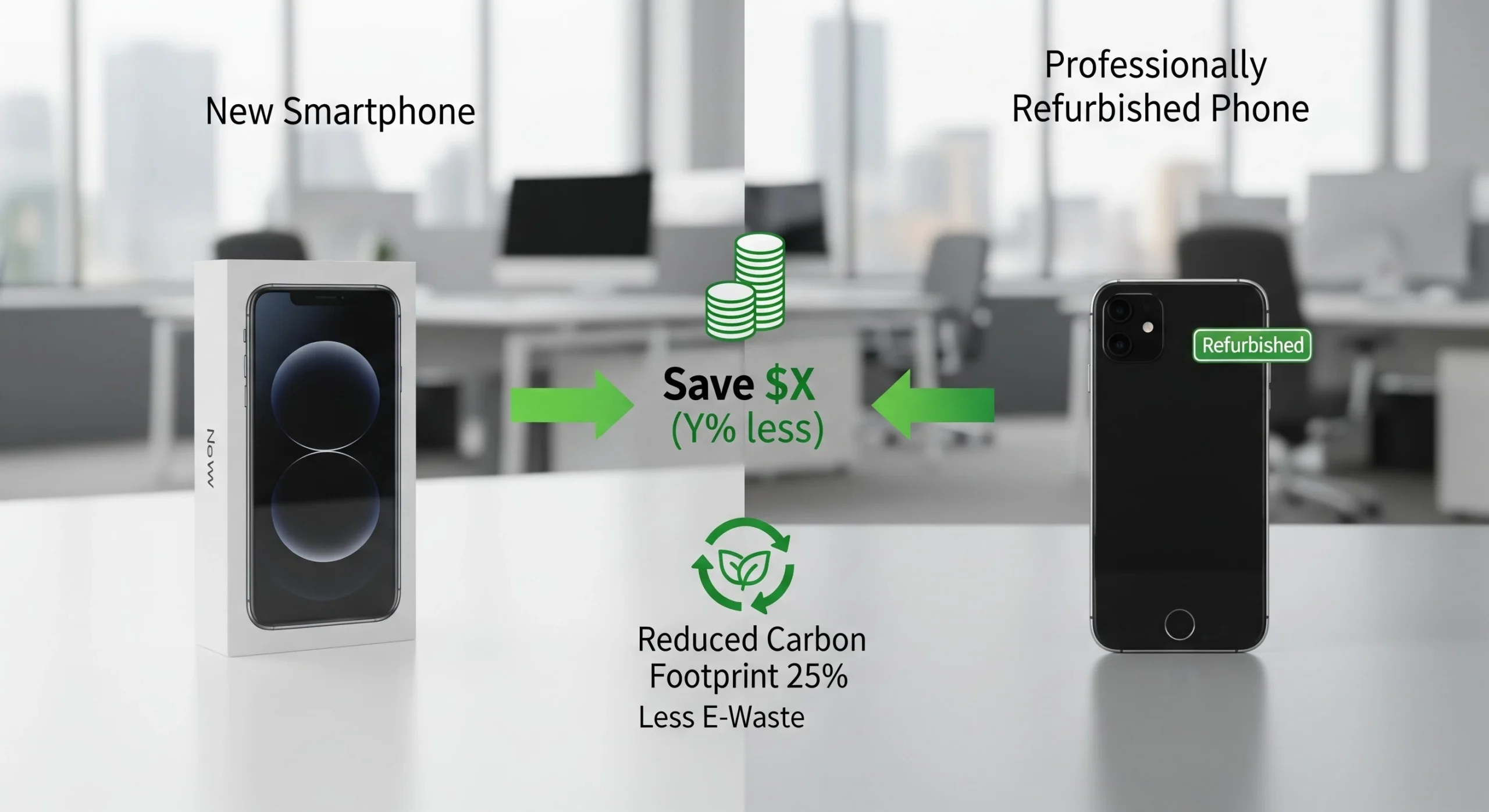
Refurbished vs New: Which Is the Better Business Buy?
One in four mobile phones sold in the UK in 2023 was second-hand or refurbished — and that figure is rising sharply. Vodafone UK reported an 83% increase in refurbished device sales, and UK consumers collectively saved £5.6 billion in 2024 by choosing pre-owned products, including electronics. The direction of travel is clear.
Yet many businesses still default to buying new as a matter of policy — not because the evidence supports it, but because it feels safer, more straightforward, or simply because it’s always been done that way. That assumption deserves scrutiny.
This article puts refurbished phones and new devices side by side across the dimensions that matter most to business buyers: cost, performance, longevity, sustainability, warranty, and compliance. Whether you’re an IT director managing a fleet refresh, a procurement lead evaluating TCO, or a sustainability officer under pressure to demonstrate measurable ESG progress, this comparison is designed to give you a clear, evidence-based answer — not a sales pitch.
What Does “Refurbished Phone” Actually Mean?
Before comparing options, it’s worth establishing what the term actually means — because it’s widely misunderstood, and that misunderstanding is one of the main sources of procurement hesitation.
Refurbished vs. Second-Hand Phone — What’s the Difference?
A second-hand phone is simply a used device sold as-is. There is no standardised testing, no quality assurance, and no formal repair process. You are buying whatever condition it happens to be in, with no meaningful accountability from the seller beyond consumer law basics.
A refurbished phone is a categorically different proposition. Before reaching the buyer, a properly refurbished device will have gone through a documented process: collection, cosmetic and functional inspection, certified data erasure, any necessary repairs, cosmetic grading (typically Grade A, B, or C), and repackaging. Grade A devices are generally in near-new condition with minimal or no visible wear. Grade B may show light cosmetic marks, but should be fully functional. Grade C typically shows more visible signs of use but remains operationally sound.
The critical caveat is that grading standards are not universally standardised across the industry. A “Grade A” from one supplier may not be equivalent to a “Grade A” from another. This inconsistency is a genuine pain point for procurement teams, and it underlines why the choice of supplier matters as much as the grading label itself.
Who Refurbishes Phones? (And Why It Matters)
Refurbished devices reach the market through several routes: trade-in programmes, ITAD (IT asset disposal) providers, network operators, and specialist refurbishers. For buyers focused on quality, the most reliable supply tends to come from corporate trade-in channels — devices returned mid-lifecycle, often well maintained and refreshed well before functional end-of-life. Understanding where a device has come from and how it has been processed gives procurement teams far greater confidence than buying blind from the secondary market.
Cost Comparison — Refurbished vs. New
Cost is usually the first question asked, and the data here is compelling.
How Much Cheaper Is a Refurbished Phone?
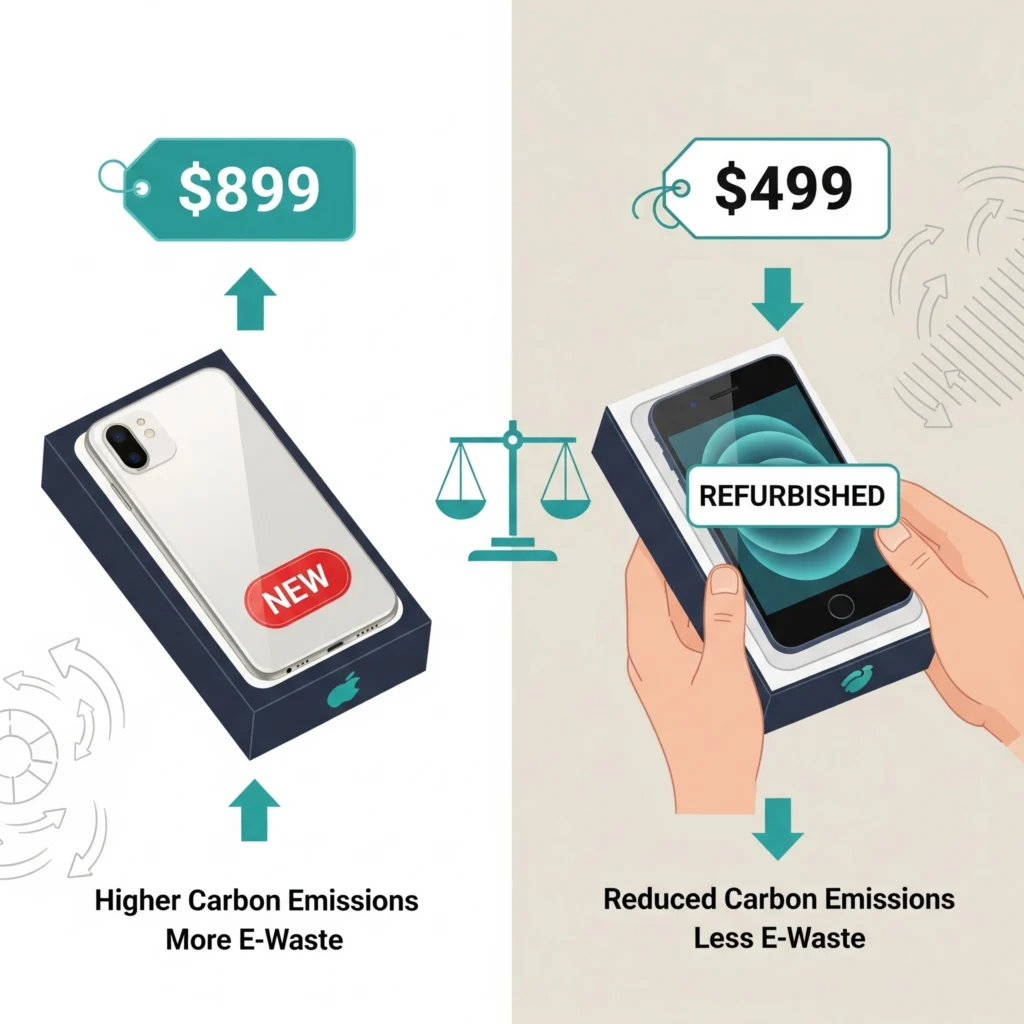
Refurbished smartphones typically cost 40–50% less than their new equivalents. A flagship device retailing at £800–£1,000 new might be available refurbished for £400–£600. For an individual buyer, that saving is meaningful. For a business procuring 100 devices, it is transformational — potentially £20,000–£40,000 recovered per refresh cycle before any other efficiency is factored in.
This is not a niche pattern. It reflects the scale of secondary market activity: approximately 45% of UK devices enter secondary markets via trade-in and resale channels, supporting a well-established supply of quality corporate handsets.
The Hidden Cost of a “New Devices Only” Policy
Businesses operating a new-only procurement policy face a compounding set of disadvantages that rarely feature in the original decision. Higher upfront CapEx per refresh cycle is the obvious one. But there are subtler costs: missed residual value recovery from outgoing devices, higher per-device environmental impact that worsens ESG metrics, and a procurement model that treats technology as disposable rather than as a managed asset.
The right framework here is total cost of ownership (TCO), not purchase price. When you factor in trade-in value recovery, extended lifecycle potential, and ESG reporting value, refurbished procurement frequently wins on a whole-life cost basis — and businesses operating new-only policies are often making a more expensive choice than they realise.
What About Depreciation and Residual Value?
New devices depreciate rapidly in their first 12–18 months — a well-documented characteristic of consumer electronics. Refurbished devices, having already absorbed that steepest portion of the depreciation curve, tend to hold their value more predictably over the remainder of their lifecycle. For IT asset managers who plan to trade in outgoing devices at the end of each refresh cycle, this matters for financial forecasting. A device that was bought refurbished at a lower price and retains its value more steadily throughout the deployment window is a better financial asset than one that was bought new and lost significant value before it ever left the box.
Performance and Reliability — Do Refurbished Phones Hold Up?
The most persistent objection to refurbished devices is the assumption that used means unreliable. The data does not support this — at least not for devices sourced through professional channels.
The Myth of the “Worn-Out” Refurbished Device
Enterprise devices are typically refreshed on a roughly three-year cycle — well before the end of the device’s functional lifespan. A smartphone returned after two to three years of managed corporate use generally retains substantial processing power, battery capacity, and usability. The “worn-out” narrative applies to genuinely end-of-life hardware; it does not describe a well-maintained handset entering a professional refurbishment programme after a standard refresh cycle. The device that ends up refurbished is often in better condition than most buyers assume.
What Quality Checks Should You Expect?
A credible refurbishment process should include full functional testing — touchscreen responsiveness, camera, audio, connectivity, and charging — alongside battery health assessment, cosmetic grading, operating system reset, and certified data destruction. If a supplier cannot clearly articulate their testing protocol or grading definitions, that is a meaningful red flag. For procurement teams buying at scale, asking for independent accreditations and documented processes should be standard practice, not an afterthought.
Software Support and OS Updates
This is a legitimate consideration, particularly for enterprise deployments. Older devices may be approaching the end of their manufacturer software support window, which has security and compatibility implications. That said, many devices entering the refurbished market mid-lifecycle still carry one to two years of active software support — sufficient for many deployment scenarios, particularly where devices are used for specific operational roles rather than as primary productivity tools. It is worth factoring software support timelines into procurement decisions, but it is rarely a dealbreaker for a well-chosen refurbished device.
Warranty and After-Sales Support
Warranty is a genuine differentiator, and buyers deserve a direct answer rather than vague reassurance.
What Warranty Comes With a Refurbished Phone?
New smartphones from major manufacturers typically carry a 12–24 month warranty. Refurbished devices are generally covered by the seller’s own warranty — commonly 12 months for reputable suppliers, and sometimes extending to 24 months from certified refurbishers. Importantly, the Consumer Rights Act applies to refurbished goods sold in the UK, providing buyers with legal protections on top of any seller warranty. For enterprise procurement, the practical questions to resolve before committing are: what does the warranty actually cover, what is the claims process, and what is the replacement or repair turnaround time? These are as important as the headline warranty duration.
Choosing a Supplier You Can Trust
Warranty quality is a direct reflection of supplier quality. Devices processed through professional, accredited refurbishment channels — with documented testing, grading, and certification — are far more likely to come with meaningful, enforceable warranty support than those sourced informally. For businesses buying at scale, the choice of supplier is not a secondary consideration: it is foundational to the quality of outcome.
Sustainability and Environmental Impact
This is where the case for refurbished devices becomes genuinely striking — and where the data moves from commercially interesting to strategically significant.
The Carbon Cost of a New Smartphone
Manufacturing a single new smartphone generates roughly 50–55 kg CO₂e. That figure encompasses raw material extraction, global supply chains, and energy-intensive production processes. For a business deploying 100 new devices, that represents over 5,000 kg of embodied carbon before a single device is switched on. Multiply that across an annual refresh cycle, and the environmental cost of a new-only policy becomes very difficult to defend.
How Much Does a Refurbished Phone Reduce Emissions?
The comparison is stark. A refurbished phone generates approximately 7.1 kg CO₂e over two years, compared to around 85.2 kg CO₂e for a new device over the same period — a reduction of roughly 90% in lifecycle emissions. Refurbished smartphones can also require up to 91% fewer raw materials than new devices. At enterprise scale, these figures represent substantive, measurable impact: analysis suggests that switching UK businesses to refurbished and remanufactured devices could reduce emissions by an estimated one million tonnes of CO₂ per year while saving approximately £1 billion annually. These are not marginal efficiency gains — they are board-level numbers.
Refurbished Devices as a Measurable ESG Lever
Organisations are increasingly choosing refurbished devices not just to control costs, but to demonstrate quantifiable progress against ESG commitments. Refurbished device adoption is becoming a traceable, reportable sustainability action — measurable in carbon saved, e-waste diverted, and raw materials preserved. For businesses that need to report on these metrics to boards, investors, or clients, having the supporting data is as important as making the decision.
This is where the practical and the strategic converge. When businesses trade in their corporate devices through iGo Trade In, they receive an ESG impact report as standard with every trade-in, documenting carbon savings and e-waste diversion metrics. That transforms a procurement decision into a reportable sustainability action — something that has genuine value well beyond the transaction itself.
GDPR, Data Security, and Compliance Considerations
For business readers, this section addresses one of the most common — and most legitimate — barriers to refurbished device adoption: what happens to the data on devices before they are reused or resold?
Why Data Security Is Non-Negotiable
Under UK GDPR, businesses are legally required to ensure the secure erasure or destruction of personal data before any device is reused, resold, or disposed of. The ICO is explicit: deleting files or performing a factory reset is not sufficient. Certified data wiping to recognised standards — such as NIST or ADISA — is required. Failure to comply can result in ICO enforcement action and significant financial penalties. The Data (Use and Access) Act, which received Royal Assent in June 2025, signals that regulatory expectations in this area are continuing to evolve, making documented compliance processes increasingly important rather than optional.
WEEE Regulations and the Reuse Pathway
Businesses must also navigate the Waste Electrical and Electronic Equipment (WEEE) regulations when managing outgoing devices. Under UK WEEE guidance, a device is only classified as waste if the holder discards it or intends to discard it. Equipment that is reused for its original purpose, requires minimal repair, and has a clear reuse market can legitimately avoid being classified as waste — preserving both its compliance status and its commercial value. This distinction matters practically: treating reusable devices as waste is simultaneously a missed financial opportunity and a potential compliance misstep. Duty of care applies across the handling chain, requiring authorised handling, documentation, and traceability at every stage.
What to Look for in a Trade-In or ITAD Partner
When selecting a partner for device disposal or trade-in, the compliance credentials of that partner are not a peripheral concern — they are central to your own legal exposure. Look for certified data destruction with a Certificate of Destruction provided as standard, documented audit trails, waste transfer notes, and registration as an authorised waste carrier with the UK Environment Agency. iGo Trade In, for example, is a registered Upper Tier waste carrier, broker, and dealer with the UK Environment Agency, and provides GDPR-compliant, certified data wiping alongside a full audit trail for every device processed — giving IT teams and compliance officers the documentation they need to evidence their compliance obligations.
Business Value Beyond the Device — Recovering Value from Your Existing Fleet
The question of whether to buy refurbished is only half of the picture. The other half is what happens to the devices you are replacing — and here, many businesses are quietly leaving significant value on the table.
Your Outgoing Devices Have Value — Don’t Waste It
When businesses upgrade their mobile fleet, outgoing devices are frequently stockpiled in storerooms, written off on the balance sheet, or sent for recycling without any attempt to recover their residual value. With approximately 45% of UK devices entering secondary markets via trade-in and resale channels, there is a well-established, active market for quality corporate handsets. Devices that have been regularly maintained and refreshed before functional end-of-life — as is typically the case in managed corporate environments — tend to command strong prices in the refurbished supply chain.
Trade-In as Part of Your Procurement Cycle
The most forward-thinking IT procurement teams are now integrating trade-in value recovery into refresh planning from the outset — treating expected residual value as a line item in the total cost of device ownership, rather than an afterthought. This approach reduces net CapEx per cycle, ensures outgoing devices are handled compliantly and traceably, and generates supporting documentation for ESG reporting.
iGo Trade In’s self-service B2B portal allows businesses to input their devices, receive instant valuations, and arrange collection — whether that’s a dedicated van for larger fleets or pre-paid courier boxes for smaller batches. Payment follows within 14 days, alongside a Certificate of Destruction and an ESG impact report. The process is designed to make value recovery as straightforward as the original procurement decision.
Are Refurbished Phones Right for Your Business?
When Refurbished Makes Clear Sense
The case for refurbished phones is particularly strong when budget efficiency is a priority without compromising operational performance; when the organisation needs to demonstrate measurable sustainability impact; when devices are being deployed in specific-use roles — field operations, temporary staff, secondary handsets — where cutting-edge specifications are not operationally necessary; or when procurement is happening at scale, and the 40–50% cost differential is significant. The headline advantages are consistent: meaningful cost savings, roughly 90% lower lifecycle emissions, compliance-ready sourcing when the right partner is chosen, and full warranty protection from reputable suppliers.
When New Might Still Be the Right Call
A balanced assessment requires acknowledging where new devices retain an edge. If the role demands the latest hardware specifications — advanced camera capability, highest-tier processing performance, or bleeding-edge connectivity — then new may be the appropriate choice. Similarly, where manufacturer warranty timelines and full software support windows from day one are operationally critical, or where devices will be subject to intensive use from the outset, new hardware may better serve the business case. The goal is matching the right device to the right requirement, not applying a blanket policy in either direction.
Key Questions to Ask Before Buying a Refurbished Phone for Business
Before committing to a supplier or a refurbished procurement strategy, these are the questions that should be answered clearly and in writing:
– What grading standard does the supplier use, and what does each grade specifically mean? Gradings are not standardised across the industry, so the definition matters.
– Is certified data destruction included, and will you receive a Certificate of Destruction? This is non-negotiable for GDPR compliance.
– What warranty is provided, and what is the claims process? Understand both the duration and the practical logistics of making a claim.
– Is the supplier a registered waste carrier authorised to handle WEEE? Check their Environment Agency registration.
– Can the supplier provide audit trails and documentation for compliance purposes? Waste transfer notes and asset disposition records should be available as standard.
– What happens to devices that cannot be refurbished? Responsible partners will recycle beyond-repair units with zero landfill — not simply discard them.
Conclusion
For the vast majority of businesses and procurement decision-makers, a refurbished phone is not a compromise — it is a well-evidenced, commercially sound, and increasingly strategic choice. The combination of 40–50% cost savings, approximately 90% lower lifecycle emissions, strong performance from professionally processed devices, and robust compliance when sourced correctly makes a compelling case that is difficult to argue against on pure merit.
The quality of the outcome depends heavily on the quality of the partner. Whether you are buying refurbished devices for your next fleet deployment or preparing to trade in your outgoing handsets, the credentials, processes, and documentation standards of whoever you work with will determine whether you realise the full potential of that decision — commercially, operationally, and in terms of ESG impact.
As reporting expectations rise and circular economy principles become embedded in procurement best practice, refurbished device adoption is moving from a cost-saving measure to a genuine competitive and reputational advantage. Businesses that build it into their strategy now will be ahead of where everyone else is heading.
If you are planning a device refresh and want to understand the value locked in your outgoing fleet, iGo Trade In’s B2B trade-in portal offers instant valuations, flexible collection, certified data destruction, and an ESG impact report as standard — making value recovery as simple as the upgrade itself.
Buying refurbished for your business?
Get a no-obligation quote for graded refurbished mobiles and tablets, backed by our Phonecheck 80-point testing and 12-month standard warranty.