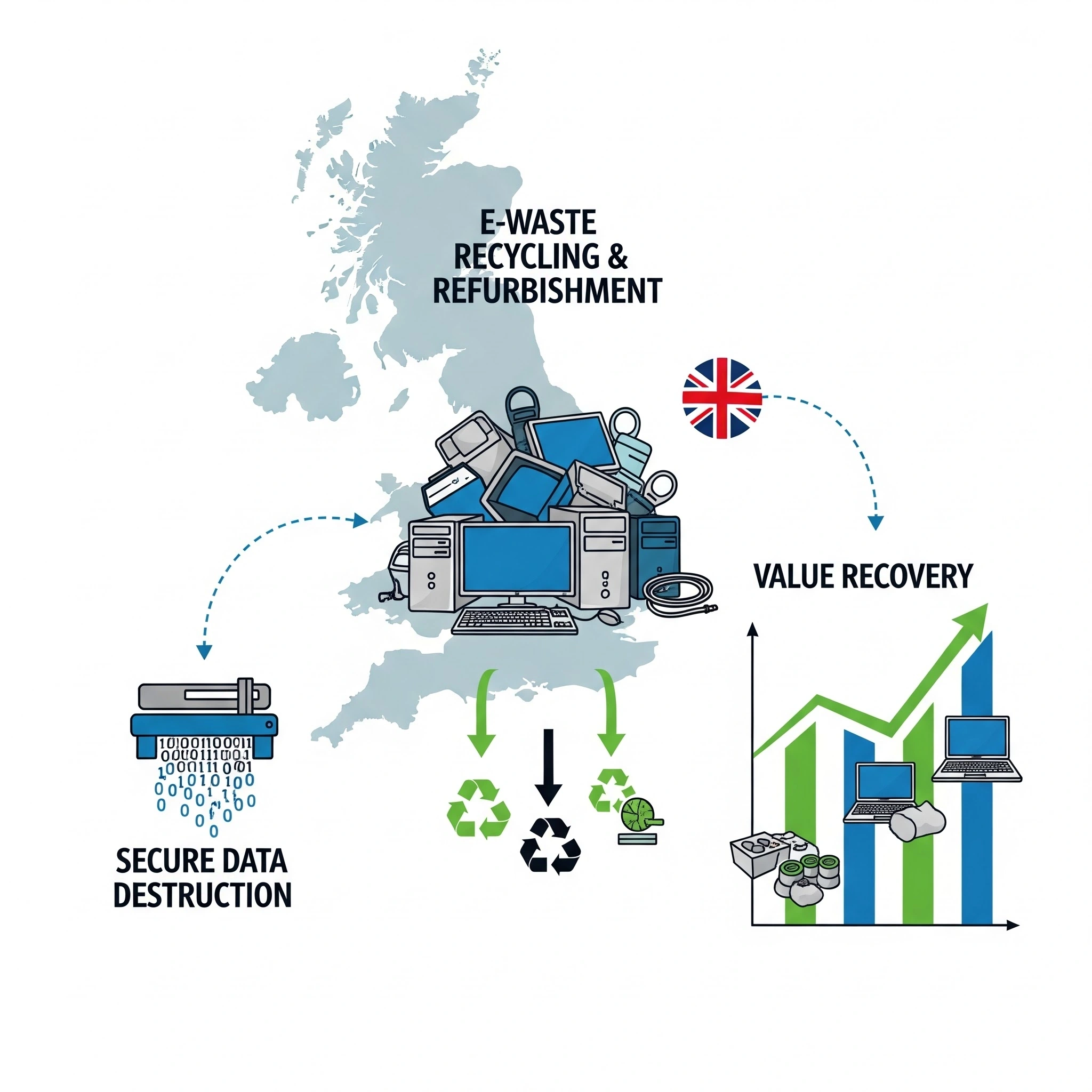
IT Asset Disposal: The Complete Guide for UK Businesses
The UK generates approximately 1.8 million tonnes of e-waste every year. Yet according to Material Focus data, formally collected volumes stand at around 496,000 tonnes — less than a third of what is actually generated. The gap is not a recycling infrastructure problem. It is a process problem: businesses are replacing devices faster than ever, driven by OS migrations, tightening security requirements, and accelerating fleet refresh cycles, but their approach to disposal rarely keeps pace with their approach to procurement.
For most organisations, device acquisition is a structured, documented process. Disposal, by contrast, often happens informally — old laptops stacked in a server room, smartphones handed back to HR, tablets written off and forgotten. The result is a growing pile of end-of-life assets that represent dormant financial value, live compliance risk, and a missed opportunity to contribute meaningfully to sustainability targets.
This guide is written for IT Directors, IT Asset Managers, procurement leads, and sustainability officers at UK businesses who manage device fleets and need a clear, practical understanding of what IT asset disposal actually involves, what the law requires, and how to do it well. Whether you are managing a 50-device refresh or a rolling programme across hundreds of endpoints, the principles are the same — and getting them right matters more than most organisations currently appreciate.
What Is IT Asset Disposal (ITAD)?
IT asset disposal — commonly referred to as ITAD — is the structured, compliant process of retiring business technology. It encompasses everything from initial asset identification and collection through to certified data destruction, value recovery or recycling, and the documentation that proves the whole process was handled correctly.
That last part is important. ITAD is not simply the act of getting rid of old equipment. It is a governed business process with legal obligations attached at multiple points — and those obligations fall on the organisation generating the waste, not just the contractor managing it.
What Falls Under ITAD?
The scope of assets covered by a professional ITAD programme is broad: laptops, desktops, servers, monitors, networking equipment, printers, peripherals, smartphones, and tablets. In practice, larger organisations tend to have formal processes for servers and desktops, but often manage smartphones and tablets far less rigorously — passing them through HR processes, allowing staff to retain personal devices, or simply accumulating them in storage.
This is a significant gap. Mobile devices frequently hold substantial quantities of corporate data — email accounts, authentication credentials, cloud-synced files, access tokens — and they often carry meaningful residual market value if processed promptly after a refresh cycle. Excluding them from a formal ITAD programme is both a compliance risk and a missed financial opportunity.
ITAD vs. IT Recycling — What Is the Difference?
Recycling is one possible outcome of ITAD. It is not the same thing, and conflating the two is one of the most common errors businesses make when planning device disposal.
Proper ITAD involves data sanitisation before anything else happens to the device, chain-of-custody documentation that tracks each asset from collection to final outcome, and value recovery through refurbishment and resale wherever the device condition permits. Recycling — breaking down physical components to recover raw materials — is what happens to devices that cannot be reused. It is the end of the road, not the whole journey.
Sending a batch of laptops to a recycling facility without verified data destruction and a documented audit trail is not compliant ITAD. It is, in effect, throwing something away with extra steps — and it leaves the disposing organisation with unresolved GDPR liability regardless of what the recycler does with the hardware.
Why IT Asset Disposal Matters for UK Businesses
The case for structured ITAD sits at the intersection of risk management and value recovery. Poor disposal creates legal exposure, financial leakage, and reputational damage. Handled well, ITAD recovers real money, supports ESG commitments, and demonstrates the kind of regulatory maturity that increasingly matters to clients, investors, and procurement frameworks.
The Scale of the Problem in the UK
The numbers establish the context clearly. The UK produces approximately 24 to 24.5 kilograms of e-waste per person annually — one of the highest rates anywhere in the world. Total generation reached roughly 1.8 million tonnes in 2025, a figure that has been rising steadily year on year. Meanwhile, the volume of electrical and electronic equipment placed on the UK market has grown by approximately 25% since 2018, with EEE volumes hitting their highest Q2 level since 2007 in 2024. Formal collection volumes, by contrast, have barely moved.
Within the business world, this pressure is being amplified by enterprise refresh cycles. The migration to Windows 11 — which has left a significant proportion of existing hardware below the minimum compatibility threshold — has accelerated bulk device replacement across UK organisations. The devices coming out of those cycles need to go somewhere, and the scale of what is entering the disposal pipeline is increasing.
The Hidden Cost of Doing Nothing
When organisations delay disposal decisions, they typically do so for understandable reasons: no one has time to deal with it, the resale value seems uncertain, or there is a vague intention to repurpose the devices internally. The problem is that delay has a real and measurable cost.
The secondary market window for smartphones and tablets is roughly 12 to 18 months before depreciation becomes steep. A business sitting on 200 smartphones after a fleet refresh — devices that might be valued at £80 to £150 each shortly after retirement — could find that value has halved by the time disposal actually happens. Multiplied across multiple refresh cycles and device types, this is not a trivial sum. There are also storage costs, the administrative burden of managing and accounting for assets that serve no operational purpose, and the compliance exposure that grows with every month those devices remain unprocessed.
The hidden asset pile is a real phenomenon in UK organisations, and most of the businesses sitting on one do not have a clear picture of what it is costing them.
UK Legal and Regulatory Framework for IT Asset Disposal
Understanding the legal landscape is not optional for anyone responsible for corporate ITAD decisions. Three distinct regulatory frameworks apply, and compliance with all three is required simultaneously. What follows is a plain-language summary of what each framework requires and why it matters in practice.
WEEE Regulations 2013 (as Amended)
The Waste Electrical and Electronic Equipment Regulations 2013, and their subsequent amendments, govern how businesses must handle the collection, treatment, and recycling of electronic waste. The central requirement for businesses is that IT equipment cannot be disposed of through general waste streams — it must be directed to Authorised Approved Treatment Facilities, known as AATFs.
Some categories of WEEE contain substances classified as hazardous waste, including persistent organic pollutants (POPs). These components require stricter handling procedures than standard electronics recycling, and failure to route them through appropriately licenced facilities creates direct legal liability.
Working with a provider that is registered with the UK Environment Agency as a waste carrier, broker, and dealer is a basic due diligence requirement under WEEE. Registration is not a marketing badge — it is the legal mechanism that permits an organisation to handle and process waste on behalf of others. Choosing an unregistered provider does not transfer liability away from the disposing business.
Duty of Care Under the Environmental Protection Act 1990
The duty of care established under the Environmental Protection Act 1990 means that a business generating waste remains legally responsible for it from the point of creation through to final disposal. Handing devices to a third party does not end this obligation — it transfers custody, not responsibility.
In practical terms, this requires businesses to use only registered waste carriers, to issue waste transfer notes for every disposal transaction, and to maintain documentation that demonstrates the waste was handled correctly at every point in the chain. If a device passed through your organisation and ends up being unlawfully disposed of by a downstream contractor, your organisation may still be held to account.
UK GDPR and the Data Protection Act 2018
For most IT Directors and IT Asset Managers, data protection is the most operationally pressing element of the ITAD regulatory landscape — and rightly so. Under UK GDPR Articles 5 and 32, personal data must be rendered irretrievable at end-of-life. The ICO’s guidance on secure disposal is explicit: secure wiping, degaussing, or physical destruction is required, and organisations must hold documented proof that these steps have been completed.
This is not a best practice recommendation. It is a legal obligation. A device disposed of without verified data destruction represents a potential breach of UK GDPR, regardless of whether the data is ever actually accessed by a third party. The fact that nothing bad happened afterwards does not retrospectively make the disposal compliant.
The Certificate of Destruction — a formal document issued by the ITAD provider confirming that data on each device has been rendered irrecoverable to a specified standard — is the primary evidence that closes this compliance loop. Without it, businesses cannot demonstrate to the ICO, to clients, or to a regulatory auditor that they met their obligations under Article 32.
Standards and Certifications to Look For in an ITAD Provider
Three standards are particularly relevant when evaluating ITAD providers for the UK market.
The ADISA IT Asset Recovery Standard is specifically aligned with UK GDPR and focuses on verified data sanitisation, chain of custody, and the auditability of ITAD processes. It is increasingly referenced within enterprise and public sector procurement frameworks, and its presence in a provider’s credentials is a meaningful indicator of operational rigour.
NIST 800-88, the US-origin data sanitisation framework, is widely adopted across the UK ITAD sector. It defines three levels of sanitisation — clear, purge, and destroy — and selecting the appropriate level based on device type and data sensitivity is part of what distinguishes professional ITAD from informal wiping.
ISO 27001, the international standard for information security management, is relevant when assessing a provider’s broader information governance posture, particularly for organisations handling high-sensitivity data.
What Is Changing — Regulation on the Horizon
Two upcoming regulatory developments are directly relevant to organisations planning their ITAD approach now.
DEFRA’s Digital Waste Tracking system is expected to roll out in October 2026. It will introduce mandatory, real-time tracking of waste flows across the UK, significantly increasing both the visibility and the accountability of the entire disposal chain. Businesses that currently rely on informal or loosely documented disposal processes will face meaningful compliance pressure once this system is live.
Scope 3 Category 12 emissions reporting is expected to become mandatory for many UK companies by 2027. This category covers end-of-life treatment of products sold or used by the business and will require organisations to quantify and report the carbon impact of device disposal. The vast majority of UK businesses currently have no data infrastructure to support this. Selecting an ITAD partner who provides structured ESG impact reporting is one of the most practical and immediate steps a business can take to start building that capability before the compliance window arrives.
Both developments are reasons to get ahead of the curve now rather than face a reactive scramble in 2026 and 2027. Structured ITAD is not just this year’s hygiene requirement — it is the foundation of a future-proofed compliance posture.
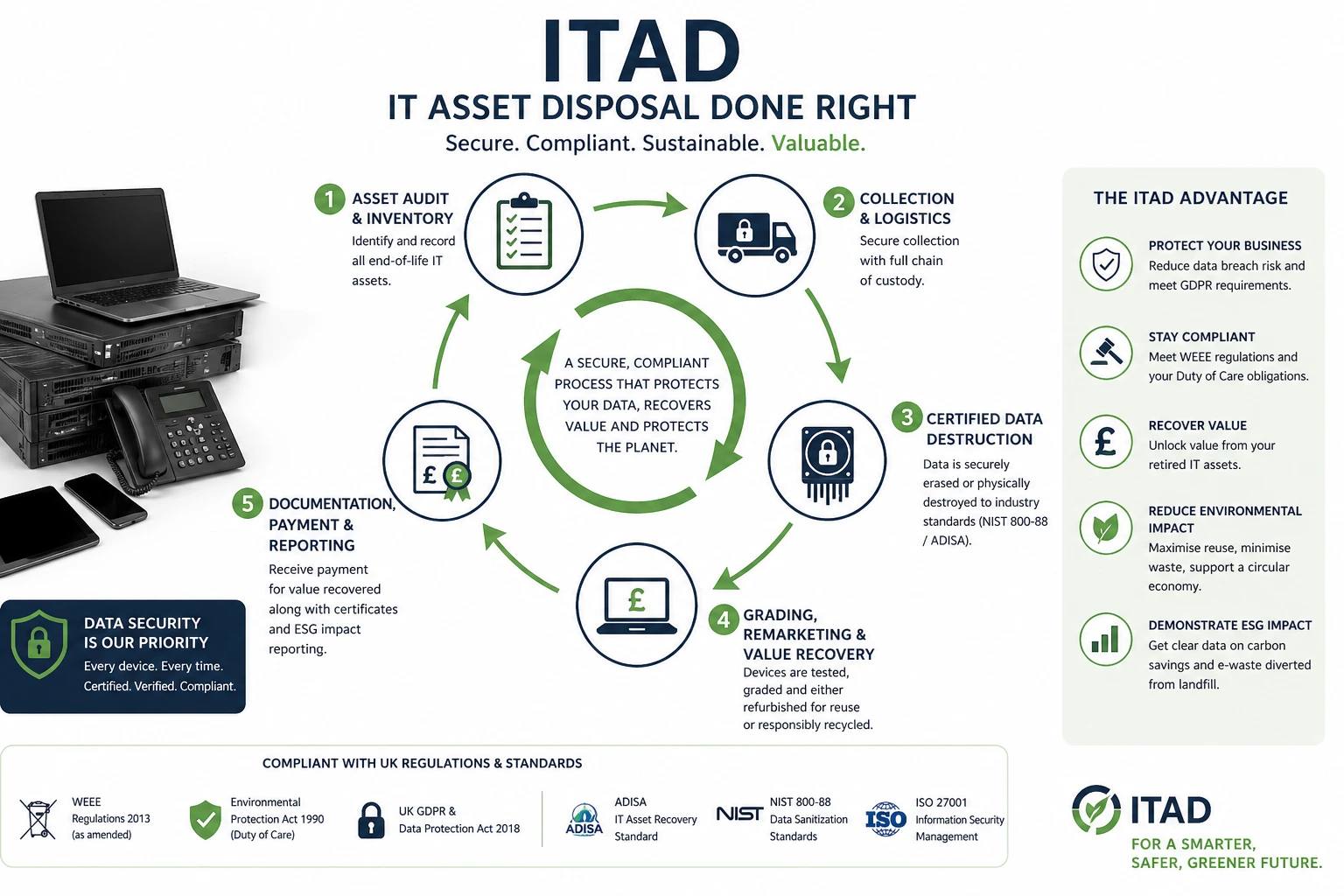
The ITAD Process — Step by Step
Understanding the regulatory requirements is one thing. Knowing what a professional ITAD programme actually looks like in practice is another. The following section walks through the key stages of a well-run end-to-end disposal process.
Step 1 — Asset Audit and Inventory
ITAD begins before a single device leaves the building. A proper audit establishes a complete inventory of assets reaching end-of-life: device type, model, serial number, age, condition, and any known data sensitivity. For organisations without accurate asset registers — a surprisingly common situation — this step alone surfaces significant compliance gaps.
It also frequently turns up devices that have been forgotten. Smartphones accumulated across multiple refresh cycles, tablets purchased for a project and never properly assigned, laptops stored in a back office after an office move — these devices carry both residual value and real compliance risk, and they cannot be managed if the organisation does not know they exist.
Step 2 — Collection and Logistics
For large-scale disposals, a dedicated van collection provides the most robust chain of custody, minimising device handling and keeping the audit trail clean from site to processing facility. For smaller batches, pre-paid tracked courier packaging achieves the same level of auditability at lower logistical cost.
What matters, regardless of fleet size, is that every device movement is documented. Informal channels — staff carrying devices home, ad hoc courier arrangements, unofficial drop-offs — introduce custody gaps that cannot be closed retrospectively.
Step 3 — Certified Data Destruction
This is the most legally critical step in the entire process. The appropriate destruction method depends on device type and data sensitivity. Software-based wiping to NIST 800-88 or equivalent standards is suitable for most devices. Degaussing is used for magnetic media where overwriting is impractical. Physical destruction — shredding or crushing — is applied where the risk profile demands it or where devices cannot be reliably wiped by other means.
Every device processed must generate a Certificate of Destruction. This document is the primary evidence that data has been rendered irrecoverable to a defined standard, and it is what allows a business to demonstrate GDPR compliance if challenged. Without it, the disposal process — however well-intentioned — is undocumented and therefore unprovable.
Step 4 — Grading, Remarketing, and Value Recovery
Once data destruction is confirmed, each device is assessed for condition and remaining market value. Devices suitable for reuse are refurbished and enter secondary markets — this is the highest-value outcome both financially and environmentally. Devices beyond economical repair are routed to AATFs for responsible recycling, with zero landfill as the target outcome.
The split between reuse and recycling will vary depending on device type, age, and the condition in which assets have been maintained. A good ITAD provider will be transparent about both outcomes, including what proportion of a disposal batch was successfully refurbished and what was recycled.
Step 5 — Documentation, Payment, and Reporting
The final stage brings together the commercial and compliance outputs of the process. Payment for recovered device value is typically made within an agreed timeframe — 14 days is the standard at the better end of the market. The Certificate of Destruction and a complete audit trail accompany this, providing the documentary evidence needed for GDPR and WEEE compliance.
Increasingly, businesses also receive ESG impact reporting as part of the process — quantified metrics covering carbon savings from device reuse, total e-waste diverted from landfill, and contribution to circular economy targets. This data is becoming essential for sustainability disclosures to boards, investors, and supply chain stakeholders, and it is something that only structured ITAD programmes are positioned to provide.
This is precisely the model that iGo Trade In delivers for businesses managing smartphone and tablet trade-ins at scale: certified data destruction, payment within 14 days, a Certificate of Destruction for every device, and ESG impact reporting included as standard. For businesses beginning to build the data infrastructure they will need for Scope 3 reporting, having a platform that generates these outputs automatically is a practical advantage, not just a nice-to-have.
Data Security in ITAD — What UK Businesses Must Get Right
Data security is consistently the highest-risk area of ITAD, and consistently the most misunderstood. IT Directors and IT Asset Managers carry personal accountability for data protection decisions within their organisations, and the stakes around end-of-life device handling are higher than many appreciate.
Why Retired Devices Are a Breach Waiting to Happen
Data does not disappear when a device is switched off, factory reset, or physically damaged. Standard factory resets do not render data irrecoverable — forensic tools can recover data from devices that appear to have been completely wiped. A smartphone that has been reset to factory settings and passed to a trade-in platform without verified sanitisation is not a clean device. It is a device whose data has been made slightly less accessible, which is not the same thing.
The ICO does not distinguish between intentional and negligent data exposure when assessing breaches. If a device disposed of without verified data destruction is later shown to have contained recoverable personal data, the disposing organisation is in a difficult position regardless of their intentions at the time.
What Certified Data Destruction Actually Means
There is a meaningful difference between verified, standards-aligned data sanitisation and informal wiping. NIST 800-88 defines three levels of sanitisation that apply to different device types and risk profiles. “Clear” involves logical techniques to overwrite data accessible through standard interfaces. “Purge” applies more targeted techniques to address recovery from more sophisticated forensic methods. “Destroy” renders the device physically non-functional and the data irrecoverable by any means.
ADISA certification provides an additional layer of assurance specifically relevant to the UK market and UK GDPR. It verifies not only the technical sanitisation process but the operational controls around the chain of custody and process auditability — which is what the ICO will look for if a disposal-related breach is investigated.
The Certificate of Destruction is the document that closes the compliance loop. It is the proof that sanitisation was completed, to what standard, on which specific devices, and at what point in time. Without it, organisations cannot demonstrate fulfilment of their obligations under Article 32 of UK GDPR. It is not a bureaucratic formality — it is the evidence base.
Building an Audit Trail
A complete chain-of-custody audit trail runs from the asset register through the collection manifest, data destruction certificate, and through to final disposal or remarketing confirmation. For organisations subject to regulatory audit, included in procurement frameworks that require data security evidence, or that face client due diligence requirements, this documentation trail is the difference between being able to demonstrate compliance and not being able to.
Businesses using informal or undocumented disposal routes may believe they are managing the risk because nothing has gone wrong yet. What they are actually doing is accumulating undocumented exposure that will be difficult to defend if it is ever tested.
ITAD and ESG — Turning Disposal Into Demonstrable Impact
The relationship between ITAD and environmental, social, and governance (ESG) reporting is growing rapidly in operational importance. IT leads who would not previously have thought of themselves as sustainability stakeholders are being asked to contribute data to sustainability disclosures, and the quality of that data increasingly depends on how well their ITAD processes are structured.
Why Reuse Beats Recycling on Carbon
Research published in Nature confirms that device reuse delivers significantly greater carbon savings than recycling alone. This matters for ITAD strategy because it means the timing of disposal decisions has direct environmental consequences — not just financial ones.
When businesses stockpile retired devices or defer disposal decisions, they are not being cautious. They are closing the window in which those devices could have been refurbished and reused, and therefore reducing the carbon saving the disposal event could have generated. Delay costs money through depreciation. It also costs carbon savings that cannot be recovered once a device’s reuse window has closed. Timely ITAD is a better environmental practice than delayed ITAD, even when both result in the same device eventually being processed.
What ESG Metrics Can ITAD Generate?
A structured ITAD programme run by a provider with appropriate reporting capability can generate a range of quantifiable ESG outputs: carbon savings per device reused versus recycled, total e-waste diverted from landfill across a disposal batch, reuse rates expressed as a percentage of total devices processed, and contribution towards circular economy commitments.
These metrics can feed directly into sustainability reports, board presentations, supply chain disclosures, and investor communications. Organisations that currently describe their disposal activity in vague qualitative terms — “we work with a responsible recycler” — will be under increasing pressure to replace that language with numbers. The businesses that have built structured ITAD reporting into their processes will be ready for that shift. Those that have not will be starting from scratch.
Preparing for Scope 3 Category 12 Reporting
Scope 3 Category 12 covers emissions associated with the end-of-life treatment of products sold or used by the business. When mandatory reporting requirements come into effect for many UK companies by 2027, organisations will need to quantify the carbon footprint of how their devices are disposed of — not just describe the process qualitatively.
Most organisations currently have no mechanism to capture this data at all. The practical solution is to ensure that the ITAD providers and platforms you work with are generating structured ESG impact data as a standard output of the disposal process. iGo Trade In includes carbon savings and e-waste diversion metrics with every trade-in as standard, which means that the data businesses will need for Scope 3 reporting is being built up automatically with each disposal cycle — without requiring any additional reporting infrastructure to be created from scratch.
Common ITAD Mistakes UK Businesses Make
Most organisations making disposal errors are not doing so through negligence. The problems tend to arise from process gaps, unclear ownership, and an underestimation of what proper ITAD actually involves. The following are the most consistently observed failure points.
Treating Recycling as Disposal
As established earlier in this guide, recycling is one possible outcome of ITAD — not a substitute for it. Routing devices to a recycling bin or an unapproved third party without prior data sanitisation is not compliant disposal. It also potentially breaches the duty of care under the Environmental Protection Act 1990 if the recipient is not an appropriately licenced waste carrier. The fact that the device is being “recycled” rather than thrown away does not resolve the data or regulatory obligations attached to it.
Delaying Disposal and Losing Value
The stockpiling problem is widespread and costly. Businesses accumulate retired devices over months or years, waiting for a convenient moment, a large enough batch, or someone to own the decision. During this time, resale value on smartphones and tablets depreciates at pace — the 12 to 18-month secondary market window is a meaningful constraint, not a theoretical one. Storage costs accrue. Compliance risk sits unresolved. And the carbon savings from reuse diminish with every month a viable device spends in a drawer rather than a refurbishment programme.
Getting ahead of disposal decisions — building it into the procurement and refresh cycle as a standard step rather than an afterthought — is the single most impactful operational change most organisations can make.
Choosing an ITAD Provider on Price Alone
The lowest-cost disposal option frequently represents the highest total cost once risk is properly accounted for. An unregistered provider, a contractor without ADISA or equivalent certification, or a service that does not provide a Certificate of Destruction may appear to offer a cheaper solution. What it is actually offering is an undocumented, non-compliant disposal process that leaves the contracting business holding the full weight of legal exposure.
The cost of a data breach, an ICO investigation, or a WEEE enforcement action will far exceed any saving made on the ITAD contract. Due diligence on providers should be a standard requirement: check Environment Agency registration, request evidence of relevant certifications, and treat the Certificate of Destruction as a non-negotiable deliverable, not an optional extra.
Overlooking Mobile Devices in ITAD Programmes
Smartphones and tablets are the category most commonly excluded from formal ITAD frameworks. They tend to be managed outside IT’s normal processes — returned through HR, passed between staff, or simply retained long after their operational usefulness has ended. This is both a data security risk and a value leakage problem.
Mobile devices often carry substantial volumes of corporate and personal data: email accounts, multi-factor authentication apps, cloud-synced documents, and access credentials. They also frequently hold meaningful residual market value, particularly in the 12 months following a fleet refresh. Any corporate ITAD policy that does not explicitly address mobile devices is incomplete, and the informal processes that typically fill the gap are not compliant substitutes.
How to Choose the Right ITAD Partner for Your Business
Not all ITAD providers are the same, and the gap between a credible, fully compliant partner and an informal operator presenting themselves as an equivalent service can be difficult to see from the outside. The following criteria provide a practical framework for evaluation.
Environment Agency registration is the baseline. Any provider handling your waste in the UK must be registered as a waste carrier, broker, and dealer. This is not optional and is publicly verifiable.
ADISA certification (or equivalent) provides specific assurance around data sanitisation, chain of custody, and UK GDPR alignment. For organisations with data-sensitive assets, it should be a requirement.
Certificate of Destruction must be issued for every device processed. If a provider cannot commit to this as standard, they should not be on your shortlist.
ESG reporting capability is increasingly relevant. Providers that can deliver quantified carbon savings, reuse rates, and e-waste diversion metrics are delivering something that has operational value beyond the disposal event itself — particularly as Scope 3 reporting requirements approach.
Logistics flexibility matters for operational practicality. A partner that can handle a van collection for a large fleet and a pre-paid courier arrangement for a smaller batch of mobile devices is far easier to work with across different disposal scenarios.
Transparency on outcomes — specifically, what proportion of devices are refurbished and resold versus recycled, and how payment is calculated — is a hallmark of a provider operating with genuine accountability. Where value is recovered, that value should be returned to the client with clarity on how it was calculated.
For businesses managing smartphone and tablet trade-ins as part of their broader ITAD programme, iGo Trade In is built specifically around this model: a self-service portal for instant valuations, flexible collection logistics, certified data destruction to NIST and ADISA standards, payment within 14 days, Certificate of Destruction, and ESG impact reporting included as standard. It sits within the broader iGo Life ecosystem, which also covers iGo Recycle — for secure collection and certified data destruction across a wider range of device categories — alongside iGo Fulfilment, which supports businesses sourcing certified refurbished hardware, and iGo Bespoke, which handles customised tech accessory bundles for fleets and deployments.
Getting Started: Building a Compliant ITAD Programme
For organisations that currently lack a structured approach, the place to start is straightforward. Audit what you have. Establish an accurate picture of devices reaching end-of-life across all categories — including mobile. Identify who currently owns the disposal process and where the gaps in documentation, authorisation, and coverage sit.
From there, the priority is policy: a clear, written ITAD policy that covers all device types, assigns responsibility, specifies the standards required of any third-party provider, and mandates the documentation outputs that GDPR and duty of care require.
Then select a partner that meets the criteria above and integrate disposal into the standard rhythm of your procurement and refresh cycles — so that it happens at the right time, in the right way, every time.
The businesses that will be best positioned in 2026 and 2027, when Digital Waste Tracking and Scope 3 reporting requirements arrive, are the ones that have already made structured ITAD a routine part of how they manage their device lifecycle — not the ones scrambling to retrofit compliance at the point a regulator asks for evidence.
Ready to start recovering value from your end-of-life devices while ticking every compliance box? Visit igotradein.co.uk to get an instant valuation on your business device fleet, or get in touch with the iGo Life team to discuss a managed ITAD programme built around your organisation’s specific requirements.