How to Recycle Old Phones & Electronics in the UK
Recycling your old phone sounds simple. Getting it right — securely, compliantly, and with maximum environmental benefit — takes a little more thought.
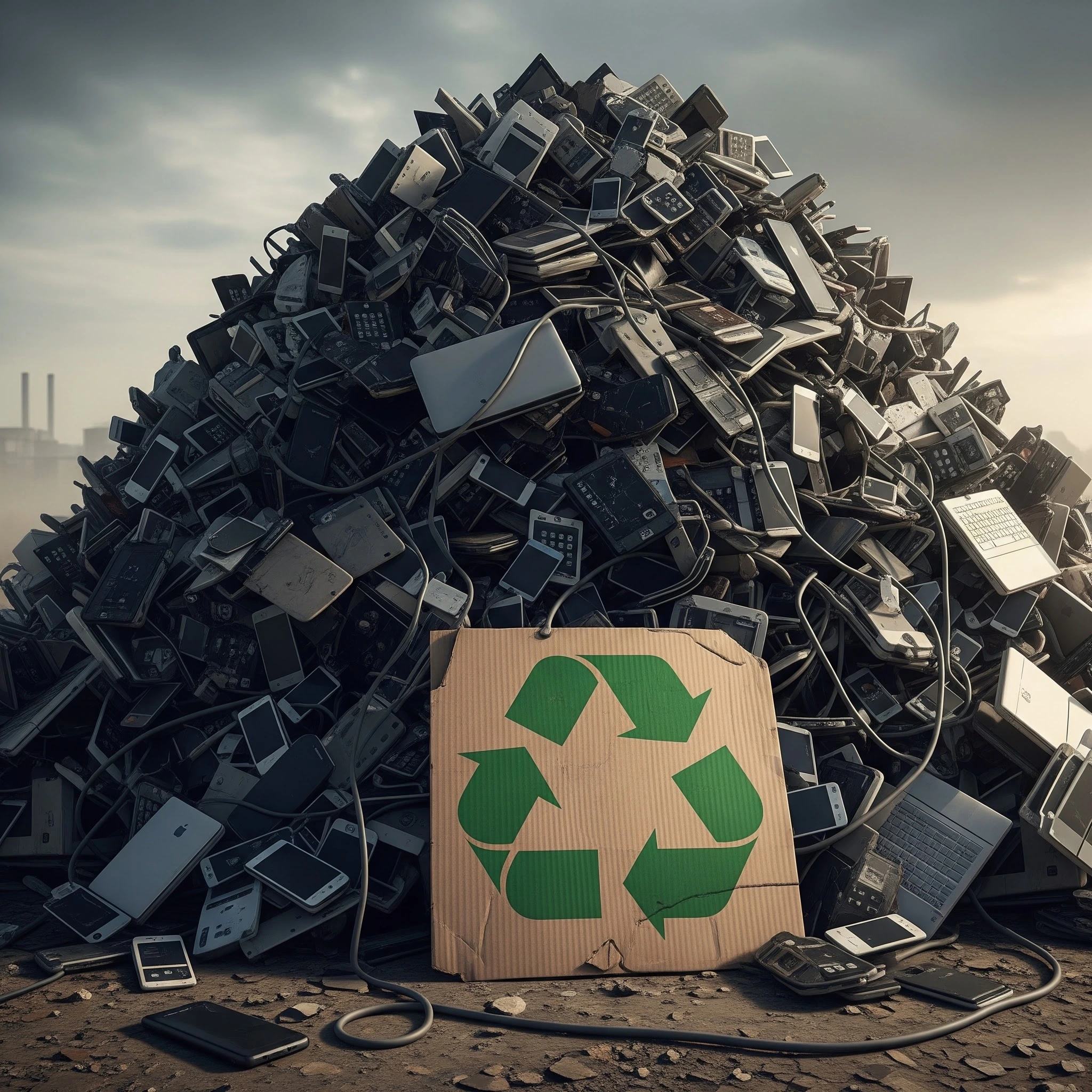
The UK generated approximately 1.8 million tonnes of electrical waste in 2025, yet formal WEEE collections remain stuck at around 496,000 tonnes. That gap is significant. Millions of old phones, tablets, laptops, and peripherals are sitting in household drawers and corporate IT stockrooms rather than entering the compliant, value-recovering recycling streams they should. For individuals, that represents a missed opportunity. For businesses, it represents a compliance risk, a depreciating asset, and an ESG reporting gap.
This guide covers both audiences. Whether you have a handful of old handsets to dispose of or you’re responsible for managing hundreds of corporate devices through a refresh cycle, the principles are the same: do it properly, protect the data, stay on the right side of the law, and recover as much value — financial and environmental — as you can.
Why Recycling Old Phones and Electronics Matters More Than Ever
The UK’s Growing E-Waste Problem
The numbers are striking. According to Environment Agency data, the UK generated approximately 1.8 million tonnes of WEEE in 2025 — a 6% increase year-on-year — which works out to roughly 23.9 to 24.5 kg of electrical waste per person annually. Against that backdrop, formal WEEE collections have barely moved: from approximately 493,000 tonnes in 2018 to just 496,000 tonnes in 2024, according to Material Focus data tracking the period. Estimates suggest that up to 40% of UK e-waste never enters a compliant recycling or reuse stream at all.
This is not a doom-and-gloom story for its own sake. It is a solvable problem — and one where individual and business decisions genuinely add up. Every device that enters a legitimate recycling or reuse stream is one fewer sitting in a landfill, a skip, or a storage room.
Why the Gap Is Growing
The structural reasons behind the recycling gap are worth understanding. Device volumes entering the UK market are rising faster than the collection infrastructure is adapting. On the enterprise side, refresh cycles are accelerating — driven by Windows 11 migrations, evolving hybrid working policies, and tightening security requirements. Consumer replacement rates remain high. The result is a growing mismatch: more devices entering end-of-life every year, with collection rates that have barely shifted in half a decade. Acting on old devices sooner rather than later matters, both environmentally and financially — devices depreciate quickly, and delayed action erodes the recoverable value.
What Counts as E-Waste? A Quick Explainer
Before exploring the practical options, it helps to be clear about the scope. WEEE — Waste Electrical and Electronic Equipment — is a broad category, and many people are surprised by how much of their tech falls under it.
The most relevant categories for this audience include smartphones and mobile phones, tablets and iPads, laptops and desktop computers, monitors and displays, keyboards, mice and peripherals, wearables and smart devices, and printers, scanners, and office tech. Even smaller battery-powered items — earbuds, smart speakers, handheld scanners — fall under WEEE regulations.
The key point is twofold. These items contain hazardous materials, including lead, mercury, and cadmium, which require careful handling to prevent environmental contamination. They also contain genuinely valuable recoverable materials — gold, silver, copper, and rare earth elements — which makes responsible recycling economically as well as environmentally worthwhile. Neither of these facts makes it appropriate to put them in the general waste bin.
How to Recycle a Phone — Your Options Explained
For individuals and smaller-scale needs, there are several legitimate routes available. Each has its trade-offs.
Trade-In Schemes (Retailers and Networks)
Manufacturer and network trade-in programmes — offered by major UK mobile networks and device brands — are accessible and reasonably convenient for individuals who want simplicity. You hand over the old device, receive a credit or payment, and the provider handles disposal. The downsides are real, however: valuations can vary significantly, transparency around what happens to the device is often limited, and you are unlikely to receive any formal documentation of data destruction. For personal use and peace of mind on a single handset, this route is acceptable. For anything more complex, it falls short.
Sell It Yourself (Marketplaces and Resale Platforms)
Platforms such as eBay, Gumtree, and specialist resale sites can yield the best financial return for individuals — provided the device is in reasonable condition, and the seller takes data security seriously. At minimum, a full factory reset is essential before any handset changes hands. It is worth noting that this is not technically a recycling route; it is a reuse route. From an environmental standpoint, that is actually preferable — more on the reuse versus recycling distinction below.
Drop-Off at a WEEE Collection Point
Local authority household waste recycling centres (HWRCs) and in-store take-back schemes operated by major retailers under their WEEE producer obligations offer a free and accessible option for responsible disposal. Many large electronics retailers in the UK operate take-back schemes under these obligations. The limitations are that you receive no financial return and, critically, no documentation confirming data destruction. For individuals with devices containing no sensitive data, this is a legitimate option.
Postal Recycling and Freepost Schemes
Organisations such as Material Focus run the Recycle Your Electricals campaign, and various charities offer free-post recycling services for small items. This is a low-effort option for disposing of minor electronics, though the same caveats apply: no financial return and no data security assurance. Fine for a broken set of wireless earbuds; not suitable for a smartphone that has been used for banking or personal communications without a verified wipe.
Specialist ITAD and Trade-In Partners (Best for Businesses)
For businesses managing multiple devices, none of the above options is adequate. Specialist IT Asset Disposal providers and B2B trade-in platforms exist precisely to address the compliance, data security, logistics, and financial recovery requirements that corporate device disposal demands. This is explored in detail in the business-facing section below.
Before You Recycle — Data Security Comes First
This is the part that most guides underplay, and it deserves proper attention. Handing over a device without correctly handling the data on it is a serious risk — and under UK GDPR, it carries real legal consequences for businesses.
What the ICO Says About Device Disposal
The ICO’s disposal and deletion guidance is explicit about what organisations are required to do. Businesses must have documented disposal processes, secure storage arrangements prior to destruction, audit logs of devices and access, and verifiable destruction methods. The ICO recognises certified wiping, degaussing, and physical destruction as appropriate methods.
Failure to meet these requirements can constitute a breach of Articles 5 and 32 of UK GDPR — the provisions covering data integrity and security. The Data (Use and Access) Act, which came into effect on 19 June 2025, is prompting updated ICO guidance in this area, so organisations that have not reviewed their disposal processes recently should do so.
What Individuals Should Do
The steps for personal devices are straightforward. Back up your data to the cloud or local storage first. Sign out of all accounts, including your Google account or Apple ID, depending on the device. Perform a full factory reset. Remove the SIM card and any memory cards before handing the device over. A factory reset is generally sufficient for personal devices heading to legitimate recyclers — but it is not a certified or auditable process, which matters in a business context.
What Businesses Must Do
For corporate devices, the stakes are considerably higher. A factory reset is not sufficient. Businesses should use certified data wiping tools aligned to recognised standards — NIST 800-88, ADISA, or equivalent — and obtain a Certificate of Data Destruction from their chosen provider. One point the ICO guidance emphasises that is often overlooked: much of the compliance risk sits in how devices are *stored before disposal*, not just in the destruction step itself. A stockroom full of retired handsets and laptops with no access controls, no audit log, and no destruction timeline is a live data risk. Addressing the IT graveyard problem is not just an operational convenience — it is a GDPR obligation.
Understanding UK Regulations Around Electronics Recycling
WEEE Regulations — What They Mean for Businesses
Under UK WEEE regulations, businesses have a legal duty to ensure electrical waste is disposed of via authorised channels. Manufacturers and importers finance recycling through registered compliance schemes, but the duty of care for proper disposal sits with the business generating the waste. Evidence from GOV.UK guidance notes that recovery rates above 90% are achievable when devices enter compliant streams — the gap in practice is largely a function of devices never reaching those streams in the first place. Using an unlicensed carrier or an informal route is not a grey area; it creates clear legal exposure.
Duty of Care Under the Environmental Protection Act
Businesses are legally responsible for the safe handling, storage, and transfer of electrical waste under the Environmental Protection Act. In practice, this means using only licensed waste carriers, maintaining waste transfer notes, and being able to demonstrate a documented chain of custody from device retirement to destruction or resale. Always verify that your chosen ITAD or recycling partner is a registered waste carrier with the UK Environment Agency before engaging them.
Workplace Recycling Rules (England, March 2025)
From 31 March 2025, mandatory separation of recyclable waste streams applies in England — including electricals, where applicable. Businesses should ensure their internal waste management processes reflect this requirement.
Reuse vs. Recycling — Which Is Actually Greener?
There is a common assumption that recycling is the responsible endpoint for an old device. The reality is more nuanced, and understanding it leads to better decisions.
Recycling recovers materials from a device — metals, plastics, glass — but it cannot recover the energy and resources already embedded in the product itself. Reuse avoids the need to manufacture a replacement in the first place. Peer-reviewed research published in 2025 confirms that extending smartphone life through reuse delivers significantly greater carbon savings than recovering raw materials through recycling alone. The environmental cost of manufacturing a new device — mining, processing, assembly, and shipping — is substantial and largely irreversible once incurred.
The practical implication is clear: always explore whether a device has residual value and can be refurbished and reused before defaulting to recycling. For businesses, this means choosing trade-in partners who actively grade, refurbish, and resell devices rather than simply processing them for material recovery. Devices fit for reuse should be reused; only those beyond viable repair should enter material recovery streams. And zero to landfill should be the baseline expectation from any credible provider — not a differentiator.

How Businesses Should Approach Electronics Recycling at Scale
The Problem With Ad-Hoc Recycling in Corporate Environments
The picture is a familiar one in many organisations. Devices accumulate in IT cupboards and storage rooms following a refresh cycle because there is no clear internal process, data security feels uncertain, and no one is quite sure what the devices are worth or who is responsible for them. This IT graveyard problem is both common and costly. Devices depreciate quickly, meaning that delayed action directly reduces recoverable value. The compliance risk of unmanaged stored devices is real, as the ICO guidance makes clear. And flat WEEE collection rates against rising device volumes suggest that a substantial proportion of corporate devices never enters compliant streams at all.
What a Compliant, Value-Recovering Process Looks Like
A well-managed approach to corporate device disposal involves several interconnected elements. It starts with a proper audit and inventory — knowing exactly what devices you have, their condition, and their approximate age before they leave your hands. From there, certified data destruction to NIST 800-88, ADISA, or equivalent standards is non-negotiable, with full documentation and auditability. Logistics should match the scale of the operation: a dedicated van collection for a large fleet refresh, or pre-paid courier boxes for a smaller batch. Financial recovery should be built in from the start, with clear valuations and payment within an agreed timeframe. Compliance documentation — a Certificate of Data Destruction, waste transfer notes, and confirmation of an Environment Agency-registered carrier — should be standard outputs, not optional extras. And increasingly, ESG impact data is a business requirement in its own right: carbon savings, e-waste diversion metrics, and reuse versus recycling rates for stakeholder and board reporting.
When to Use a Specialist B2B Trade-In Partner
For businesses that need to manage device disposal compliantly and at scale, a specialist B2B trade-in platform is the logical solution. iGo Trade In offers exactly this: a self-service portal where businesses can input their devices, receive instant valuations, and have the entire process managed end-to-end. Collection is handled via dedicated van for larger fleet refreshes or pre-paid courier boxes for smaller batches. Data wiping is certified and compliant. Payment is made within 14 days alongside a Certificate of Destruction. Every trade-in includes an ESG impact report covering carbon savings and e-waste diversion. Devices fit for reuse are refurbished and resold; those beyond viable repair are responsibly recycled with zero landfill. iGo Trade In is a registered Upper Tier waste carrier, broker, and dealer with the UK Environment Agency — so the compliance chain of custody is fully covered.
ESG Reporting and the Growing Demand for Auditable E-Waste Data
The expectations around what businesses must demonstrate about their device disposal practices are changing. A disposal confirmation is no longer enough. Boards, investors, supply chain partners, and clients are asking for verifiable data: how much e-waste was diverted from landfill, what carbon savings were achieved, and what proportion of devices entered reuse versus material recycling streams. As sustainability disclosures become more standardised and more scrutinised, the ability to produce this data on demand is shifting from a nice-to-have to a procurement and reporting requirement.
The problem is that most common recycling routes simply cannot provide it. Retailer take-back schemes, HWRC drop-offs, and postal recycling services are not set up to deliver auditable ESG metrics. Choosing a provider that delivers a formal ESG impact report alongside compliance documentation is increasingly a differentiator in procurement decisions — and a practical requirement for organisations with sustainability commitments to report against.
Quick Checklist — Recycling Electronics the Right Way
For individuals:
– Back up data and sign out of all accounts
– Perform a full factory reset
– Remove SIM and memory cards
– Choose a legitimate WEEE-compliant route — retailer take-back, HWRC, or a reputable postal scheme
– Consider selling or trading in if the device is in working condition
For businesses:
– Audit and inventory devices before disposal
– Use only registered, licensed waste carriers
– Insist on certified data destruction and a formal Certificate of Data Destruction
– Choose a provider who actively reuses and refurbishes — not just recycles
– Request ESG impact data: carbon savings, reuse rates, and e-waste diversion figures
– Retain waste transfer documentation for compliance purposes
Conclusion
Recycling old phones and electronics in the UK is not just an environmental gesture. It is a legal responsibility, a data security requirement, and — for businesses — a genuine financial and reputational opportunity. The gap between how much e-waste the UK generates and how much is properly handled is large and growing. Every device handled correctly: securely wiped, graded for reuse where possible, and responsibly recycled where not, closes that gap a little further.
For individuals, the ask is straightforward — do not leave old devices in a drawer. Even a single handset contains materials worth recovering and, potentially, data worth protecting. For businesses, the opportunity is greater. A managed, compliant, value-recovering approach to device disposal turns an operational burden into a recoverable asset, a documented compliance position, and a measurable ESG outcome.
If your organisation is approaching a device refresh cycle, managing an ongoing fleet, or simply sitting on a stockpile of retired handsets that have never been formally processed, iGo Trade In is built for exactly that. Visit igotradein.co.uk to get an instant valuation and start recovering the value — financial, environmental, and reputational — that is currently sitting unused in your IT cupboard.