
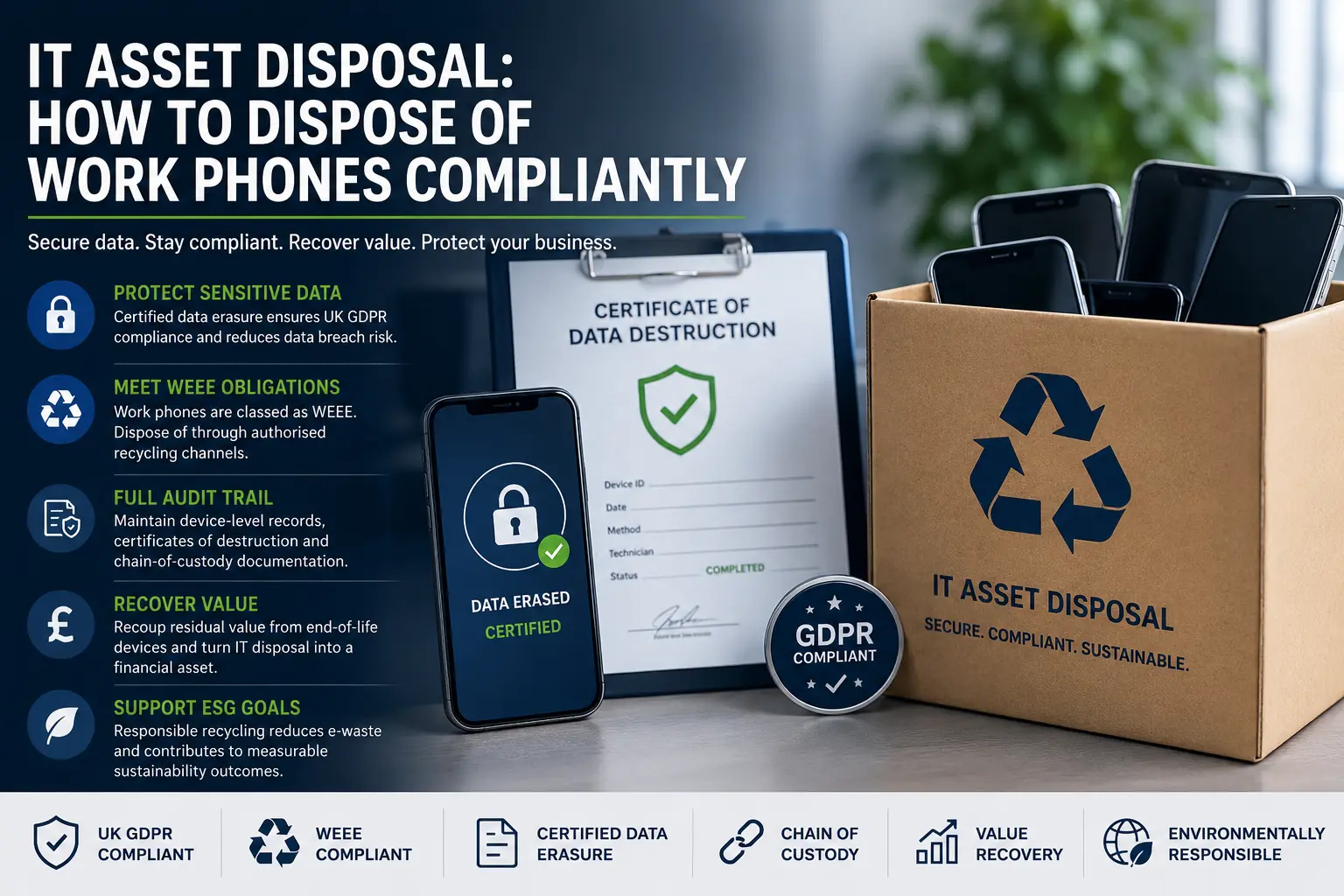
According to WRAP estimates, around 25 million mobile phones are discarded in the UK every year. For consumers, that figure represents a recycling challenge. For UK businesses, it represents something more specific: a compliance obligation that is frequently misunderstood, routinely delayed, and — when handled incorrectly — quietly expensive.
Every work phone that leaves service carries with it a set of legal responsibilities that do not disappear when the device is switched off or placed in a storage cupboard. Personal data stored on that handset remains subject to UK GDPR. The device itself is classified as WEEE — waste electrical and electronic equipment — and must be disposed of through authorised channels. And the business that originally owned it retains a duty of care throughout the entire disposal chain, regardless of who physically handles the device.
This guide is written for IT managers, procurement leads, and business owners who need clear, practical answers to those obligations — not abstract compliance theory. It covers what UK GDPR actually requires when disposing of devices that hold personal data, what certified data erasure looks like in practice, what WEEE recycling obligations apply to UK businesses, how to identify a trustworthy IT asset disposal partner, and how responsible device disposal can recover residual financial value while contributing to measurable ESG outcomes.
The central message is straightforward: compliant IT asset disposal is not as complicated as many businesses assume, but it does require doing things in the right order, with the right partner, and with the right documentation in place.
Why Work Phone Disposal Is a Bigger Risk Than Most Businesses Realise
The Compliance Paradox: Delay Makes It Worse
There is a counterproductive cycle that many IT teams fall into when it comes to end-of-life devices. Devices are held back from disposal because the team is uncertain about how to handle the data securely. That uncertainty is entirely reasonable — but the response to it often compounds the very problem it is trying to avoid.
A device sitting in a drawer or storeroom still holds its data. It still represents an unresolved GDPR obligation. It is still depreciating in value, often rapidly given that UK businesses typically refresh their mobile fleets every three to four years. And it is still present in the business’s asset register — or worse, absent from it — creating audit gaps that are difficult to resolve later.
The longer the delay, the worse the problem becomes on every dimension: financial, compliance, and operational. Addressing it properly — with a certified, documented process — resolves all of these simultaneously.
Old Devices Are Both a Liability and an Asset
There is a dual nature to end-of-life corporate devices that is easy to overlook. On one side, a handset that still holds unwiped business data — employee records, customer information, email credentials, app-stored logins — represents a live GDPR liability. It does not matter that the device is no longer in active use. The data remains, and the obligation to protect it remains with it.
On the other side, that same device often retains meaningful commercial value. Smartphones that have been in service for three to four years are still traded actively in the secondary market, particularly when they have been maintained in reasonable condition. Handled correctly, IT asset disposal converts a compliance obligation into both a financial recovery and a sustainability opportunity — turning liability into value rather than simply eliminating risk.
UK GDPR and Work Phone Disposal: What the Law Requires
What UK GDPR Says About Data on End-of-Life Devices
Under UK GDPR, organisations have a legal obligation to ensure that personal data is securely erased or destroyed when the devices holding it are retired from service. This applies to any device that has ever held personal data — which, in a corporate context, means practically every work phone ever issued. Employee records, business emails, contacts, calendar data, app credentials: all of it counts.
The obligation does not disappear because a device has been decommissioned, because it has not been used in months, or because it is physically locked in a cabinet. The data is still there, and the business is still responsible for it. The Data (Use and Access) Act 2025 reinforces the UK’s data governance framework and the ICO’s continuing role in enforcing those standards — making clear that data handling obligations apply throughout the entire lifecycle of a device, not just during active use.
The Accountability Principle — You Must Be Able to Prove It
One of the most important and most frequently overlooked aspects of UK GDPR is the accountability principle. Under this principle, it is not sufficient to simply claim that data has been wiped. Organisations must be able to demonstrate it. That means maintaining documented evidence of what was done to each device, by whom, using what method, and when.
For businesses disposing of dozens or hundreds of devices at once — during a fleet refresh, an office decommission, or a technology upgrade cycle — this requirement becomes especially critical. The audit trail must be device-level, not batch-level. A general statement that devices were wiped will not satisfy an ICO inquiry. What is required is granular documentation: certificates of data destruction, chain-of-custody records from collection through to processing, and asset-level reporting that can be produced on demand.
Businesses that cannot produce this documentation are not just exposed to regulatory risk — they are also unable to demonstrate compliance to their own board, their clients, or any third party that requires assurance around data handling practices.
What Counts as Adequate Data Erasure Under UK GDPR?
This is where a common and costly misconception needs addressing directly. A factory reset does not constitute secure data erasure. Restoring a device to its default settings removes visible data from the user interface, but it does not overwrite all stored data at the storage level. Forensic recovery tools can, in many cases, retrieve data from a device that has only been factory reset — which means a business that hands over factory-reset devices to a disposal partner (or to a secondary buyer) has not met its UK GDPR obligations.
Certified data erasure is a different process entirely. It uses specialised software to overwrite data to a defined standard — typically aligned with NIST 800-88 guidelines — and generates a device-level verification record confirming that the process was completed successfully. The ICO recognises ADISA (the Asset Disposal and Information Security Alliance) as a valid certification framework for IT asset disposal providers. ADISA-certified processes involve documented, tested erasure tools, verification at the individual device level, and formal reporting — providing exactly the kind of audit trail that the accountability principle demands.
For devices that cannot be reliably wiped through software — severely damaged hardware, locked devices, or those with non-functional storage — physical destruction such as shredding is the appropriate alternative. Even in these cases, a formal certificate of destruction and chain-of-custody documentation are required.
The Consequences of Getting It Wrong
The consequences of inadequate device disposal are straightforward and serious. An ICO investigation can follow any data breach that traces back to a disposed device. Fines under UK GDPR are substantial. Reputational damage — particularly for businesses that hold sensitive customer or employee data — can be lasting. And perhaps most practically, sensitive business data surfacing in the secondhand device market is not a hypothetical risk: it happens, and it happens as a direct result of inadequate erasure practices at the point of disposal.
These are not reasons to be alarmed — they are reasons to ensure that IT asset disposal is handled by a certified partner with the right processes, credentials, and documentation in place.
Certified Data Erasure: What It Looks Like in Practice
Factory Reset vs. Certified Data Wipe — Understanding the Difference
The distinction between a factory reset and certified data erasure is one of the most important concepts for IT managers to understand when planning a device disposal programme. A factory reset is a user-accessible function that removes accounts and visible data from a device’s interface. It is designed for device handover between users, not for secure permanent erasure. Under forensic examination, data wiped only by factory reset can frequently be recovered.
Certified data erasure operates at the storage level. Specialised software — aligned with standards such as NIST 800-88 — overwrites data in a way that cannot be reversed, and generates a verification record confirming that the process was applied to each individual device. This is the standard that UK GDPR’s accountability principle requires, and it is the baseline expectation when engaging a credible IT asset disposal partner.
The Role of ADISA Certification in UK ITAD
ADISA Standard 8.0 is an ICO-approved UK GDPR certification scheme specifically designed for IT asset disposal providers. To hold ADISA certification, a provider must maintain a documented Data Capability Statement outlining their destruction methods, use verified and tested erasure tools and processes, and offer physical destruction where software-based erasure is not viable.
For businesses, choosing an ADISA-certified IT asset disposal partner is one of the most practical ways to demonstrate compliance with UK GDPR’s accountability principle. ADISA certification has increasingly become a baseline trust signal in enterprise procurement — IT teams and compliance officers can reasonably treat it as a minimum threshold when evaluating disposal partners. Providers who cannot demonstrate ADISA certification should be asked to explain in detail how their processes meet the equivalent standard.
What a Certificate of Data Destruction Should Include
A compliant certificate of data destruction is a specific document, not a generic confirmation email. For it to serve as meaningful compliance evidence, it should contain: asset identifiers for each device processed (such as IMEI numbers), the erasure standard applied, the date on which processing took place, confirmation of the outcome for each device, and the name and registration details of the processing organisation.
This is the document that sits in a business’s compliance records and provides demonstrable evidence of data destruction in the event of an ICO inquiry, a client audit, or an internal governance review. If a disposal provider cannot produce device-level certificates in this format, that is a significant red flag.
When Physical Destruction Is the Right Call
Not every device can be reliably wiped using software-based erasure. Severely damaged hardware, devices with non-functional operating systems, or handsets that are locked and cannot be accessed may require physical destruction — typically shredding or degaussing — to ensure data cannot be recovered. In these cases, certified data erasure software cannot be applied, and physical destruction becomes the only compliant option.
It is worth noting that physical destruction carries the same documentation requirements as software-based erasure. A certificate of destruction must still be issued, chain-of-custody records must still be maintained, and the business must still be able to account for every device. Physical destruction is not a shortcut around compliance — it is simply the appropriate method when software erasure is not viable.
WEEE Recycling and Your Business Obligations Under UK Law
What WEEE Regulations Require of UK Businesses
Data compliance is only one half of the equation when disposing of work phones. The Waste Electrical and Electronic Equipment (WEEE) Regulations place a parallel legal obligation on UK businesses: electronic devices must be disposed of responsibly, through authorised treatment facilities or registered compliance schemes. Placing devices in general waste — or, more commonly, simply allowing them to accumulate indefinitely — is not a compliant outcome. It is, in the case of general waste disposal, illegal.
Businesses have a Duty of Care under UK waste regulations that applies throughout the entire disposal chain. This means being responsible not just for handing devices over to a third party, but for ensuring that the third party is authorised to handle, transport, and process them lawfully. If an unlicensed carrier transports devices improperly, the legal liability does not automatically transfer away from the business that generated the waste. The Duty of Care principle means accountability remains with the originating organisation unless the chain of custody is properly documented and handed to a licensed operator.
EEE vs WEEE — Why the Distinction Matters
The regulatory framework draws a meaningful distinction between EEE — electrical and electronic equipment that is suitable for reuse — and WEEE — equipment that has become waste. This distinction affects how devices must be classified, handled, and in some contexts exported, and it has real compliance implications for businesses and their disposal partners.
Misclassifying a device as waste when it is functionally sound and fit for resale creates an unnecessary regulatory burden and destroys recoverable value. Equally, treating a non-functional or damaged unit as EEE — when it should be classified as WEEE — can contribute to illegal e-waste flows, particularly where devices are exported. A competent IT asset disposal partner applies the correct classification at the point of assessment, ensuring both regulatory compliance and maximum value recovery.
Using a Registered Waste Carrier — Why It Matters
Under UK waste regulations, businesses must use a licensed waste carrier to transport WEEE. Engaging an unlicensed carrier does not transfer legal responsibility — the generating business retains liability regardless. When evaluating a disposal partner, it is important to verify that they hold registration with the UK Environment Agency as an Upper Tier waste carrier, broker, and dealer. This is not a minor administrative detail: it is the legal foundation of a compliant disposal chain.
iGo Trade In holds registration with the UK Environment Agency as an Upper Tier waste carrier, broker, and dealer, providing businesses with a fully documented and legally compliant chain of custody from the point of collection through to processing and outcome reporting.
The Zero-Landfill Standard
The appropriate benchmark for corporate device disposal is zero landfill. Devices that cannot be resold or refurbished should be responsibly recycled through authorised treatment facilities — recovering raw materials, managing hazardous components safely, and preventing toxic substances from entering the waste stream or contaminating the environment.
With an estimated 25 million mobile phones discarded annually in the UK, and DEFRA’s Waste Prevention Programme directing government policy firmly toward circular economy principles, the expectation on businesses is increasingly clear: device disposal must be demonstrably responsible, not simply convenient. Zero landfill is the standard that credible IT asset disposal providers should be held to, and it is a commitment that businesses should explicitly require of any partner they engage.
Reuse vs Recycling — Which Is More Sustainable for Your Business?
Why Reuse Beats Recycling on Carbon
There is a widespread assumption that recycling is the environmentally responsible outcome for an end-of-life device. It is better than landfill — but it is not the most beneficial option available. According to Carbon Trust research, a smartphone carries approximately 60 kg CO₂e of embodied carbon, with around 80% of that footprint generated during manufacturing, before the device is ever switched on. Recycling recovers some raw materials, but it cannot recover those embodied emissions. The carbon cost of making the device has already been spent.
Reuse — extending the working life of a device through refurbishment and resale — delivers a fundamentally different environmental outcome. When a refurbished device is sold into the secondary market and used in place of a new device, it displaces the manufacture of a new handset and the associated carbon cost. For businesses looking to demonstrate genuine environmental responsibility, prioritising refurbishment-ready disposal routes over straightforward recycling is where the measurable impact lies.
What Happens to Devices That Are Fit for Reuse?
For devices that are functionally sound and eligible for resale, the process through a responsible IT asset disposal partner follows a clear sequence: certified data erasure, cosmetic grading, functional testing, refurbishment where required, and resale into the secondary market. This extends device lifespans, diverts electronics from the waste stream, and — critically for the disposing business — recovers residual financial value that would otherwise be lost.
iGo Trade In’s model is built around this principle. Devices assessed as fit for reuse are certified, refurbished where necessary, and resold, with the value returned to the business that traded them in. The broader iGo Life ecosystem, which includes iGo Recycle for secure collection and certified data destruction, reflects the same commitment to maximising device life before recycling becomes the necessary outcome.
Responsible Recycling for Beyond-Repair Devices
For devices that cannot be refurbished — whether due to physical damage, age, or functional failure — responsible recycling through authorised treatment facilities remains the correct route. This means component recovery, safe handling of hazardous materials such as lithium-ion batteries, and compliance with WEEE regulations throughout. Zero landfill is the standard; responsible recycling is the process that delivers it for devices that cannot be given a second life.
How to Choose a Trustworthy IT Asset Disposal Partner
The Certifications and Registrations to Look For
Evaluating an IT asset disposal partner should begin with credentials — not price. The certifications and registrations that a credible provider holds are not optional quality markers; they are the baseline evidence that the provider operates to a legally and ethically defensible standard.
The key credentials to look for are: ADISA certification, which is the ICO-approved UK GDPR data destruction standard; ISO 27001, covering information security management; registration with the UK Environment Agency as an Upper Tier waste carrier, broker, and dealer; and alignment with NIST 800-88 data sanitisation guidelines. Businesses should request copies of current certifications before engaging any provider — and should treat an inability to produce them as disqualifying.
What Documentation Should You Receive?
A compliant IT asset disposal process generates a specific set of documents, and any provider unable to produce them should not be engaged. At a minimum, businesses should expect to receive device-level certificates of data destruction that include IMEI or asset identifiers; chain-of-custody records covering the full journey from collection through to processing; WEEE recycling certificates where applicable; and an ESG or environmental impact report.
Without this documentation, a business cannot demonstrate compliance to the ICO, its board, or any client that requests evidence of responsible data handling. Documentation is not a bureaucratic afterthought — it is the entire point of using a certified provider.
Logistics, Scale, and Flexibility
A practical consideration that is often overlooked in the evaluation process is operational flexibility. A business disposing of 300 handsets during a fleet refresh has different logistics requirements to one trading in 15 devices from a closed regional office. The right partner can accommodate both scenarios — and every variation in between — without requiring the business to adapt its process to suit a rigid collection model.
Look for providers offering dedicated van collection for larger volume consignments and pre-paid courier solutions for smaller batches. This flexibility ensures that compliant IT asset disposal remains practical and accessible regardless of order size, and that it does not create additional operational friction for the IT or procurement team managing the process.
Introducing iGo Trade In
iGo Trade In is a purpose-built platform for UK businesses looking to dispose of corporate smartphones and tablets compliantly, efficiently, and at scale. The platform provides an instant online valuation portal, certified GDPR-compliant data erasure, flexible collection logistics for any order size, payment within 14 days, device-level certificates of data destruction, and an ESG impact report detailing carbon savings and e-waste diversion metrics.
iGo Trade In is registered with the UK Environment Agency as an Upper Tier waste carrier, broker, and dealer, providing a fully auditable chain of custody from collection through to final outcome. For businesses that need to demonstrate GDPR compliance, meet WEEE obligations, and evidence their environmental credentials — without building a complex internal process to do so — iGo Trade In is designed to make all of that straightforward.
ESG Reporting and the Business Case for Compliant IT Asset Disposal
How Device Disposal Contributes to Scope 3 Emissions Reduction
For businesses with formal ESG reporting obligations — or those under increasing pressure from clients, investors, or boards to demonstrate environmental responsibility — compliant IT asset disposal is not simply a risk mitigation exercise. It is a measurable contribution to sustainability performance.
When a business trades in devices that are subsequently refurbished and resold, it contributes to a reduction in upstream supply chain emissions by displacing the manufacture of new devices. Given that approximately 80% of a smartphone’s lifecycle carbon footprint is generated during production, this is a meaningful and quantifiable contribution to Scope 3 emissions reduction. For businesses working to report and reduce their Scope 3 footprint, device reuse through a certified ITAD partner is one of the more straightforward interventions available.
E-Waste Diversion as a Circular Economy KPI
Alongside carbon data, ESG reporting increasingly requires businesses to demonstrate circularity metrics — evidence that waste streams are being actively diverted from landfill and redirected toward reuse or responsible recycling. E-waste diversion is a clean and auditable KPI: the weight of devices kept out of landfill and directed toward a better outcome can be measured, recorded, and reported.
A well-structured ESG impact report from an IT asset disposal process should include: the number of devices processed, units resold or refurbished, weight diverted from landfill, and estimated carbon savings from device reuse. iGo Trade In provides this report as a standard component of every trade-in, giving sustainability officers and ESG leads the data they need for internal reporting, board presentations, and client-facing sustainability disclosures — without requiring additional effort to generate it.
A Practical Step-by-Step Guide to Disposing of Work Phones Compliantly
Step 1 — Audit Your Device Inventory
Before any device leaves the business, conduct a thorough audit of everything to be disposed of. Record the make, model, IMEI number, condition, and any asset tags for each handset. This inventory forms the foundation of the chain-of-custody documentation and ensures nothing is overlooked or unaccounted for during the disposal process. It is also the reference point against which your certificates of data destruction should be reconciled at the end.
Step 2 — Assess Devices for Reuse or Recycling
Once you have a complete inventory, assess which devices are likely to be fit for resale and which will require recycling. For most businesses, this assessment can be handled by the disposal partner at the point of collection — but having a general sense of condition ahead of time will help set realistic expectations around residual value. Bear in mind the distinction between EEE and WEEE: devices assessed as reusable should be handled accordingly.
Step 3 — Select a Certified IT Asset Disposal Partner
Using the criteria outlined earlier in this guide, select a provider that holds ADISA certification, ISO 27001, and UK Environment Agency registration as an Upper Tier waste carrier. Confirm that they will provide device-level certificates of data destruction, chain-of-custody records, and an ESG impact report as standard outputs of the process. Request copies of current certifications before proceeding.
Step 4 — Arrange Collection
Work with your chosen partner to arrange collection in line with your volume and logistical requirements. For large fleet disposals, dedicated van collection is the most practical option. For smaller batches, pre-paid courier solutions remove the need for any internal logistics effort. Ensure that chain-of-custody documentation begins at this point — collection should be evidenced and recorded by the provider.
Step 5 — Confirm Data Destruction and Receive Documentation
Once devices have been processed, confirm that you have received device-level certificates of data destruction for every unit submitted. Cross-reference these against your original inventory to ensure full reconciliation. File the certificates in your compliance records alongside the chain-of-custody documentation. This is the evidence pack that demonstrates compliance in the event of an ICO inquiry or client audit.
Step 6 — Record Your ESG Outcomes
Review the ESG impact report provided by your disposal partner and incorporate the relevant metrics — carbon savings, e-waste diversion, units refurbished — into your sustainability reporting. These figures are directly applicable to Scope 3 emissions reporting and circular economy KPIs, and they are generated as a natural by-product of a well-managed IT asset disposal process.
Dispose of Work Phones the Right Way — Without the Complexity
Compliant IT asset disposal is not a specialist capability that only large enterprises can access. For any UK business with a fleet of corporate devices reaching end of life, the process is achievable, well-defined, and — with the right partner — genuinely straightforward.
The obligations are clear: UK GDPR requires certified data erasure and documented evidence of it. WEEE regulations require responsible disposal through authorised channels with a licensed waste carrier. The Duty of Care principle means those obligations remain with the business until the entire chain of custody is properly completed and documented.
iGo Trade In is designed specifically to make that process practical for UK businesses of all sizes. From instant online valuations and flexible collection logistics to certified data destruction, payment within 14 days, and ESG impact reporting included as standard, the platform handles every element of compliant corporate device disposal in a single, auditable process.
If your business is approaching a device refresh, managing a fleet decommission, or simply overdue in addressing a growing backlog of retired handsets, now is the right time to act. Visit igotradein.co.uk to get an instant valuation for your devices and start a disposal process that is compliant, straightforward, and — unlike the drawer full of old handsets — genuinely useful.

Great content! Keep up the good work!