The UK generated approximately 1.65 million tonnes of e-waste in 2022 — roughly 24.5 kg per person — making it one of the highest producers of electronic waste per capita anywhere in the world. Sitting within that mountain of discarded technology are millions of iPhones: devices that still hold real monetary value, still contain recoverable materials, and in many cases still hold recoverable data.
For individuals, an iPhone trade-in is simply a smart way to offset the cost of upgrading to a newer model. For businesses, the calculation is more complex — and considerably higher stakes. An IT director managing a fleet refresh or an office decommissioning isn’t just looking to recover cash. They’re navigating GDPR compliance obligations, WEEE regulations, ESG reporting requirements, and audit trails that need to hold up under scrutiny.
This guide covers everything you need to know about trading in an iPhone in 2026: how to prepare your device, what affects its value, which trade-in routes are available in the UK, and how to ensure the process is secure, compliant, and financially worthwhile — whether you’re handing in one handset or a hundred.
Why Trading In Your iPhone in 2026 Makes More Sense Than Ever
The Hidden Value in Old iPhones
The secondary market for refurbished smartphones in the UK remains robust. Mid-range smartphones priced at £300 and above accounted for approximately 23% of UK sales in 2024, reflecting consistent consumer and business appetite for quality refurbished devices. iPhones, in particular, hold their value well relative to most Android competitors — and that residual value is real money sitting unused in a drawer.
The problem is that the value depreciates with every passing month. A device that might fetch £200 today could be worth noticeably less by the end of the year, especially if a new iPhone generation is announced, which Apple typically does in September or October. For businesses, the scale of this missed opportunity is significant. Dozens or hundreds of decommissioned corporate devices sitting in an IT cupboard represent a balance sheet opportunity that most organisations are currently leaving entirely on the table.
Acting sooner rather than later is simply the financially prudent position.
The Environmental Argument Is Growing Harder to Ignore
Beyond the financial case, the environmental imperative is becoming increasingly difficult to set aside — particularly for organisations with ESG commitments or sustainability reporting obligations.
Approximately 40% of UK e-waste is not properly collected or recycled. That means a substantial proportion of devices are either hoarded indefinitely, lost, or incorrectly disposed of — none of which represents a responsible outcome for the materials and components involved.
The circular economy argument for trading in rather than discarding is compelling. Research consistently shows that the majority of a smartphone’s lifecycle carbon emissions — commonly cited in the range of 70–80% — are embedded at the point of manufacture. The WWF’s “Fast Phones” report supports this view, highlighting that extending a device’s useful life through reuse or refurbishment delivers a meaningful reduction in carbon impact compared to manufacturing a new device. When a traded-in iPhone is refurbished and resold rather than disposed of, that embedded carbon investment is effectively extended — which is precisely what circular economy principles are designed to achieve.
Regulatory expectations are also tightening. The UK WEEE collection target has increased to 532,882 tonnes for 2026, signalling that regulators are raising the bar on proper device disposal year on year. For businesses, aligning with these expectations isn’t optional — it’s an increasingly formal part of operating responsibly.
How to Prepare Your iPhone for Trade-In
Thorough preparation protects two things simultaneously: your data and your trade-in value. Cutting corners on either can be costly.
Back Up Your Data First
Before doing anything else, create a complete backup of your device. There are two main routes.
iCloud backup is the most straightforward option for most users. Go to Settings, tap your name, select iCloud, then iCloud Backup, and tap Back Up Now. Wait for the process to complete and confirm that the backup was successful before moving on. Bear in mind that iCloud’s free storage tier (5GB) may not be sufficient for a full backup if you have a lot of photos, apps, or files — you may need to temporarily upgrade your storage plan.
For a more comprehensive backup, or when iCloud storage is insufficient, a local backup via iTunes (on Windows) or Finder (on a Mac) is the better option. Connect your iPhone via cable, open the relevant application, select your device, and choose the option to back up your iPhone to your computer. An encrypted backup via this method is the most complete option available.
For businesses managing multiple devices: Mobile Device Management (MDM) solutions typically handle data migration differently from personal iCloud accounts. IT teams should confirm their MDM provider’s protocols for data handling and backup before initiating a bulk trade-in. Don’t assume the process mirrors a standard consumer backup.
Sign Out and Remove Your Apple ID
This step is critical — and it’s one of the most common reasons trade-in values are reduced or offers rejected outright.
Activation Lock is Apple’s anti-theft feature, tied directly to an Apple ID. When a device still has an active Apple ID linked to it, a new owner cannot set it up. For trade-in providers, that means the device is either worthless or significantly reduced in value — and many programmes will reject it entirely.
To disable Activation Lock, go to Settings, tap your name at the top of the screen, scroll to the bottom, and tap Sign Out. You’ll be prompted to enter your Apple ID password. Once signed out, Find My iPhone is automatically disabled and the Activation Lock is removed.
For corporate devices managed via Apple Business Manager (ABM) or Device Enrolment Programme (DEP): IT administrators must release the device from ABM before it can be accepted into a trade-in programme. This is a step that is frequently overlooked in bulk disposals, causing delays and valuation disputes. Build it into your decommissioning checklist as a non-negotiable requirement.
Wipe the Device Properly
Once your backup is confirmed and your Apple ID is removed, perform a factory reset. On modern iPhones, go to Settings, then General, then Transfer or Reset iPhone, and select Erase All Content and Settings. Follow the on-screen prompts to completion.
For personal use, Apple’s built-in erase function is generally sufficient — provided the backup and sign-out steps have already been completed. The device will be restored to factory settings and ready for a new owner.
For businesses, the situation is more nuanced and the stakes are considerably higher. A standard consumer factory reset removes data at the logical level, but it may not fully sanitise storage media in a way that meets the requirements of UK GDPR or the NCSC’s guidance on the secure sanitisation of storage media. The NCSC’s guidance is explicit: storage must be sanitised before disposal, and ownership identifiers should be removed. Where devices have held sensitive corporate data — customer records, financial information, emails — the ICO expects that data to be rendered unrecoverable even by specialist forensic tools.
This is where certified data wiping from a qualified ITAD provider becomes essential rather than optional. The Data (Use and Access) Act came into force on 19 June 2025, and ICO guidance on device disposal continues to evolve in line with these updated expectations. Businesses should ensure their disposal processes are aligned with current requirements — and documented accordingly.
The documentation piece matters. Certificates of Destruction issued by ITAD providers create an auditable record that data has been irreversibly destroyed to a recognised standard (NIST SP 800-88, ADISA, or ISO-aligned processes). Without this documentation, businesses cannot demonstrate compliance in the event of an ICO audit or a data breach investigation.
Assess the Physical Condition of Your iPhone
Trade-in valuations are directly tied to the physical condition of the device, so an honest and accurate self-assessment before you start avoids the most common source of trade-in disappointment: arriving at a lower offer than expected because the device was re-graded on receipt.
Most trade-in providers use a tiered condition grading system. Devices in Good or Working condition show minor cosmetic wear but function fully. Fair condition devices have visible scratches or minor damage. Poor condition applies to devices with a cracked screen or significant physical damage. Non-Working or Faulty covers devices that don’t power on or have major hardware issues.
Check your screen for cracks, chips, or dead pixels. Check the battery health — go to Settings, then Battery, then Battery Health and Charging. A battery below 80% health is a common trigger for a downward valuation adjustment, so it’s worth knowing your figure before you receive an offer. Check that all buttons, speakers, cameras, and connectors work as expected. Inspect the housing for dents, deep scratches, or signs of water damage.
Remove any cases, screen protectors, and third-party accessories before submitting the device. Most trade-in programmes assess the device itself, not its accessories.
Note Your iPhone Model and Storage Capacity
Before requesting a valuation, confirm exactly which iPhone you have and what storage capacity it holds. You can find both details by going to Settings, then General, then About. The Model Name field will tell you precisely which iPhone variant you have — for example, iPhone 15 Pro Max — and the Capacity field will confirm the storage tier.
Note that the available storage shown on your device will be slightly less than the marketed figure, due to the operating system and pre-installed software. Trade-in valuations are based on the headline storage capacity (128GB, 256GB, 512GB, 1TB) rather than the available figure.
Higher storage configurations and newer models consistently attract better trade-in values. Even so, older devices — iPhone 12 and above, at the time of writing — retain meaningful value in the secondary market, so it is worth seeking a valuation regardless of how old you believe the device to be.
What Affects Your iPhone Trade-In Value in 2026?
Several variables determine how much your device is worth, and understanding them helps set accurate expectations before you begin.
Model and age are the primary drivers. iPhone 15 and 16 series devices command the strongest valuations in 2026. Older models remain tradeable, but values decrease with each generation — though the drop is less steep for Apple than for many Android manufacturers, owing to the strength of the Apple brand in the secondary market.
Storage capacity has a meaningful impact. Higher storage tiers — 256GB, 512GB, and 1TB — attract materially better offers than entry-level configurations. If you’re managing a mixed corporate fleet, it’s worth cataloguing devices by storage tier before requesting bulk valuations.
Physical condition, as discussed above, is the variable most within your control. Screen integrity, battery health, and casing condition are the three most common reasons an offer is revised downward on receipt.
Network lock status affects value because an unlocked iPhone can be resold to a broader pool of buyers. Devices locked to a specific UK network are worth less than factory-unlocked equivalents.
Activation Lock and MDM enrolment are the most significant value killers for corporate fleets. Devices that arrive at a trade-in provider still linked to an Apple ID or MDM profile are either heavily discounted or rejected. This is an administrative issue, not a technical one — but it requires planning.
Market timing is worth considering. Secondary market values typically soften in the weeks following Apple’s annual product announcements, as the incoming supply of new devices suppresses demand for previous generations. Trading in before a major launch, rather than after, tends to preserve more value.
iPhone Trade-In Options in the UK — What Are Your Choices?
Apple Trade In
Apple’s own trade-in programme allows customers to exchange a current device for credit towards a new purchase, either online at Apple.co.uk or in an Apple Store. The credit is applied at the point of purchase, making it a convenient option when you’re buying directly from Apple.
Convenience is the primary appeal here — the process is seamless, and the credit is immediate. However, Apple’s own trade-in values may not always be the most competitive available in the market. It is worth comparing against independent platforms before committing, particularly if you have a device in excellent condition or a high-storage configuration where the difference in offer values can be meaningful.
Mobile Network and Retailer Trade-In Programmes
Major UK networks — EE, O2, Vodafone, and Three — as well as retailers such as Currys and John Lewis operate trade-in schemes, typically as part of a new contract or device purchase. These are designed primarily for convenience within the upgrade journey rather than for maximum value recovery.
For businesses, network and retailer trade-in schemes are generally not designed to handle B2B fleet volumes. More importantly, they typically lack the compliance documentation that corporate device disposal requires: there is usually no Certificate of Destruction issued, and chain-of-custody records are not provided as standard. For any organisation subject to UK GDPR, this is a significant gap.
Independent Trade-In and Buy-Back Platforms
Independent buy-back platforms offer price comparison and direct purchase for used iPhones. Values can vary considerably between providers, and using a comparison tool before settling on one is straightforward and worthwhile.
These services are generally best suited to individuals or small volumes, with most operating via pre-paid courier returns. Data security procedures vary between providers, so if you’re using one, check what sanitisation process they apply and whether any form of destruction record is issued.
Selling Privately
Private sale through platforms such as eBay, Facebook Marketplace, or Gumtree can yield higher returns for devices in excellent condition — particularly recent models that are in full working order. The trade-off is time, effort, and the responsibility for data wiping falling entirely on the seller, with no audit trail and no verification that the process has been completed correctly.
For businesses disposing of corporate devices, private sale is not a viable route. The absence of any compliance documentation, the inability to handle meaningful volumes efficiently, and the data security risk make it entirely impractical.
B2B ITAD and Trade-In Platforms — The Corporate Route
For organisations managing ten or more devices — whether as part of a planned refresh cycle, a fleet upgrade, or an office decommissioning — a dedicated B2B ITAD or corporate trade-in platform is the appropriate route. The UK ITAD market was valued at approximately $1.1 billion in 2024 and is projected to reach $2.14 billion by 2030, reflecting the scale of enterprise demand for compliant, auditable device disposition.
What distinguishes a corporate trade-in provider from consumer-facing alternatives is the combination of certified data destruction, formal documentation, scalable logistics, and ESG reporting — delivered as a joined-up process rather than a collection of separate services.
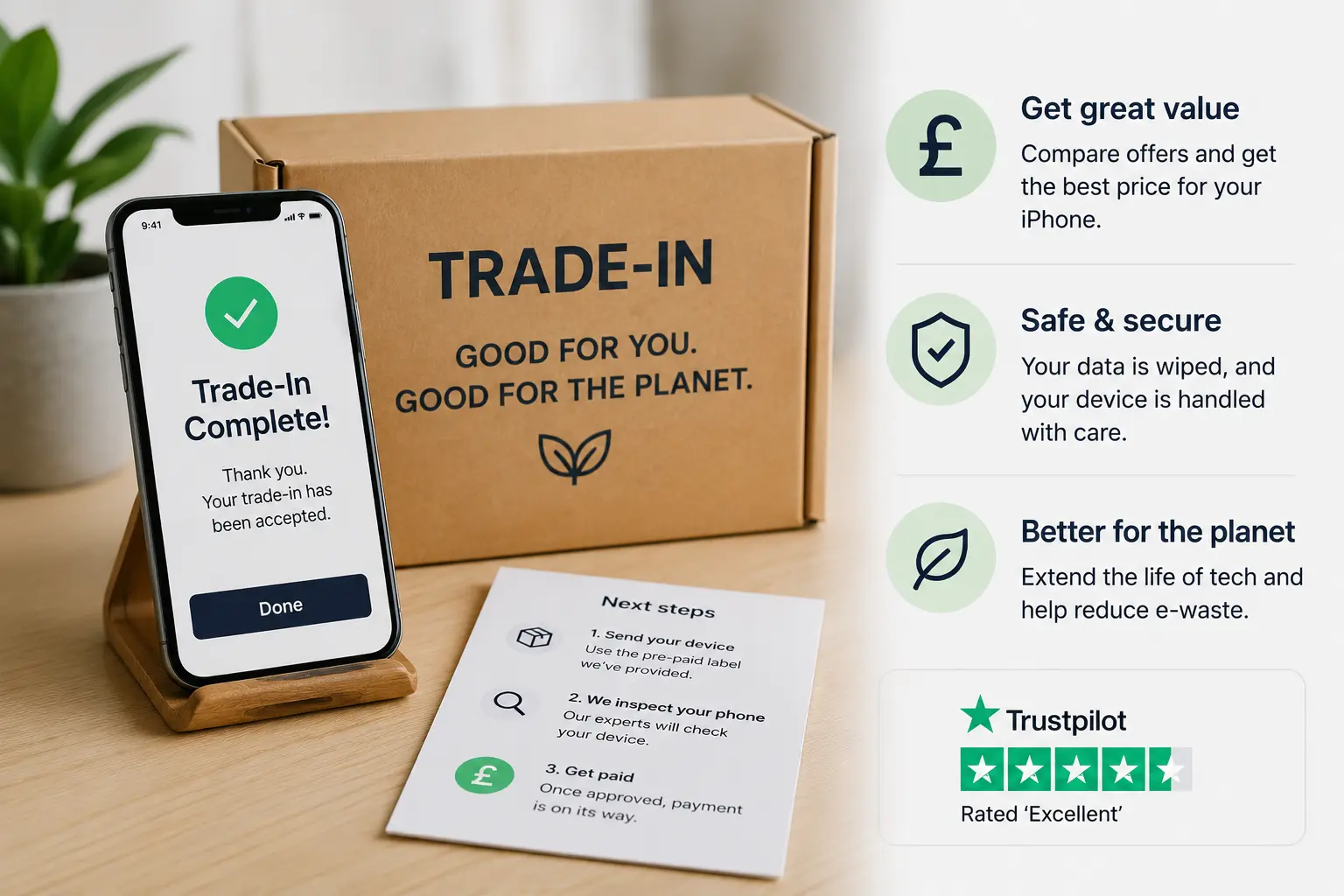
iGo Trade In is a UK-based B2B platform built specifically for this use case. Businesses input their devices into a self-service portal, receive instant valuations, and iGo handles everything from that point: collection via dedicated van for larger fleets or pre-paid courier boxes for smaller batches, certified data wiping aligned with NIST, ADISA, and ISO standards, quality checks, payment within 14 days, a Certificate of Destruction, and an ESG impact report showing carbon savings and e-waste diversion figures. Devices fit for reuse are refurbished and resold; beyond-repair units are responsibly recycled with zero landfill. iGo Trade In is a registered Upper Tier waste carrier, broker, and dealer with the UK Environment Agency.
For IT dealers, resellers, and mobile network channel partners managing trade-ins on behalf of their clients, iGo Trade In also operates a white-label model — enabling partners to offer a fully compliant, branded trade-in service without building the infrastructure themselves.
UK GDPR and Data Security — What Businesses Must Know Before Trading In
Your Legal Obligations Under UK GDPR
Under UK GDPR, organisations have a clear legal obligation to ensure that personal data held on any device is irreversibly destroyed before that device is disposed of, transferred, or traded in. The ICO’s guidance is unambiguous: data must be rendered unrecoverable even by specialist forensic tools. This obligation applies regardless of whether the device is being sold, traded in, returned to a carrier, or sent for recycling.
The Data (Use and Access) Act came into force on 19 June 2025, and the ICO is reviewing its guidance in this area accordingly. Businesses should treat this as a prompt to audit their current device disposal processes and ensure they are aligned with both existing requirements and the direction of travel in regulatory expectations.
Failure to meet UK GDPR data destruction obligations can result in regulatory investigation and enforcement action. The financial exposure is real, but the reputational risk — particularly for organisations handling customer data — is equally significant and considerably harder to quantify.
What “Proper” Data Destruction Actually Means for Mobile Devices
A standard factory reset performed through iPhone Settings removes data at the logical level. For personal use, this is generally adequate. For corporate devices that have held sensitive data, it may not be sufficient to meet the standards expected under UK GDPR or the NCSC’s guidance on secure sanitisation of storage media.
The NCSC is explicit that storage media must be sanitised before disposal and that ownership identifiers must be removed. Certified data destruction, as delivered by qualified ITAD providers, uses industry-standard methods aligned with NIST SP 800-88, ADISA standards, and ISO frameworks. The output of this process is a Certificate of Destruction — a formal, auditable record that can be produced as evidence of compliance.
Businesses should maintain asset tracking records, destruction certificates, and chain-of-custody documentation as a matter of course. Without this documentation, they cannot demonstrate compliance in the event of an ICO audit or a breach investigation. The absence of a paper trail is itself a compliance risk.
The Risks of Stockpiling Old Corporate iPhones
One of the most common — and most overlooked — device disposal risks is the habit of storing decommissioned phones in an IT cupboard or storeroom indefinitely. It feels like a neutral decision: the devices aren’t being used, they’re not going anywhere, and dealing with them can always be pushed to later.
But the risks accumulate silently. Devices sitting in storage may still contain unencrypted data — creating an ongoing GDPR exposure that is easy to forget precisely because the hardware is out of sight. Physical damage does not equate to data destruction; a cracked screen or a device that no longer powers on can still yield recoverable data with the right tools. And all the while, the trade-in value of those devices is depreciating month by month.
The practical response is a scheduled, documented device disposal process — integrated into fleet refresh cycles rather than treated as an afterthought, for organisations looking to combine trade-in with broader device lifecycle management, iGo Life’s complementary services — including iGo Recycle for secure collection and certified destruction, and iGo Fulfilment for refurbished hardware procurement — offer a coherent ecosystem for managing the full lifecycle of corporate mobile devices from acquisition through to end-of-life.
Get Started with Your iPhone Trade-In
Whether you’re an individual looking to recover value from an old handset or an IT manager preparing to clear a backlog of decommissioned corporate devices, the principles are the same: act promptly, prepare thoroughly, choose the right route for your situation, and don’t let data security be an afterthought.
For businesses managing any meaningful volume of devices, the case for working with a dedicated B2B trade-in provider is clear. The compliance requirements alone make consumer-facing platforms an inadequate option — and the combination of certified data destruction, ESG impact reporting, and straightforward payment that a platform like iGo Trade In provides is increasingly the baseline expectation, not a premium add-on.
Visit igotradein.co.uk to get an instant valuation for your devices, or get in touch with the iGo Life team to discuss your fleet disposal requirements.